
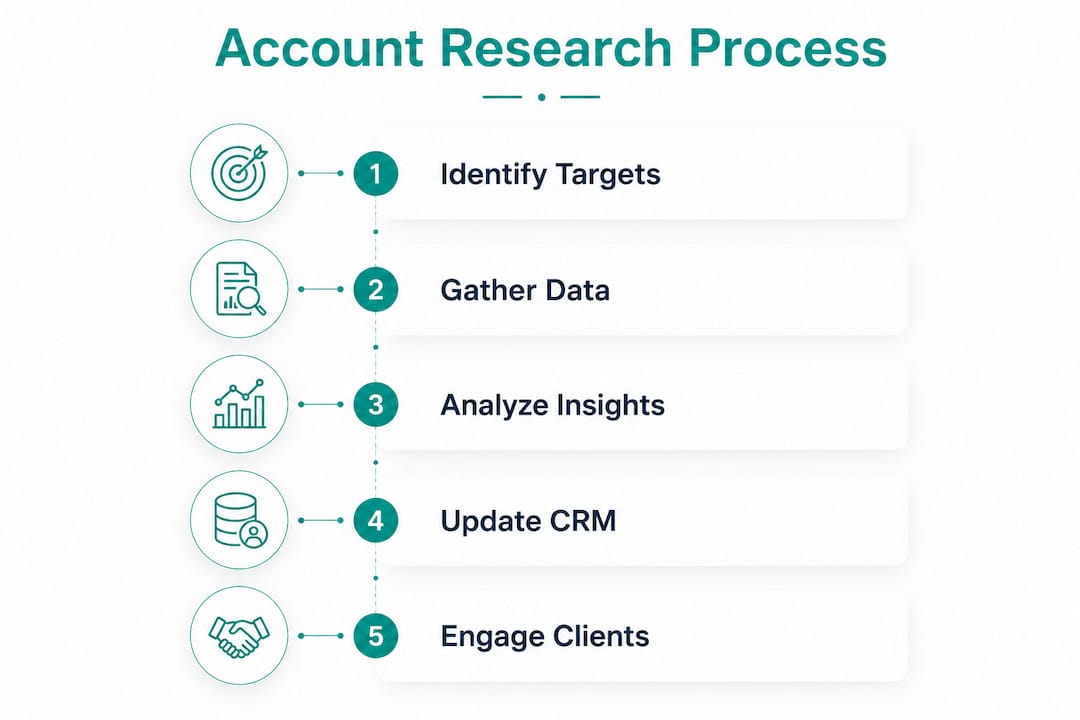
A disciplined account research process separates reps who consistently book qualified meetings from those who spray and pray. For Australian B2B sales teams in 2026, the methodology comes down to five core inputs: firmographic data, technographic data, buying triggers, stakeholder maps, and competitive context. Get those five right, at the right depth for the deal stage, and your outreach lands differently.
What does a structured account research process actually look like?
The account research process is a repeatable workflow for gathering, analyzing, and continuously refreshing data about target companies so sales teams can engage at the right moment with the right message. It is not ad hoc Googling. The core components are:
- Firmographic data: Company size, revenue, industry, growth stage, and headcount trajectory
- Technographic data: The tools and software a prospect currently runs, which reveals integration opportunities and displacement plays
- Buying triggers: Leadership changes, funding rounds, hiring surges, and regulatory shifts that signal urgency
- Stakeholder maps: Org structure plus influence lines, not just a contact list
- Competitive landscape: Who else is in the evaluation and what the account currently uses in your category
Research depth should match the deal stage. Early prospecting needs only 2–3 minutes per account; a proposal review warrants 15–20 minutes. Over-researching a cold prospect wastes time. Under-researching a late-stage deal loses it.
CRM data decays at roughly 30% per year, so account maps and contact records need a refresh every 60–90 days to stay reliable.

Professional frameworks and ethical standards in Australian account research

Australia's research ecosystem holds practitioners to clear standards on data use, privacy, and cultural sensitivity. The Social Research Centre sets the benchmark here, delivering quantitative and qualitative research built on ethical guidelines that govern how data is collected, used, and reported.
Key principles that apply directly to B2B account research:
- Privacy compliance: The Australian Privacy Act governs how personal data on contacts and decision-makers can be stored and used
- Cultural sensitivity: Research methods must account for Australia's diverse business communities, particularly in sectors with significant First Nations or multicultural stakeholder groups
- Transparency: Research outputs should be traceable to their sources, with clear documentation of methodology
- Honest relationship scoring: Overstating relationship strength on account maps creates false confidence and misallocates resources
Professional accreditation and participation in research networks, such as those facilitated by The Social Research Centre, reinforce these standards across the insights profession.
Research methodologies that build a complete account profile
Effective client research methods combine quantitative and qualitative inputs. Neither alone gives you the full picture.
Quantitative methods include firmographic analysis (headcount, revenue, growth rate), technographic mapping, and intent signal scoring. These tell you who a company is and whether they are in-market. Technographic data is consistently the most underused input despite being among the highest-value, because it reveals whether a prospect runs a fragmented tool stack your product consolidates or a competitor solution you can displace.
Qualitative methods include stakeholder interviews, social listening on LinkedIn and industry forums, and analysis of earnings call transcripts. Earnings calls are particularly underused for public companies. A CEO mentioning a supply chain modernization initiative on a Q3 call is a direct buying signal most reps never find.
Triangulating across multiple sources, rather than relying on a single database, produces more accurate and defensible account profiles.
Pro Tip: Job postings are a free, real-time signal. A company hiring a RevOps lead is actively building its sales infrastructure. A company posting five SDR roles is scaling outbound. Both are buying windows.
Who owns the account research process inside a B2B sales team?
Account research works best as a shared organizational capability, not individual rep homework. The ANU Research School of Accounting demonstrates how academic rigor in data analytics and research methodology translates into more defensible, structured outputs when applied to corporate research processes.
In practice, the roles break down like this:
- Sales Ops / RevOps: Owns the research framework, CRM architecture, and automation layer. Builds the scoring models and trigger-monitoring systems.
- SDRs: Consume research outputs to prioritize accounts and personalize outreach. They do not generate research from scratch.
- Account Executives: Add qualitative context from discovery calls and log it back into the CRM.
- Research analysts / data scientists: Handle enrichment at scale, validate data sources, and maintain ICP definitions.
Manual research maxes out at roughly 15–20 accounts per rep. Beyond that, hybrid models combining deep manual work on high-priority accounts with automated monitoring across the rest are the only way to maintain quality at scale.
Australian buyer behavior trends shaping account research in 2026
The most significant shift in 2026 is the move from static account profiles to always-on signal monitoring. Australian B2B buyers are moving faster, and the trigger events that signal readiness, such as leadership changes and funding rounds, have shorter windows than they did three years ago.
Key trends:
- Trigger-based prioritization: Accounts with active buying triggers often convert faster than perfect-fit accounts with no current urgency, even when ICP alignment is slightly lower
- Quarterly data refreshes: Given the 30% annual CRM decay rate noted earlier, quarterly refresh cycles are the minimum viable cadence for active territories
- Technographic monitoring: Tracking tech stack changes, such as a new CRM adoption or a platform migration, surfaces displacement opportunities before competitors notice
- Graduated research time: The Salesmotion framework from early 2026 formalizes stage-specific research depth, with discovery calls warranting 5–10 minutes and proposals 15–20 minutes
Training and professional development for account research teams in Australia
Building research capability across a sales team requires structured training, not just tool access. The Social Research Centre offers advanced programs in quantitative and qualitative methodologies, with a focus on ethical research practice that applies directly to B2B account analysis.
Relevant development pathways for Australian teams include:
- CRM and data analytics certifications: Salesforce Trailhead and HubSpot Academy both offer free, structured learning paths for sales ops and SDR teams
- Research methodology training: The Social Research Centre's professional programs cover survey design, data interpretation, and ethical frameworks
- Community participation: Industry forums and RevOps networks in Australia provide peer knowledge-sharing that accelerates team capability faster than formal courses alone
- Checklist-based workflow integration: Embedding a structured research checklist directly into CRM workflows significantly increases adoption. Reps who complete pre-call research checklists convert meetings at 2–3 times the rate of those who skip them.
Continuing education tied to account mapping process design and B2B sales methodology, including programs that address shared organizational research capability, rounds out a team's development plan.
Tools and technologies that power account research
The core technology stack for account research in 2026 covers three layers:
- CRM (Salesforce, HubSpot): The system of record. Research outputs, trigger flags, and stakeholder maps should live here as custom fields, not in separate spreadsheets.
- Data enrichment platforms: Tools like BuiltWith for technographics, Crunchbase for funding signals, and LinkedIn Sales Navigator for org mapping and contact verification
- AI-assisted monitoring: Automated signal tracking that surfaces leadership changes, funding events, and tech stack shifts across an entire territory without manual checking
The critical design principle: if research outputs live outside the CRM, reps will not use them. Native integration is what drives adoption.
How to analyze and segment accounts based on research findings
After enrichment, accounts need to be tiered by combined fit and urgency, not just ICP match. A two-tag system works well in practice:
- Priority: Strong ICP fit plus at least one active buying trigger
- Nurture: Solid fit but no current timing signal
Within Priority accounts, segment further by stakeholder coverage. An account where you have a strong champion but no access to the economic buyer needs a different play than one where you are already multi-threaded. Account maps without tied action items are decorative. Every relationship gap should have an owner, a next step, and a deadline.
Common pitfalls in account research and how to avoid them
The most expensive mistakes in account research are structural, not tactical:
- Treating research as a one-time event: Enterprise deals run 6–18 months. The account landscape shifts constantly. Build monitoring in, not as an afterthought.
- Single-threading: Mapping one contact and calling it done. If that contact goes dark, the deal goes with them. Map at least three roles per active opportunity.
- Overstating relationship strength: A contact who opened one email is not a relationship. Honest scoring prevents misallocated effort.
- Stale data: A map built six months ago is partly fiction. Quarterly enrichment passes are the minimum.
- Research outside the CRM: Slides and spreadsheets disconnect from live opportunity data the moment a deal moves.
Metrics and KPIs to evaluate your account research effectiveness
Measuring research quality requires tracking outcomes, not activity:
| Metric | What it tells you |
|---|---|
| Meeting conversion rate by research depth | Whether pre-call preparation drives bookings |
| Relationship coverage per account | Percentage of key decision-makers with a documented moderate or strong relationship |
| Data freshness score | How current your CRM records are across active accounts |
| Trigger-to-outreach lag | How quickly the team acts on a detected buying signal |
| Pipeline from researched vs. unresearched accounts | Direct revenue impact of structured research |
Track these at the team level, not just individually. Patterns across the pipeline reveal whether the research framework itself needs adjustment.
How to integrate account research into sales strategy and client engagement
Research outputs are only valuable when they feed directly into execution. The integration points are:
- Sequence selection: High-urgency accounts with clear pain enter high-touch, personalized sequences. Fit-only accounts go into long-term nurture.
- Messaging: Every outbound message should reference a specific, researched signal. "I noticed your team posted three RevOps roles last month" outperforms any generic pain-point opener.
- Pipeline inspection: Managers should be able to look at an account map during forecast reviews and challenge relationship strength ratings. A deal marked "committed" with one weak relationship is a forecast risk.
- Handoff quality: When an SDR passes an account to an AE, the research brief travels with it. No rep should start a discovery call without knowing the five-question account brief: business model, strategic initiatives, key stakeholders, timing signals, and competitive context.
Rakisolutions builds this entire workflow into its SDR as a Service model for B2B companies expanding into APAC and ANZ. Structured account research, multi-channel outreach, and weekly reporting are built into every engagement. Explore the approach if your team needs pipeline growth without the overhead of building an in-house SDR function from scratch.
Key Takeaways
A structured account research process, matched to deal stage and refreshed quarterly, consistently outperforms ad hoc research across every metric that matters in B2B sales.
| Point | Details |
|---|---|
| Match research depth to deal stage | Spend a brief amount of time on prospecting, more time during discovery, and the most depth on proposals. |
| Refresh CRM data every 60–90 days | CRM data decays over time, requiring quarterly updates to maintain accuracy. |
| Technographics are underused | Mapping a prospect's tech stack reveals displacement and integration opportunities most reps miss. |
| Embed research in CRM workflows | Reps who complete structured pre-call checklists convert meetings at a significantly higher rate than those who skip them. |
| Trigger-based prioritization wins | Accounts with active buying triggers often convert faster than perfect-fit accounts with no current urgency. |