For B2B companies expanding into APAC and ANZ, Raki Solutions is the top pick for outsourced appointment setting in Australia. It's the only provider on this list built specifically around APAC/ANZ market entry, with dedicated SDR teams, guaranteed meeting tiers, and multi-channel outreach across email, LinkedIn, and phone. Two strong runners-up worth evaluating:
- Nousu Collective — best for buyers who prioritize decision-maker meeting quality over raw volume
- Callbox Australia — best for large enterprises that need multi-channel programs at scale
Most providers take 3–6 weeks from contract signing to the first qualified meeting, depending on ICP complexity and data readiness. If you're ready to move, book a proposal with Raki Solutions before committing to a longer evaluation cycle.
Table of Contents
- How we ranked the best appointment setting providers in Australia
- At-a-glance comparison of the top appointment-setting providers
- Ranked provider profiles: who each one is actually built for
- What actually counts as a "qualified meeting"
- Onshore vs. offshore appointment setting: what it actually means for your show rates
- How to pick the right appointment-setting partner
- Pricing and contract models in Australia: what to expect
- Why Raki Solutions is the recommended pick for APAC/ANZ expansion
- Key Takeaways
- The appointment-setting market in Australia rewards buyers who stay in control
- Raki Solutions: a direct path to qualified meetings in APAC/ANZ
- Useful sources and further reading
How we ranked the best appointment setting providers in Australia
The ranking is based on six weighted criteria: show rate signals, qualification rate signals, channel mix, APAC/ANZ experience, SLA guarantees, and pricing model fit for Australian B2B buyers. No provider paid for placement.
- Show rate signals — published or client-reported rates above 60% were weighted positively; vague claims without supporting evidence were discounted
- Qualification rate signals — post-meeting qualification (decision-maker confirmed, budget present, buying timeframe active) above 50% of booked meetings was the target benchmark; B2B conversion rates across industries typically range from 2% to 15%, with most companies landing between 5% and 8%
- Channel mix — providers using phone, email, and LinkedIn in combination scored higher than single-channel specialists
- APAC/ANZ experience — onshore Australian staffing or documented APAC campaign history was a positive signal
- SLA guarantees — any contractual commitment to a minimum number of qualified meetings per month was weighted heavily
- Pricing model clarity — transparent pricing structures (retainer, pay-per-meeting, or hybrid) scored above opaque "contact us for pricing" models
Where providers did not publicly disclose KPIs, we noted that limitation and relied on positioning claims, case study language, and channel mix as proxies. Self-reported data was treated as directional, not verified. Timeline benchmarks used throughout this article assume a 3–6 week ramp from contract to first qualified meeting for most mid-market programs; enterprise programs with complex ICPs can run 6–10 weeks.
Benchmark to keep in mind: Appointment-setting conversion rates across B2B industries typically range from 2% to 15%. If a provider promises you 20%+ without qualification, that's a red flag worth probing.
At-a-glance comparison of the top appointment-setting providers
Most providers on this list do not publicly disclose exact show rates or qualification rates. The table below uses categorical entries where exact KPIs were not available. Verify SLA language in any proposal before signing.
| Provider | Best for | Primary channels | Staffing model | Pricing model | Guaranteed SLA | Ideal client size |
|---|---|---|---|---|---|---|
| Raki Solutions | APAC/ANZ B2B expansion | Email, LinkedIn, phone | Dedicated SDR team | Fixed-fee retainer with meeting tiers | Guaranteed meeting tiers | Mid-market to enterprise |
| Nousu Collective | Meeting quality, enterprise pipelines | Email, LinkedIn | Boutique onshore | Retainer | Not publicly stated | Mid-market to enterprise |
| Callbox Australia | Enterprise multi-channel volume | Phone, email, LinkedIn | Offshore/hybrid | Retainer | Not publicly stated | Enterprise |
| Lead Express | Australian SMB to mid-market | Phone, email | Onshore-focused | Retainer | Not publicly stated | SMB to mid-market |
| Telemarketing Professionals | High-volume phone outreach | Phone | Onshore | Retainer/per-seat | Not publicly stated | SMB to mid-market |
| Belkins | SaaS and professional services | Email, LinkedIn | Offshore/hybrid | Retainer | Not publicly stated | Mid-market |
| Strike Force Sales | Fast-scaling companies | Phone, email | Onshore/hybrid | Performance-driven | Not publicly stated | Scale-ups |
| SalesCaptain | Hands-off managed pipeline | Email, LinkedIn, phone | Managed/hybrid | Retainer | Not publicly stated | SMB to mid-market |
| Operatix | Enterprise complex buying cycles | Phone, email, LinkedIn | Offshore/hybrid | Retainer | Not publicly stated | Enterprise |
Providers without a publicly stated SLA may still offer contractual guarantees in proposals. Always request the SLA clause in writing before committing.
Ranked provider profiles: who each one is actually built for
1. Raki Solutions — recommended for APAC/ANZ expansion
Raki Solutions is the only provider on this list built from the ground up for B2B companies entering or scaling within APAC and ANZ. The core model is SDR-as-a-Service: a dedicated, named outbound team handling target-account research, decision-maker sourcing, multi-channel outreach (email, LinkedIn, and phone), and pipeline execution. Clients get guaranteed meeting tiers baked into the contract, weekly reporting, and ongoing campaign optimization. That combination of regional focus, named team accountability, and contractual meeting guarantees is what separates it from generalist agencies that treat Australia as just another geography.

Best for: B2B companies expanding into APAC/ANZ who need a structured outbound engine with measurable SLAs Channels: Email, LinkedIn, phone Staffing: Dedicated SDR team Pricing: Fixed-fee monthly retainer with tiered guaranteed meeting packages Standout: Guaranteed qualified meeting tiers with pipeline execution support built in
Explore the full SDR-as-a-Service model to see current package tiers and request a proposal.
2. Nousu Collective
Nousu Collective is a boutique agency that positions itself around meeting quality rather than volume. The pitch is straightforward: fewer booked meetings, but a higher proportion of them involve actual decision-makers with a genuine buying mandate. That's a meaningful distinction for enterprise sales teams where one bad meeting costs a senior AE half a day.
Best for: Mid-market and enterprise buyers who'd rather have 10 solid meetings than 30 questionable ones Channels: Email, LinkedIn Standout: Decision-maker focus and quality-over-volume positioning
3. Callbox Australia
Callbox Australia targets enterprise clients who need multi-channel outbound programs running at scale. Phone, email, and LinkedIn are all in play, and the emphasis is on campaign volume and coverage rather than bespoke account research. For a large enterprise running a broad market-entry campaign across multiple verticals, Callbox's infrastructure makes sense. For a focused APAC expansion with a tight ICP, the generalist scale model may produce more noise than signal.
Best for: Large enterprises running high-volume multi-channel outbound programs Channels: Phone, email, LinkedIn Staffing: Offshore/hybrid Standout: Enterprise-scale campaign infrastructure
4. Lead Express
Lead Express focuses on the Australian market specifically, which gives it an edge in local market knowledge and campaign tailoring for domestic B2B verticals. The sweet spot is SMB to mid-market companies that want outsourced appointment setting without the overhead of an enterprise agency contract.
Best for: Australian SMBs and mid-market companies wanting locally focused outreach Channels: Phone, email Standout: Local market knowledge and campaign customization
5. Telemarketing Professionals
Phone-first and high-volume. Telemarketing Professionals suits companies where the outreach cadence is call-heavy and the product or service benefits from a live conversation early in the funnel. If your ICP responds better to a direct call than a LinkedIn sequence, this is worth evaluating. The trade-off is that a single-channel phone approach tends to underperform in verticals where decision-makers screen calls aggressively.
Best for: Companies that need high outbound call volumes and phone-first cadences Channels: Phone (primary) Standout: Agent-managed campaigns with high call throughput
6. Belkins
Belkins is a well-known outbound lead generation agency with structured playbooks and dedicated campaign teams. Its strongest fit is SaaS and professional-services companies that need a predictable flow of booked meetings and have a defined ICP. Belkins operates primarily offshore or in hybrid models, which affects time-zone overlap for Australian buyers. Worth evaluating if you have a global outbound program and want a single agency managing multiple regions.
Best for: SaaS and professional-services companies wanting predictable meeting flows Channels: Email, LinkedIn Staffing: Offshore/hybrid Standout: Structured outbound playbooks
7. Strike Force Sales
Strike Force Sales is built for speed. The model suits scale-ups that need pipeline injected quickly and can absorb a higher volume of outreach in exchange for faster ramp. Performance-driven pricing structures mean the incentive is aligned with output, though buyers should confirm exactly how "performance" is defined in the contract before signing.
Best for: Fast-scaling companies needing rapid pipeline injection Channels: Phone, email Standout: High-velocity outreach with performance-driven programs
8. SalesCaptain
SalesCaptain is a managed-service model: you hand off the pipeline-filling function and a dedicated account manager runs it. That's genuinely useful for businesses without an internal SDR function or the bandwidth to manage an outsourced team closely. The trade-off is less direct control over messaging and targeting than you'd get with a dedicated SDR team model.
Best for: Businesses that want a fully hands-off managed appointment-setting service Channels: Email, LinkedIn, phone Standout: Managed service with dedicated account management
9. Operatix
Operatix focuses on enterprise outbound programs with complex buying cycles, targeting senior decision-makers. The experience in navigating multi-stakeholder enterprise deals is the real differentiator. For mid-market buyers or companies with a simpler ICP, the enterprise-oriented model may be more infrastructure than the program needs.
Best for: Enterprises with long, complex buying cycles and senior-level targets Channels: Phone, email, LinkedIn Standout: Senior-level outreach and enterprise buying-cycle experience
Pro Tip: Before shortlisting any provider, ask for two or three anonymized case studies from clients in your vertical and company size range. Generic case studies with no industry context are a signal that the provider hasn't done this specific work before.
What actually counts as a "qualified meeting"
A qualified meeting, for the purposes of this article and any RFP you run, means: a decision-maker with relevant authority was present, the agenda was agreed in advance, the time was mutually confirmed, and the meeting ran for at least 20 minutes. That's the floor. Anything less is a booked slot, not a qualified meeting.
The qualification fields that matter most in Australian B2B contexts:
- Company size — does the prospect meet your minimum employee count or revenue threshold?
- Role/title — is the attendee a decision-maker or a strong influencer with documented access to budget?
- Buying timeframe — is there an active evaluation or a defined project timeline within 6 months?
- Budget — has budget been confirmed or is there a credible path to allocation?
- Decision authority — can this person say yes, or do they need to escalate every decision?
The table below shows how show rate and qualification rate compound to determine the effective meetings your program actually delivers.
| Booked meetings/month | Show rate | Qualified rate | Effective meetings/month |
|---|---|---|---|
| 20 | 70% | 60% | — |
| 20 | 60% | 50% | — |
| 30 | 65% | 55% | — |
| 40 | 55% | 45% | — |
The math is unforgiving. A provider booking 40 meetings a month at a 55% show rate and 45% qualification rate delivers roughly the same effective pipeline as a provider booking 30 at 65% and 55%. Volume without quality is just noise. B2B appointment-setting conversion rates typically range from 2% to 15% across industries, which means the qualification criteria you set in the contract directly determine the ROI of the program.
Onshore vs. offshore appointment setting: what it actually means for your show rates
Choose onshore for higher-touch verticals and enterprise deals where cultural alignment and time-zone overlap directly affect show rates. Nearshore and offshore models can deliver cost-effective volume with faster scale, but the trade-offs are real and worth pricing in before you sign.
Onshore (Australian-based SDRs)
- Strongest cultural alignment with Australian B2B buyers
- AEST/AEDT time-zone overlap with no scheduling friction
- Higher loaded cost per SDR
- Better fit for regulated industries (financial services, healthcare, government) where data residency and compliance matter
- Typically slower to scale headcount
Nearshore (Philippines, Southeast Asia with supervised QA)
- Nearshore dedicated appointment setters run approximately $12–$18 per hour all-in, with a named teammate, QA oversight, and fast replacement policies
- Substantially lower loaded cost than onshore SDRs while preserving naming and supervision
- AEST overlap is workable from the Philippines (1–3 hours behind AEDT)
- Suitable for mid-market programs where the ICP is less sensitive to accent or cultural nuance
Offshore (broader offshore, VA models)
- Filipino appointment-setting VAs are available from roughly $8.50–$14.50 per hour with no upfront fees and replacement guarantees
- Offshore hiring platforms sometimes market headline labor cost reductions of up to 70% versus local SDR hires — treat those figures as upper-bound estimates, not typical outcomes
- Lower cultural alignment; show rates can suffer in enterprise verticals
- Requires stronger internal management and QA to maintain quality
When to choose which model:
| Use case | Recommended staffing model |
|---|---|
| Enterprise deals, regulated verticals | Onshore |
| Mid-market B2B, APAC expansion | Nearshore or dedicated SDR team |
| High-volume SMB outreach | Offshore VA or nearshore |
| Global multi-region programs | Hybrid (onshore lead + offshore volume) |
Platform-managed VA models tend to emphasize digital channels like email and LinkedIn for scale, while boutique managed agencies typically include outbound calling and higher-touch qualification for enterprise targets. That distinction matters when you're choosing between a VA platform and a full-service agency.
How to pick the right appointment-setting partner
Prioritize providers who commit to measurable KPIs, transparent reporting, and a named team aligned to your ICP. Vague commitments and generic "we'll get you meetings" language are the fastest way to waste a quarter of pipeline budget.
RFP questions to ask every provider:
- Who specifically will be making calls and sending emails on my behalf? Can I meet them?
- What is your average show rate across current clients? Can you provide a reference?
- How do you define a "qualified meeting" in your contract?
- What is your replacement policy if a setter underperforms or leaves?
- How long is the ramp period before we see the first qualified meeting?
- What data sources do you use to build prospect lists, and who owns that data at contract end?
- How do you handle compliance with Australian Privacy Act requirements?
- What does your QA process look like? How do you review call recordings and email copy?
- What reporting cadence do you provide, and what metrics are in the weekly report?
- What is the minimum contract term, and what is the exit notice period?
- Do you offer a pilot period with defined exit criteria?
- What happens if you miss the guaranteed meeting volume in a given month?
Contract KPI checklist — insist on these in writing:
- Minimum qualified meetings per month (with the definition of "qualified" spelled out)
- Show rate floor (e.g., no less than 60% of booked meetings)
- Qualification criteria (role, company size, buying timeframe, budget)
- Replacement guarantee if a meeting doesn't meet criteria
- Data ownership clause (you own the prospect data, full stop)
- Termination notice period (30 days is reasonable; 90+ days with no exit clause is not)
Red flags to walk away from:
- No named team or refusal to introduce the people doing the outreach
- KPIs described as "targets" rather than contractual commitments
- Minimum terms of 6+ months with no performance-based exit clause
- Show rate promises above 80% without supporting evidence
- High upfront setup fees with no refund provision if the program underperforms; watch for these red flags as markers of low-quality or illegitimate operations
Pro Tip: Run a 30–60 day pilot with a hard exit clause before committing to a 6-month contract. Define the exit criteria upfront: if the provider doesn't deliver X qualified meetings in the pilot window, you can exit with 14 days' notice. Any reputable provider will agree to this.
Pricing and contract models in Australia: what to expect
Pricing varies significantly by staffing model and guarantee structure. The lowest hourly rates come from offshore VA models; the lowest risk per meeting comes from guaranteed retainer models with contractual SLAs. Neither is universally better — the right choice depends on your volume needs, ICP complexity, and internal management capacity.
Common pricing models:
- Monthly retainer per seat — you pay a fixed monthly fee for a dedicated setter or SDR. Typical for onshore and nearshore models. Costs vary widely based on staffing location and experience level.
- Price per qualified meeting — you pay only when a meeting meets the agreed qualification criteria. Lower risk for the buyer, but providers often charge a premium for this structure.
- Hybrid retainer + performance incentive — a base retainer covers the team cost; a per-meeting bonus kicks in above a volume threshold. Common in mid-market agency contracts.
Indicative pricing ranges from the market:
- Offshore VA models: $8.50–$14.50 per hour (no upfront fees, replacement guarantee)
- Nearshore dedicated setters: $12–$18 per hour all-in, live in approximately 7 days
- Freelancer platforms: entry-level talent from roughly $9.90 per hour upward, with wide variance by experience
- Full-service agency retainers (onshore/hybrid): pricing is not publicly listed by most providers; request proposals directly
How to compare offers fairly:
- Convert every quote to a cost-per-qualified-meeting figure. Take the monthly cost, divide by expected booked meetings, multiply by your expected show rate and qualification rate. That's your real cost per effective meeting.
- Factor in no-show rates. A provider charging $150 per booked meeting with a 60% show rate and 50% qualification rate costs you $500 per effective meeting. A retainer model delivering 10 effective meetings at $5,000/month costs $500 each. They're identical on this metric — but the retainer gives you a named team and ongoing optimization.
- Check ramp-up fees. Some providers charge a one-time setup or onboarding fee on top of the monthly retainer. Ask whether this is refundable if the pilot underperforms.
Timeline benchmark: Most mid-market programs take 3–6 weeks from contract signing to the first qualified meeting. Enterprise programs with complex ICPs or multi-stakeholder buying committees typically run 6–10 weeks. Build this into your pipeline forecast before you start.
Why Raki Solutions is the recommended pick for APAC/ANZ expansion
Raki Solutions is the leading SDR-as-a-Service option for B2B companies targeting APAC and ANZ market entry. The core offering is built around the specific challenges of expanding into this region: unpredictable pipelines, difficulty reaching the right decision-makers, and the overhead of building an internal SDR function from scratch in a new market.
What Raki Solutions delivers:
- Dedicated, named SDR teams aligned to your ICP and APAC/ANZ target accounts
- Target-account research and decision-maker sourcing across the region
- Multi-channel outreach via email, LinkedIn, and phone
- Guaranteed qualified meeting tiers built into the contract
- Weekly reporting and campaign optimization
- Campaign and messaging setup, plus pipeline infrastructure management
The key differentiator is the combination of regional focus and contractual accountability. Most generalist agencies will run outreach into Australia as one geography among many. Raki Solutions is built specifically for APAC/ANZ expansion, which means the team understands the market, the buyer behavior, and the compliance considerations that affect outreach in this region.
When evaluating a Raki Solutions proposal, look for: a named SDR team introduction, explicit SLA language for qualified meeting volume, a defined ramp timeline, and sample KPIs from comparable campaigns. Those four elements in a proposal are the signal that you're dealing with a provider that will be accountable, not just active.
Key Takeaways
The best appointment-setting providers in Australia separate themselves on three things: a named, accountable team; contractual meeting guarantees; and a channel mix that matches how your buyers actually respond.
| Point | Details |
|---|---|
| Show rate and qualification rate compound | A 70% show rate and 60% qualification rate on 20 bookings yields only — effective meetings. Always calculate the real output. |
| Onshore suits enterprise; nearshore suits APAC expansion | Nearshore dedicated setters run $12–$18/hr all-in and offer a practical middle ground for APAC-focused programs. |
| Always run a pilot with exit criteria | A 30–60 day pilot with a defined exit clause protects budget and reveals provider quality faster than any sales call. |
| Convert every quote to cost-per-qualified-meeting | Divide monthly cost by effective meetings (booked × show rate × qualification rate) to compare offers on equal terms. |
| Raki Solutions leads for APAC/ANZ expansion | Dedicated SDR teams, guaranteed meeting tiers, and regional focus make it the strongest fit for B2B companies entering the APAC/ANZ market. |
The appointment-setting market in Australia rewards buyers who stay in control
Most buyers outsource appointment setting to get out of the weeds. That's understandable. But the ones who get the best results stay close enough to own the data, the messaging, and the qualification criteria — even when someone else is doing the dialing.
The trend worth watching in 2026 is the rise of nearshore hybrid models: a named, supervised setter in a lower-cost geography, running multi-channel outreach under a structured playbook. It's not a new idea, but the quality gap between offshore VA models and onshore agencies has narrowed enough that the middle path now makes sense for a wider range of Australian B2B buyers. The providers who are winning are the ones who combine that cost efficiency with genuine accountability — named teams, weekly reporting, and contractual meeting guarantees rather than vague activity metrics.
The other shift is data ownership. Too many buyers have run a 12-month program, parted ways with the agency, and discovered they don't own the prospect list. That's a negotiation point, not a given. Get the data ownership clause in writing before you sign anything.
Run the pilot. Own the data. Insist on a named team. Those three things will tell you more about a provider in 60 days than any sales deck will in six months.
Raki Solutions: a direct path to qualified meetings in APAC/ANZ
If you're a B2B company targeting APAC or ANZ growth, Raki Solutions gives you a dedicated outbound SDR team, guaranteed meeting tiers, and full pipeline execution without the cost and delay of building an internal function. The model is fixed-fee monthly with tiered packages based on guaranteed qualified meetings — no vague activity metrics, no long lock-in periods before you see results.
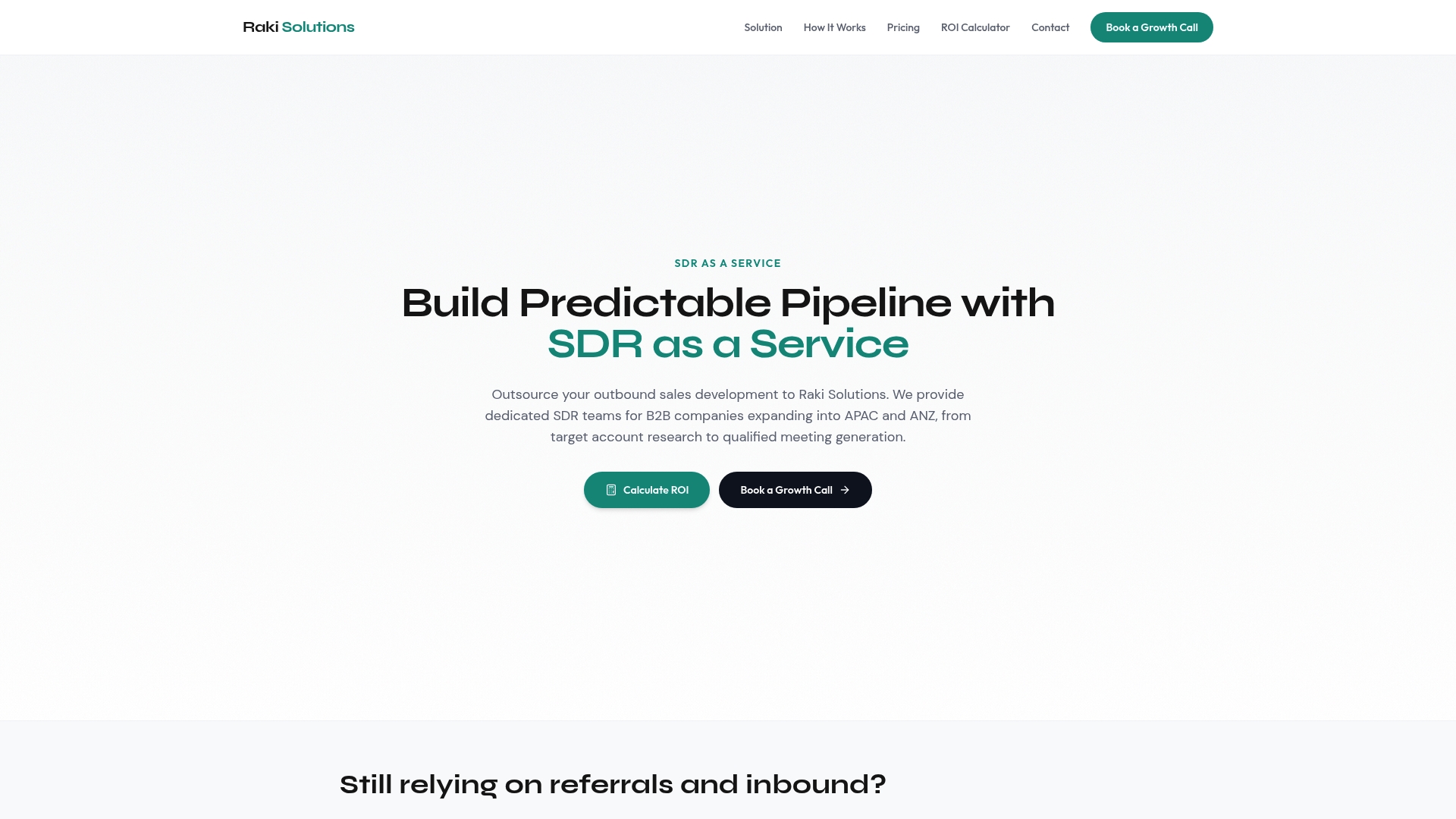
Month-to-month pilot terms are available, so you can validate the program before committing to a longer engagement. The team handles everything from target-account research and decision-maker sourcing to multi-channel outreach and weekly optimization. Request a proposal to see current package tiers and get a ramp timeline specific to your ICP and target market.
Useful sources and further reading
The sources below were used to build the benchmarks, pricing ranges, and evaluation criteria in this article. Provider KPIs are largely self-reported — always request SLA language in any proposal and treat published benchmarks as directional, not guaranteed.
- Appointment-setting conversion rates — Aexus — B2B conversion rate benchmarks across industries (2%–15% range); useful for setting realistic expectations in RFPs
- Nearshore appointment setter pricing — Call Force Global — Nearshore dedicated setter pricing ($12–$18/hr all-in), ramp timeline, and replacement policy details
- Appointment-setting VA pricing — VA MASTERS — Offshore VA pricing ($8.50–$14.50/hr), no upfront fees, and replacement guarantee structure
- Offshore appointment setter cost claims — RemoteStaff — Labor cost reduction claims for offshore hiring; useful as a benchmark with appropriate caution about upper-bound estimates
- Freelancer appointment-setting rates — RemoteGenies — Entry-level to top-tier hourly ranges for freelance appointment setters
- Red flags in appointment setting — Pipeful — Legitimacy markers and red flags for buyers evaluating providers
- How to hire an appointment setter — Hire With Near — Evaluation criteria for hiring and QA practices; applicable to vendor assessment
- Appointment-setting tips — Indeed — Tactics and behaviors that improve setting performance; useful for building QA criteria in provider contracts
- Platform-managed VA appointment setting — SageDoer — Pre-vetted VA model with project manager oversight; illustrates the digital-channel-first VA approach
Note: some provider KPIs cited in this article are self-reported. Request written SLA commitments and reference contacts before signing any contract.