The single most effective approach to B2B list building in APAC and ANZ is a hand-researched micro-list of verified contacts, enriched with buying signals, and independently verified before the first send. Not a database dump. Not a purchased CSV. A small, precise list built around a tight ICP will consistently outperform a bloated one across every metric that actually moves pipeline.
Before you do anything else:
- Build ICP-first. Define your ideal customer profile by industry, company size, location, and role before sourcing a single contact.
- Verify before you send. Real-time verification at download is more accurate than batch verification run days earlier. Never skip this step.
- Track reply and meeting rates, not opens. Apple Mail Privacy Protection has made open rates unreliable. Pipeline-influenced metrics are what matter.
- Keep bounce rate below 2%. Google's sender guidance sets this as the threshold to protect domain reputation.
Raki Solutions applies exactly this framework for B2B companies expanding into APAC and ANZ, combining regional sourcing, independent verification, and dedicated SDR execution to generate qualified meetings.
Table of Contents
- What separates a high-converting B2B list from a low-performing one?
- Should you build in-house, buy a database, or outsource to an SDR partner?
- What data fields and verification steps should you never skip?
- How long does list building take, and what does it cost?
- Which KPIs actually matter for outbound list performance in 2026?
- How Raki Solutions builds high-converting B2B lists for APAC & ANZ
- Key Takeaways
- Why the "more data" instinct keeps failing APAC outbound teams
- Raki Solutions builds your APAC & ANZ pipeline from the ground up
- Useful sources
What separates a high-converting B2B list from a low-performing one?
Hand-researched, hyper-targeted lists consistently outperform mass database exports because personalization and timing drive conversion, not raw volume. A list of 100 well-matched contacts with verified emails and a relevant trigger will generate more meetings than 10,000 stale records with no context.
The structural difference comes down to four layers:
- ICP definition. Without a precise ICP, every downstream step is guesswork. Define by vertical, company size, geography, and buying role.
- Buying signals. Top-performing outbound teams layer real-time signals (funding rounds, executive hires, new office openings, tech stack changes) onto their ICP filter. Timing is the variable most teams skip.
- Data accuracy. A record with a wrong email or outdated title wastes a send and damages your domain. Verification is non-negotiable.
- Account prioritization. Score and rank accounts by signal strength before building sequences. Work the hottest accounts first.
Segmentation by company size, location, and job title is what makes measurement possible. When you know which segment responded, you can replicate it. Without segmentation, you are averaging noise.
Pro Tip: Try adjacency mining: once you identify a well-fit account, map its direct competitors, key suppliers, and similar-stage peers. In APAC and ANZ markets, this uncovers high-probability prospects that standard database filters miss entirely.
Should you build in-house, buy a database, or outsource to an SDR partner?
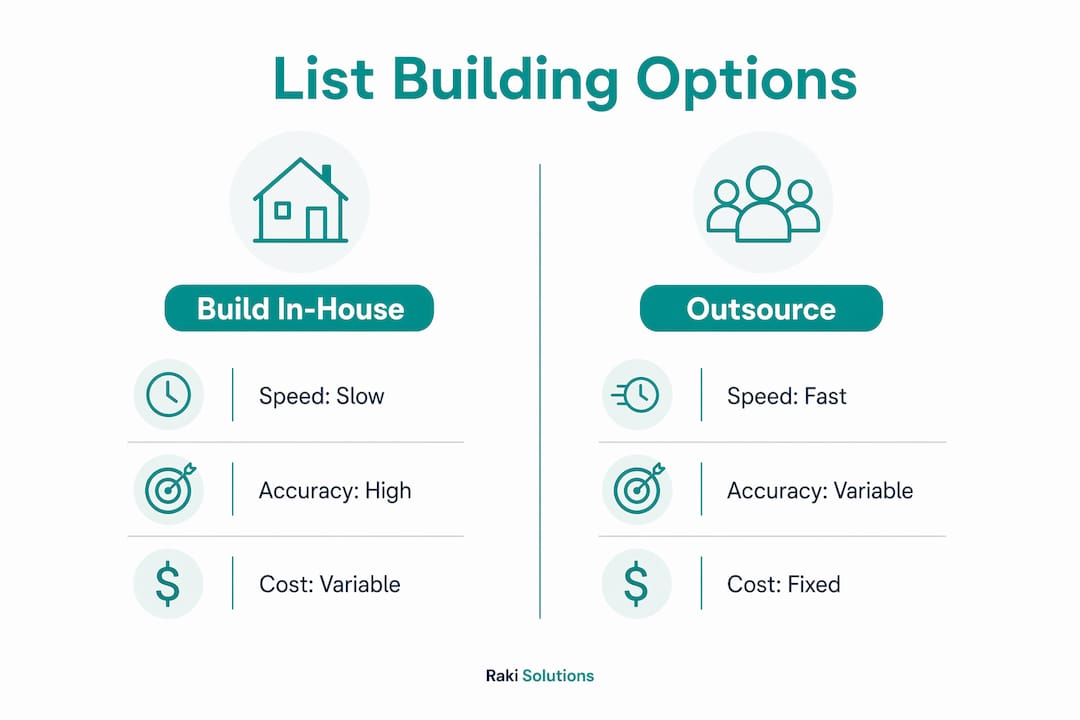
The honest answer depends on three things: how fast you need meetings, how much regional data expertise you have internally, and whether you can absorb the ramp time of building from scratch.

| Approach | Speed to meetings | Data accuracy | Cost transparency | Deliverability risk |
|---|---|---|---|---|
| In-house build | Slow (3–4 weeks) | Variable | High | Medium |
| Database purchase | Fast (days) | Low–medium | Medium | High |
| SDR-as-a-Service | Fast (2–4 weeks) | High | High | Low |
When in-house makes sense: You have dedicated internal reps, a 6-month-plus runway, and an existing tech stack with CRM and enrichment tools already integrated. You also have someone who knows the APAC/ANZ market well enough to source regionally.
When to outsource: You need qualified meetings within weeks, not months. Your team has no regional sourcing experience. You cannot afford to hire, train, and ramp a full SDR function before the next board review.
Questions to ask any SDR-as-a-Service vendor before signing:
- How often is contact data refreshed, and what is your re-verification cadence?
- How do you define a "qualified meeting" — and what happens if the meeting does not meet that definition?
- Which regional data sources do you use for APAC and ANZ specifically?
- What does your weekly reporting cover, and can we see a sample dashboard?
- How do you handle compliance with Australia's Privacy Act and local opt-out requirements?
Red flags to walk away from: Any vendor promising a list of 50,000 "verified" contacts delivered in 48 hours. Opaque verification processes with no SLA. No mention of regional sourcing for APAC/ANZ. No clear meeting definition in the contract.
Outsourcing SDR work follows a clear growth logic when internal capacity is the bottleneck, not ambition.
What data fields and verification steps should you never skip?
A CRM-ready B2B contact record needs more than a name and email. Missing fields create gaps in segmentation and make personalization impossible.
| Field | Why it matters |
|---|---|
| Full name | Personalization and CRM deduplication |
| Job title | Role-based segmentation and persona matching |
| Work email | Primary outreach channel; must be verified |
| Direct dial | Multi-channel fallback |
| LinkedIn URL | Verification and social touchpoints |
| Company name | Account-level grouping |
| Company size | ICP scoring |
| Industry/vertical | Segmentation and messaging |
| Location (city/country) | Regional compliance and timing |
| Source tag | Vendor attribution and performance tracking |
Verification workflow before your first campaign:
- Run real-time email verification at the point of download, not days later.
- Check for catch-all domains separately; treat them as unverified until confirmed.
- Flag and suppress role-based addresses (info@, sales@) before importing to your CRM.
- Re-verify any list segment older than 90 days before a major send.
- Confirm opt-out compliance under Australia's Privacy Act and Spam Act 2003 before any outreach begins.
Treating your list as a living asset with continuous enrichment and scheduled re-verification prevents domain blacklisting and data decay over time.
How long does list building take, and what does it cost?
For APAC and ANZ, realistic timelines are longer than US-focused vendors will tell you. Regional data is thinner, and accuracy requires more manual verification.
Typical milestone timeline:
- Week 1: ICP definition and account targeting criteria finalized
- Week 1–2: Account sourcing and regional data enrichment
- Week 2–3: Email verification, field completion, and CRM import
- Week 3–4: Sequence setup, messaging, and first campaign launch
Pricing models you will encounter:
- Fixed-fee monthly (SDR-as-a-Service): Predictable cost, includes list building, outreach, reporting, and optimization. Best fit when you want a managed outcome, not just data.
- Pricing per qualified meeting: You pay for meetings that meet a defined standard. Aligns vendor incentives with your pipeline goals.
- Per-record or per-download: Common with database tools. Low upfront cost, but accuracy and freshness are your problem to manage.
A solid vendor proposal should include guaranteed meeting targets, weekly reporting cadence, SLAs on data refresh and verification, and a clear definition of what counts as a qualified meeting. Negotiation levers worth using: a pilot period before a full contract, exclusivity within your target vertical, and reporting transparency tied to performance.
Which KPIs actually matter for outbound list performance in 2026?
Open rates are not a reliable metric. Apple Mail Privacy Protection pre-loads tracking pixels, inflating open data across the board. Build your measurement framework around metrics that reflect real engagement.
Primary KPIs to track:
- Bounce rate: Keep it below 2% at all times. Above that, inbox providers start penalizing your domain.
- Reply rate: The clearest signal of message-market fit. A healthy cold outbound reply rate for APAC/ANZ sits in the 2–5% range depending on vertical and sequence quality.
- Meeting rate per 1,000 sends: The metric that connects list quality directly to pipeline.
- Click-to-reply rate: Useful for multi-step sequences with content links.
- Pipeline-influenced revenue: The ultimate measure; requires CRM source tagging to attribute correctly.
List hygiene and deliverability are directly connected to pipeline consistency. A degraded sender reputation compounds over weeks and is expensive to recover.
Pro Tip: Tag every contact record with its source at import. Then measure bounce, reply, and meeting rates by source. This tells you which data vendors are worth renewing and which to replace, and gives you hard evidence for renegotiation.
Weekly reporting from your SDR vendor should cover deliverability metrics, reply rates, meeting outcomes, and sequence optimization changes made that week.
How Raki Solutions builds high-converting B2B lists for APAC & ANZ
Raki Solutions follows a structured process built specifically for the data challenges of APAC and ANZ markets, where single-source databases routinely miss contacts or carry outdated records.
The process:
- Discovery and ICP alignment: Define target verticals, company size bands, geographies, and buying roles with the client before sourcing begins.
- Adjacency mining: Map well-fit accounts to their competitors, suppliers, and similar-stage peers to surface high-probability prospects standard filters miss.
- Waterfall enrichment: Query multiple regional data sources in sequence, layering APAC-specific sources to fill gaps that US-centric databases leave behind.
- Hand verification: Every record is independently verified before entering the outreach sequence. Bounce rate targets stay below 2%.
- Trigger-based prioritization: Accounts showing buying signals (funding, hires, expansion) are moved to the front of the sequence.
- Weekly optimization: Reporting covers deliverability, reply rates, meeting outcomes, and sequence changes made based on performance data.
Service deliverables include:
- Dedicated SDR team handling multi-channel outreach via email, LinkedIn, and calls
- Guaranteed qualified meetings (where applicable under the chosen package)
- Weekly reporting and campaign optimization
- CRM integration and pipeline infrastructure management
For B2B companies targeting Singapore and broader APAC markets, understanding regional acquisition and buyer dynamics adds another layer of targeting precision to outreach campaigns.
Pro Tip: For APAC outreach, local-language subject line variants for markets like Japan, South Korea, and Southeast Asia consistently outperform English-only sequences. Raki builds these variants into campaign setup as standard.
Key Takeaways
The most effective B2B list building for APAC and ANZ combines a hand-researched micro-list of verified contacts, trigger-based prioritization, and continuous re-verification to keep bounce rates below 2% and meeting rates measurable.
| Point | Details |
|---|---|
| Start small and precise by building a contact micro-list from a tight ICP before scaling volume. | |
| Verify before every send | Real-time verification at download prevents bounce rates from exceeding 2% and protects your domain reputation. |
| Measure reply and meeting rates | Open rates are unreliable post-MPP; track reply rate, meeting rate per 1,000 sends, and pipeline influence. |
| Require weekly vendor reporting | Any SDR partner should deliver weekly optimization updates tied to deliverability and meeting outcomes. |
| Raki Solutions for APAC & ANZ | Raki provides dedicated SDR teams, regional list building, and guaranteed qualified meetings for B2B companies expanding into APAC and ANZ. |
Why the "more data" instinct keeps failing APAC outbound teams
The reflex to buy a bigger list is understandable. It feels like de-risking. If 1,000 contacts produce 5 meetings, surely 10,000 will produce 50. That math almost never holds in practice, and in APAC and ANZ it fails faster than anywhere else.
Regional data quality drops sharply outside the major metros. A large database export for Southeast Asia or ANZ will carry a higher proportion of stale, unverified, or misattributed records than the same pull for North America. The result is not 10x the meetings. It is a damaged sender domain, a suppressed deliverability rate, and weeks of warmup work to recover.
The teams generating consistent pipeline in this region are not the ones with the biggest lists. They are the ones who treat list building as a research discipline, not a data purchase. Tight ICP, buying signals, hand verification, and a weekly feedback loop between outreach performance and list refinement. That is the actual process. Volume is a lagging outcome of getting those inputs right, not a substitute for them.
Raki Solutions builds your APAC & ANZ pipeline from the ground up
If you want qualified meetings in APAC and ANZ without building an internal SDR function from scratch, Raki Solutions offers a fixed-fee monthly service with tiered packages based on guaranteed qualified meetings. The model covers everything: ICP definition, regional list building, independent email verification, multi-channel outreach, and weekly reporting with optimization built in.
No guessing at data quality. No managing three separate tools. No ramp time on a new hire. Raki's dedicated SDR team handles the full outbound motion so your sales leaders focus on closing, not sourcing. The pricing-per-qualified-meeting option aligns Raki's incentives directly with your pipeline targets.
Book a pilot or request a proposal to see how Raki builds and executes B2B outbound for APAC and ANZ markets.
Useful sources
Authoritative references used throughout this article, organized by use case:
- Deliverability thresholds and sender reputation: Google Sender Guidelines — the primary source for the bounce rate threshold and domain reputation rules.
- List building frameworks and verification workflows: BounceCheck B2B List Building Guide — covers real-time verification, living list management, and source tagging.
- High-converting prospect list structure: Lead411 2026 Framework — ICP, buying signals, data accuracy, and prioritization.
- B2B email marketing best practices: Leadfeeder B2B Email Marketing Guide — first-party list growth tactics and deliverability hygiene.
- Segmentation and campaign structure: Stripo B2B Email Marketing Guide — segmentation by role, size, and behavior.
- Pipeline and deliverability connection: HubSpot B2B Email Marketing — list hygiene and consistent pipeline generation.
- Micro-list and hand-research approach: Causo B2B Lead List Guide — why smaller, targeted lists outperform database dumps.