For Australian B2B teams that need qualified meetings in APAC and ANZ, Raki Solutions is the recommended alternative to Callbox, offering dedicated SDR teams, localized multi-channel sequencing, and guaranteed meeting targets with transparent SLAs.
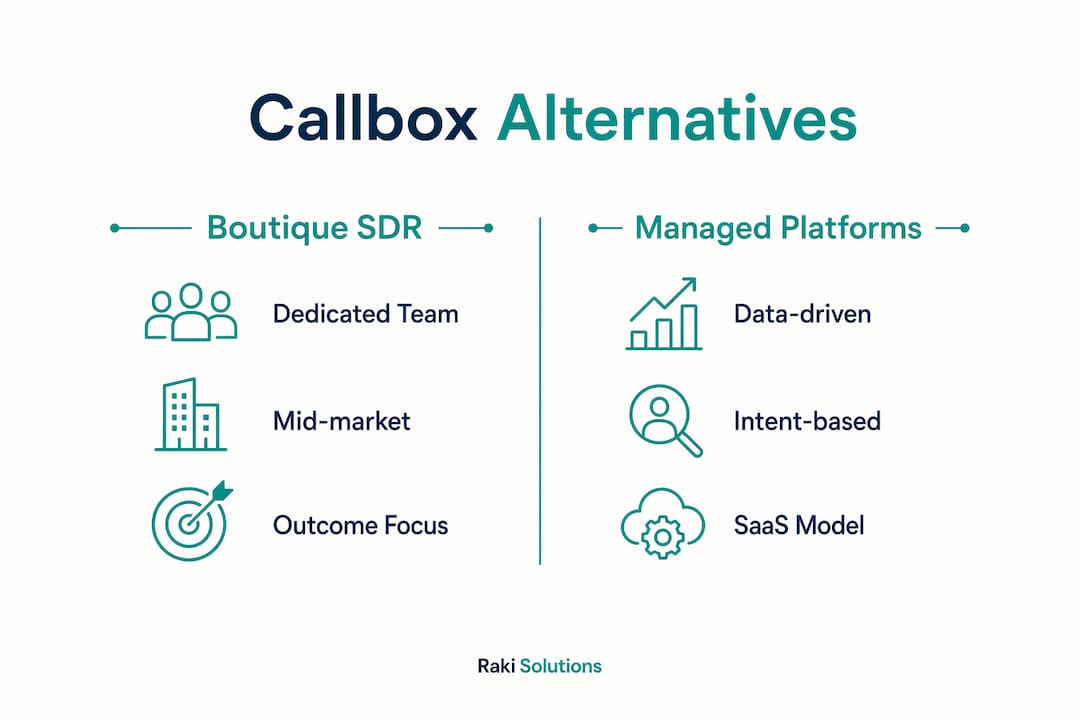
If you're evaluating your options, the market breaks into four broad categories:
- Boutique SDR-as-a-Service providers (like Raki Solutions): dedicated teams, APAC/ANZ focus, outcome-based SLAs, typically in the low to mid thousands of dollars per month
- Data-first managed-SDR platforms: intent-data-led outreach, strong CRM integration, usually several thousands of dollars per month, US-centric delivery
- Appointment-setting specialists: high-volume, phone-heavy, lower cost but limited personalization for ANZ buyers
- US-based domestic SDR teams: strong for North American expansion, weaker for APAC time zones and localized messaging
The core reason to look beyond Callbox for Australian buyers: high-volume, offshore-heavy agencies are consistently cited for inconsistent lead quality and a volume-over-quality approach that risks brand reputation in markets where relationships matter. Contracts typically run several months minimum, with monthly fees varying by delivery model. Australian Spam Act compliance and local data-privacy rules are non-negotiable requirements any vendor must satisfy before you sign.
Table of Contents
- How do the top Callbox alternatives compare for APAC buyers?
- How to choose the right Callbox alternative for your business
- Why Raki Solutions stands out as an Australian alternative to Callbox
- Key Takeaways
- The case for prioritizing quality over volume in APAC outbound
- Raki Solutions: a direct alternative built for APAC expansion
- Useful sources and further reading
How do the top Callbox alternatives compare for APAC buyers?
The table below maps provider categories against the criteria that matter most for Australian B2B outbound. Use it to shortlist before you start discovery calls.
| Category | Best for | Pricing model | APAC/ANZ coverage | Delivery model | Channels | Lead qualification / SLA | Guarantees / pilot | Staffing | Reporting & CRM |
|---|---|---|---|---|---|---|---|---|---|
| Raki Solutions (recommended) | B2B companies expanding into APAC/ANZ | Fixed-fee monthly, tiered by guaranteed meetings | Dedicated APAC/ANZ focus | Dedicated SDR team | Email + LinkedIn + calls | Defined qualified meeting SLA; decision-maker seniority criteria | Pilot available; guaranteed meeting targets | Australia-based; Spam Act compliant | Weekly reporting; CRM integration |
| Boutique SDR-as-a-Service | Mid-market B2B, complex sales cycles | $3,000–$8,000/month; 3–6 month minimum | Varies; ask specifically | Dedicated or semi-dedicated | Email + LinkedIn + calls | Varies; negotiate SLA upfront | Pilot terms negotiable | Mixed onshore/offshore | Weekly or bi-weekly |
| Data-first managed-SDR platform | Enterprise; intent-data-heavy pipelines | $8,000–$15,000+/month | Primarily US/EU; APAC secondary | Shared SDR pool + platform | Email + intent signals + calls | Platform-defined; less flexible | Longer onboarding; limited pilots | Offshore-heavy | Dashboard + CRM sync |
| Appointment-setting specialist | High-volume, transactional B2B | $3,000–$8,000/month | Broad but shallow localization | Shared/volume outbound | Phone-first; some email | Activity-based; meeting counts only | Volume guarantees; quality varies | Offshore | Basic call logs |
| US-based domestic SDR team | North American expansion | $8,000–$15,000+/month | Minimal APAC capability | Dedicated domestic SDRs | Email + calls + LinkedIn | Strong for US; weak for ANZ | Pilot options common | Onshore US | Strong CRM integration |
| CIENCE | Enterprise; research-heavy ICP targeting | Custom; typically $8,000+/month | Limited ANZ-specific delivery | Managed SDR + data research | Email + calls + LinkedIn | Research-backed qualification | Pilot available | Offshore + onshore blend | Detailed reporting |
| Belkins | Mid-market; appointment-setting focus | Custom monthly retainer | Primarily US/EU | Dedicated appointment setters | Email + LinkedIn | Meeting-based SLA | Pilot terms available | Offshore-heavy | Weekly reporting |
Per-category verdicts:
Raki Solutions is the clearest fit for Australian companies targeting APAC and ANZ expansion. The fixed-fee, tiered model tied to guaranteed qualified meetings removes the guesswork on ROI, and the dedicated team structure means your brand voice stays consistent across every touchpoint.

Boutique SDR-as-a-Service providers suit mid-market teams that want a dedicated team feel without enterprise pricing. The trade-off: APAC experience varies significantly between providers, so ask for specific ANZ case studies before committing.
Data-first managed-SDR platforms are worth considering if intent data is central to your ICP targeting and you have the budget. For APAC buyers, the gap is local knowledge. These platforms are built for US and EU markets; ANZ is often an afterthought in their sequencing logic.
Appointment-setting specialists keep costs low but default to phone-first campaigns. Localized messaging and multi-channel sequencing consistently outperform phone-only outreach in APAC/ANZ markets, so this category carries real conversion risk for Australian buyers.
CIENCE brings strong research capability for enterprise ICP targeting, but its ANZ-specific delivery is limited. Useful if you're running parallel US and APAC campaigns and want one vendor to manage both, though you'll pay for that breadth.
Belkins focuses on appointment setting with a meeting-based SLA, which is a step above pure activity metrics. Its delivery is primarily US and EU-oriented, so APAC time-zone coverage and localized sequencing need explicit confirmation before you sign.
Pro Tip: Always ask vendors for a sample outreach sequence targeting an Australian or ANZ decision-maker, not a generic US template. If they can't produce one in 48 hours, that's your answer on APAC capability.
Trust signals to request from any vendor before shortlisting:
- APAC or ANZ case studies with named outcomes (meetings booked, pipeline generated)
- Sample SLA clause defining what counts as a qualified meeting (attendee seniority, decision-making authority, no-show policy)
- Transparent weekly reporting screenshots or dashboard access
- Local references or client contacts in Australia or New Zealand
- Written confirmation of Australian Spam Act compliance and data-handling practices
How to choose the right Callbox alternative for your business
The biggest mistake buyers make is conflating activity with outcomes. Emails sent and calls made are not pipeline. Before you evaluate any vendor, get clear on what a qualified meeting means for your sales cycle, then hold every provider to that definition.
Evaluation criteria checklist
- Sales motion fit: does the vendor's delivery model match your sales cycle complexity (transactional vs. enterprise, short vs. long)?
- APAC experience: can they name specific ANZ clients and outcomes, not just "global coverage"?
- Delivery model: dedicated SDR team vs. shared pool — dedicated teams protect brand voice and build ICP knowledge over time
- Lead qualification definition: is the SLA tied to decision-maker seniority and confirmed interest, or just a booked calendar slot?
- Reporting and CRM integration: weekly reporting cadence, pipeline attribution, and native or API-based CRM sync
- Time-zone and language coverage: can the team operate in AEST and engage with Australian buyers in business hours?
- Pricing shape and hidden fees: setup fees, list rental, CRM integration costs, and overage charges all add to the base monthly rate
Questions to ask vendors during discovery
- How do you define a qualified meeting, and what happens if a contact no-shows?
- Can you share a sample outreach sequence built for an Australian or ANZ ICP?
- What is the average tenure of your SDRs, and how do you handle rep attrition mid-campaign?
- What is your pilot structure: length, deliverables, reporting cadence, and exit terms?
- How do you source contact data, and is it compliant with the Australian Spam Act and Privacy Act?
- What CRM do you integrate with natively, and what does that setup process look like?
- Can you provide two or three client references in Australia or the APAC region?
Red flags to walk away from
- Vendors that report only on activity (calls made, emails sent) with no outcome SLA
- Opaque list sourcing with no explanation of data compliance
- No local references or APAC case studies despite claiming regional coverage
- Success-based pricing models that reward meeting volume over meeting quality, which pushes vendors toward quantity over genuine qualification
- Contracts longer than six months with no pilot or early-exit clause
Timeline and cost expectations
Realistic timelines from first vendor contact to first qualified meetings:
- Evaluation and shortlisting: 1–2 weeks (discovery calls, reference checks, SLA review)
- Onboarding and campaign setup: 2–4 weeks (ICP definition, messaging, CRM integration, list build)
- Pilot period: 6–8 weeks to generate statistically meaningful meeting data
- First qualified meetings: typically weeks 4–6 of an active campaign
Most B2B lead generation agencies charge $3,000–$15,000 per month, with minimum commitments of 3–6 months standard across the market. Budget for setup fees, which may be a few thousand dollars one-time, list rental or data costs if not included, and CRM integration time from your internal team. Total first-quarter investment, including setup, typically runs a moderate percentage above the base monthly rate.
Why Raki Solutions stands out as an Australian alternative to Callbox
Raki Solutions was built specifically for B2B companies expanding into APAC and ANZ, which is a meaningfully different brief from most global lead-generation agencies operate against. The core service is a dedicated SDR team that handles target account research, decision-maker sourcing, and multi-channel outreach across email, LinkedIn, and calls. Weekly reporting and pipeline infrastructure management are included, not add-ons.
The structural difference from Callbox and volume-focused alternatives is the outcome orientation. Buyers increasingly favor SDR-as-a-Service models that act as an extension of the client's sales team and provide strategic ICP refinement rather than plugging in a generic outreach engine. Raki Solutions operates on a fixed-fee monthly model with tiered packages tied to guaranteed qualified meeting targets. You know what you're paying and what you're getting before the campaign starts.
For Australian buyers specifically, the compliance piece matters. Every campaign runs within Australian Spam Act and Privacy Act requirements, covering consent, unsubscribe handling, and data storage. That's not a differentiator you should have to negotiate for; it should be a baseline, and Raki Solutions treats it as one.
Pilot terms are available for teams that want to validate fit before committing to a full engagement. A pilot includes a defined SLA, a clear qualified-meeting definition (attendee seniority, decision-making authority, no-show policy), and weekly transparent reporting so you can assess quality in real time, not at the end of a quarter.
Before a discovery call, prepare: your ICP definition (industry, company size, decision-maker title), your current outbound stack and CRM, your target ANZ accounts or verticals, and your definition of a qualified meeting. The more specific you are upfront, the faster the campaign gets to results.
Key Takeaways
For Australian B2B teams, the best Callbox alternative is a dedicated, APAC-focused SDR-as-a-Service provider with outcome-based SLAs, multi-channel sequencing, and full Australian compliance built in from day one.
| Point | Details |
|---|---|
| Recommended pick | Raki Solutions offers dedicated APAC/ANZ SDR teams with guaranteed meeting targets and transparent weekly reporting. |
| Pricing and contract norms | Expect $3,000–$15,000/month with 3–6 month minimums; budget 20–30% above base for setup and data costs. |
| Multi-channel sequencing wins | Email + LinkedIn + calls outperforms phone-only outreach in APAC/ANZ; require this from any vendor you shortlist. |
| Offshore volume risk | Vendors focused on activity metrics over qualified outcomes risk brand reputation in relationship-driven ANZ markets. |
| Run a pilot first | A 6–8 week pilot with a defined qualified-meeting SLA and weekly reporting is the fastest way to validate vendor quality before full commitment. |
The case for prioritizing quality over volume in APAC outbound
The conventional wisdom in B2B outbound is that more activity equals more pipeline. Run enough sequences, book enough calls, and the numbers work out. That logic holds in markets with high buyer tolerance for cold outreach. APAC and ANZ are not those markets.
Australian and New Zealand decision-makers respond to relevance and context, not volume. A generic cold email sequence built for a US ICP, sent at the wrong time of day, with no reference to local market conditions, does not just underperform. It actively damages the sender's brand in a market where word travels fast and professional networks are tight. That's the real cost of choosing a volume-focused vendor for ANZ expansion, and it rarely shows up in the activity reports.
What actually works is localized sequencing: messaging calibrated to the buyer's market context, LinkedIn personalization that references real company signals, and calls timed to AEST business hours by SDRs who understand the local sales culture. The pilot structure matters too. A 6–8 week pilot with two or three ICPs, weekly reporting, and a combined email, LinkedIn, and calls sequence gives you real signal on what's working before you scale spend. Require that structure from any vendor, and walk away from anyone who can't commit to it in writing.
The other thing buyers underestimate: the qualified-meeting definition is the most important clause in any SDR contract. If the vendor defines a qualified meeting as a booked calendar slot with no seniority or intent criteria, you will get meetings that waste your sales team's time. Push for a definition that includes decision-maker title, confirmed business need, and a no-show policy before you sign anything.
Raki Solutions: a direct alternative built for APAC expansion
If your pipeline goal is qualified meetings with decision-makers in Australia, New Zealand, or broader APAC, Raki Solutions is built for exactly that brief. Unlike global volume agencies, the entire service is oriented around APAC and ANZ expansion: dedicated SDR teams, localized multi-channel sequencing, and guaranteed meeting targets tied to a defined SLA.
The pilot structure is designed to remove risk from the first engagement. You get a defined qualified-meeting SLA, weekly transparent reporting, and a clear exit path if the fit isn't right. No opaque activity dashboards, no six-month lock-in before you see results.
Pilot terms include:
- Guaranteed meetings structure: tiered packages with defined meeting targets per period
- Reporting cadence: weekly pipeline and outreach reporting with full visibility
- Typical pilot length: 6–8 weeks to generate meaningful qualification data
- Pricing: fixed-fee monthly; contact for a package matched to your ICP and target account list
To start a conversation, book a discovery call with the Raki Solutions team. Come with your ICP, your target ANZ verticals, and your definition of a qualified meeting. The call takes 15 minutes and ends with a clear pilot proposal.
Useful sources and further reading
A note on compliance: any vendor you brief for Australian outbound must operate within the Spam Act 2003 (Cth) and the Privacy Act 1988 (Cth). Confirm consent mechanisms, unsubscribe handling, and data storage practices in writing before campaign launch.
- Best Callbox Alternatives for B2B Demand Generation 2026 — covers model categories, volume-vs-quality trade-offs, and APAC-specific sequencing considerations
- 9 Callbox Alternatives for B2B Lead Generation in 2026 — pricing ranges, contract norms, SDR-as-a-Service market trends, and pilot structure guidance
- Top 10 Callbox Alternatives To Consider in 2026 — vendor trust signals, SLA benchmarks, and reporting standards buyers should request
- 10+ Best Callbox Alternatives (2026): Hidden Costs Revealed — model categorization (appointment-setting, multichannel outbound, data-driven SDR, domestic SDR) and cost breakdowns
- Callbox Alternatives — Capterra Australia — user reviews and category comparisons for lead-generation and outbound software
- Callbox Company Profile — Owler — competitive intelligence on Callbox's market position, revenue, and competitor landscape
- Spam Act 2003 (Cth) — ACMA — the primary Australian authority on commercial electronic message compliance
- Privacy Act 1988 (Cth) — OAIC — governs personal data handling, storage, and consent requirements for Australian outbound campaigns