
Cold calling scripts are structured conversation frameworks that guide sales professionals through a prospect call while leaving room for genuine dialogue. The best B2B cold call script is not a monologue to read word for word. It is a modular tool built around four core phases: opener, bridge, discovery, and close. Top SDRs using this adaptive framework book meetings at 5%–8% within two weeks. That number drops to roughly 1.5% when reps read scripts verbatim. The difference is not talent. It is structure combined with flexibility.
What is the proven framework for an effective B2B cold calling script?
A proven cold call framework moves through five phases in under 90-second. Each phase has a specific job. Miss one and the call stalls.
Phase 1: The opener (first 8 seconds)

The opener earns the right to keep talking. Permission-based openers outperform aggressive ones. A pattern-interrupt opener like "Did I catch you at a bad time?" works because it gives the prospect control. Research confirms that effective B2B cold calls require a permission-based opener as the first of five critical components.
Phase 2: The bridge (next 15–20 seconds)
The bridge is your reason for calling. It must be specific and tied to a real trigger. "I noticed your company just expanded into Queensland" beats "I'm calling about our sales solution" every time. A vague reason signals that you did not do your homework.
Phase 3: Discovery (30–45 seconds)
Discovery is where most reps fail. They pitch instead of ask. Diagnostic open-ended questions let prospects describe their situation, which improves qualification inside a 60–90 second call. Ask one question and then listen. "What does your current outbound process look like?" is more powerful than any feature description.
Phase 4: Value statement (10–15 seconds)
Once the prospect has spoken, reflect their pain back with a one-sentence value statement. "We help B2B teams in ANZ fill their pipeline without adding headcount" lands harder after you have heard the prospect describe their exact problem.
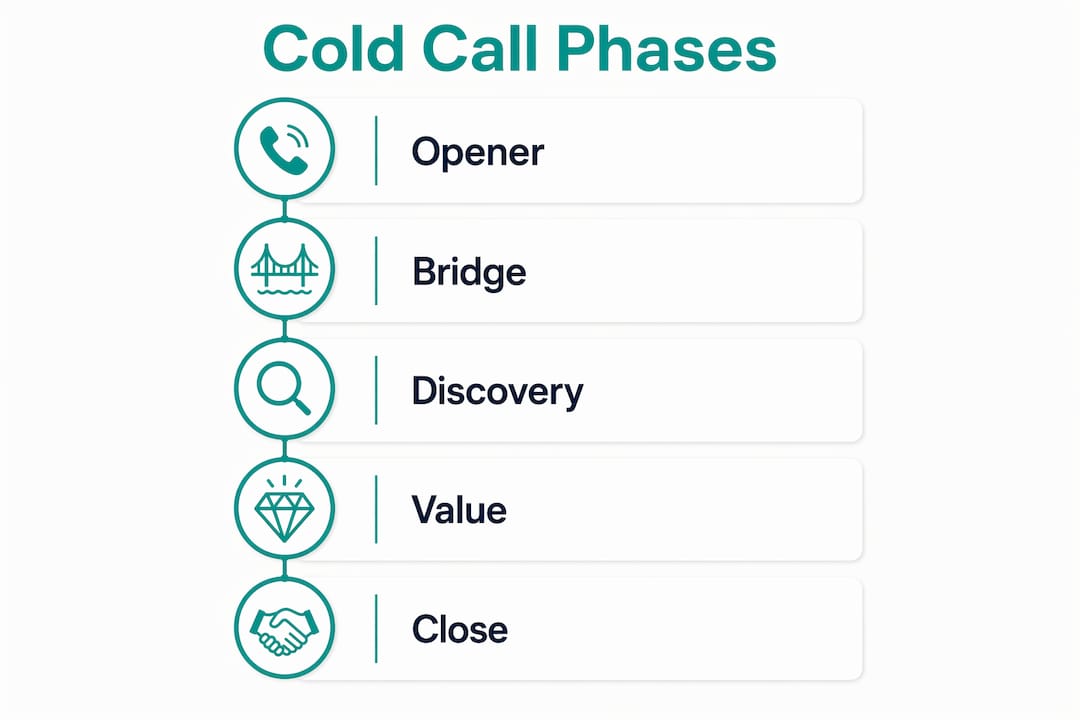
Phase 5: The close
Ask for a low-commitment next step. "Does Thursday at 10 AM work for a 20-minute call?" is specific and easy to say yes to. Avoid open-ended closes like "Would you be interested?" They invite a soft no.
Pro Tip: Write each phase on a separate index card. Practice them out of order so you can adapt mid-call without losing your place.
How to customize cold calling scripts for your B2B audience
Generic scripts fail because they treat every prospect the same. The fix is building your script around your Ideal Customer Profile (ICP) variables before you dial.
The most useful ICP variables to research before a call include:
- Recent triggers: funding rounds, new executive hires, product launches, or geographic expansion
- Peer references: name a company in the same sector that you have helped
- Pain phrasing: use the exact words your best customers used to describe their problem before they bought
Signal-based prospecting prioritizes recent funding, key hires, or tech changes to improve call conversion over generic pitches. The real work happens before you dial. A rep who spends 10 minutes researching an account will outperform one who makes 30 uninformed calls.
Replace generic statements with specific references. "We work with SaaS companies scaling into APAC" is stronger than "We work with tech companies." "I saw your CFO posted about pipeline visibility last week" is stronger than "I thought you might be interested in our product."
Script modularity matters here. Build a library of bridge statements, discovery questions, and value statements organized by industry vertical. Swap modules based on what you know about the account. This keeps the structure intact while making every call feel tailored.
Pro Tip: Pull three to five phrases directly from your best customers' discovery call transcripts. Use their exact words in your bridge and value statement. Prospects recognize their own language and trust it.
What are the best practices for cadence, timing, and multichannel integration?
Call volume alone does not drive results. Three to five call attempts spaced over several days capture 98% of all effective conversations. Anything beyond six attempts returns diminishing value. Front-load your cadence and move on.
The best days and times for B2B calls in Australia follow a consistent pattern. Mid-morning on Tuesday, Wednesday, and Thursday outperforms Monday mornings and Friday afternoons. Decision-makers are more reachable between 8:00 AM and 10:00 AM and again between 4:00 PM and 5:30 PM local time.
Voicemail is not dead. Effective voicemails are short, specific, and prompt callbacks, with a 27% callback rate when done correctly. Keep voicemails under 20 seconds. State your name, your company, one specific reason for calling, and your number. Never pitch in a voicemail.
Multichannel coordination multiplies your results. A call that follows a LinkedIn connection request and a personalized email lands differently than a cold dial with no prior contact. Cold call success depends on structure and account research more than verbal tricks or sheer volume. The call is one part of a coordinated sequence, not an isolated event.
Track these metrics to know if your approach is working:
- Dial-to-connect rate: measures list quality and timing
- Connect-to-conversation rate: measures your opener effectiveness
- Conversation-to-meeting rate: measures your full script performance
- Meeting-to-opportunity rate: measures qualification quality
Pro Tip: Run your calls in 90-minute blocks with no interruptions. Answer rate and energy both drop when you break the rhythm.
How to handle objections and keep the conversation moving
Objections are not rejections. They are signals that the prospect is still on the line and processing. The most common objections in B2B cold calls fall into three categories: timing, relevance, and gatekeeping.
"We're not interested right now." Respond with curiosity, not defense. "That's fair. Can I ask what your current approach looks like for [specific problem]?" This shifts from selling to diagnosing. The prospect often answers, which reopens the conversation.
"Send me an email." This is a soft brush-off. Acknowledge it and anchor a specific follow-up. "I'll do that. Before I let you go, is [specific pain point] something your team is actively working on?" One question keeps the call alive without being pushy.
"We already have a solution." Do not argue. Ask a diagnostic question instead. "What does that look like for you?" or "How is that working for the ANZ market specifically?" gives you information and keeps the dialogue open.
The key principle across all objection handling is to avoid robotic script responses. Memorizing frameworks and adapting language mid-call increases engagement and avoids the scripted tone that kills trust. Listen for what the objection reveals about the prospect's real situation.
After handling an objection, always return to a clear next step. "Given what you've shared, would a 20-minute call next week make sense?" is a natural transition that feels earned rather than forced.
Pro Tip: Write down the three objections you hear most often. Craft two different responses for each and test them across 20 calls. Track which version converts more conversations to meetings.
What common mistakes reduce cold calling effectiveness?
The most damaging mistake is reading a script word for word. Reading scripts verbatim reduces conversion rates to about 1.5%. Prospects hear the monotone delivery and disengage within seconds. The script is a guide, not a teleprompter.
Other frequent errors that kill results:
- Stale or unverified data: calling wrong numbers or reaching prospects who left the company six months ago wastes every rep's most limited resource, which is time
- Ignoring timing: calling on Monday mornings or Friday afternoons cuts connect rates significantly
- Skipping the bridge: jumping straight from opener to pitch removes the reason the prospect should care
- Measuring the wrong metrics: tracking dials instead of conversations hides the real problem in your script or list
Top teams book meetings at four times the average rate by combining tight ICP definitions, verified direct dials, fresh data, and structured calls. List hygiene is not a back-office task. It is a front-line performance driver.
A/B testing fixes most script problems. Change one variable at a time: the opener, the bridge trigger, or the close format. Run each version across at least 30 calls before drawing conclusions. Small changes in phrasing produce measurable shifts in conversion.
The right time to ditch the script is when you no longer need it. Once you have internalized the framework, the script becomes a mental checklist rather than a written crutch. That is the goal.
Pro Tip: Record your calls with consent and listen back to the first 15 seconds. Most reps are surprised by how rushed or flat they sound. Slow down your opener by 20% and watch connect rates improve.
Key Takeaways
Effective cold calling scripts work because they combine a repeatable structure with account-specific personalization, disciplined cadence, and adaptive delivery.
| Point | Details |
|---|---|
| Use a five-phase framework | Move through opener, bridge, discovery, value, and close in under 90 seconds. |
| Personalize before you dial | Research triggers, peer references, and pain phrasing for each account. |
| Front-load your cadence | Three to five attempts spaced over days captures most effective conversations. |
| Handle objections with questions | Respond to pushback with diagnostic questions, not defensive pitches. |
| Internalize, don't memorize | Adaptive use of the framework converts at 5%–8%; verbatim reading converts at 1.5%. |
What I've learned from watching reps ditch their scripts too early
Most sales professionals treat the script as the finish line. They write a solid opener, practice it twice, and then wonder why their connect-to-meeting rate stays flat. The script is not the product. The conversation is.
The reps I have seen book the most meetings share one habit: they treat every call as a research exercise, not a pitch opportunity. They are genuinely curious about what the prospect is dealing with. That curiosity comes through in tone, pacing, and the questions they ask. No script produces that. Only preparation and genuine interest do.
The other pattern I have noticed is that the best performers rotate their bridge statements constantly. They track which triggers resonate with which verticals and update their modules every few weeks. A bridge built around a funding round works for three months, then goes stale. The reps who keep refreshing their triggers stay ahead of the curve.
My honest advice: spend as much time building your research process as you spend writing your script. The script is the vehicle. The research is the fuel. Without fresh, specific account intelligence, even the best framework produces average results.
— Rakhveer
How Rakisolutions helps B2B teams build outbound pipelines that convert
Building and executing a cold calling program from scratch takes time that most B2B sales teams do not have. Rakisolutions works with companies expanding into the APAC and ANZ regions as a dedicated outbound growth partner, handling the full SDR function from account research and script development to meeting booking and pipeline reporting.
Rakisolutions does not measure success by activity. Every engagement is built around qualified meetings and measurable commercial outcomes. If your team is struggling with inconsistent outreach, low connect rates, or a pipeline that stalls after the first call, Rakisolutions provides the structure and execution to fix it. Visit Rakisolutions to see how the team supports B2B sales growth across Australia and the broader ANZ market.
FAQ
What are cold calling scripts used for in B2B sales?
Cold calling scripts are conversation frameworks that guide sales reps through a structured call while leaving room for genuine dialogue. They improve consistency, reduce hesitation, and increase the rate of qualified meetings booked.
How many phases does an effective cold call framework have?
A proven cold call framework uses five phases: a permission-based opener, a specific bridge, open-ended discovery questions, a one-sentence value statement, and a low-commitment close. Each phase takes 10–45 seconds depending on the prospect's response.
How many call attempts should you make before moving on?
Three to five call attempts spaced over several days captures the vast majority of effective conversations. Beyond six attempts, the return drops sharply and the time is better spent on a new account.
What is the biggest mistake in cold call objection handling?
The biggest mistake is responding to objections with defensive pitches or scripted rebuttals. Effective objection handling uses diagnostic questions to keep the prospect talking and uncover the real concern behind the pushback.
How do you measure cold calling script performance?
Track four metrics in sequence: dial-to-connect rate, connect-to-conversation rate, conversation-to-meeting rate, and meeting-to-opportunity rate. Each metric isolates a different part of the script and process so you can fix the right variable.