Cold email vs LinkedIn outreach: the direct comparison
Neither channel wins outright. Cold email is a volume engine; LinkedIn is a quality engine. The teams consistently booking the most meetings in Australian B2B markets run both, but they assign each channel a specific job.
Here is what the numbers look like when you strip out vanity metrics. LinkedIn InMail reply rates are generally higher than cold email reply rates in typical 2026 campaigns. Cold email wins on cost per meeting; LinkedIn wins on reply-to-meeting conversion, because a prospect who can see your profile and mutual connections before responding is already half-warmed. According to Happierleads data across 2,400 B2B sequences, cold email averages a 3.43% reply rate, with the top 1% of campaigns achieving 15–25%. LinkedIn InMail reply rates average between 18% and 25%, with reply-to-meeting conversion rates at 18% for email and 27% for LinkedIn.
That said, the gap between channels shrinks considerably when outreach targets accounts already showing intent signals. Reaching out the same day a prospect evaluates your pricing page is worth more than any subject line test you will ever run.

| Factor | Cold Email | LinkedIn Outreach |
|---|---|---|
| Average reply rate | varies, lower than LinkedIn | generally higher than cold email |
| Reply-to-meeting conversion | notable but variable | generally better than cold email |
| Cost per booked meeting | lower than LinkedIn | higher than cold email |
| Scalability | High (hundreds per day per SDR) | Low (daily connection limits) |
| Personalization depth | Automated data enrichment | Profile-based, manual |
| Compliance (Australia) | Spam Act 2003 applies | Platform policies apply |
| Message complexity | Long-form possible | Short-form preferred |
| Engagement longevity | Multi-step sequences | Relationship-based threading |
| Best for | Broad ICP, mid-market volume | Senior buyers, ABM, high-value deals |
Raki Solutions builds outbound programs around exactly this split: cold email for volume prospecting across the APAC region, LinkedIn reserved for high-value accounts where trust has to exist before the conversation starts.
Table of Contents
- What cold email actually gets right (and where it falls short)
- What LinkedIn outreach actually gets right (and where it falls short)
- Head-to-head: how the two channels compare on what actually matters
- How to combine both channels for better results
- Technical infrastructure that makes or breaks cold email in Australia
- Raki Solutions builds the outbound engine so you don't have to
- Key Takeaways
What cold email actually gets right (and where it falls short)
Cold email's core advantage is math. One SDR can touch hundreds of prospects per day, run A/B tests across subject lines and value propositions within a week, and generate enough data to validate or kill an ICP hypothesis before wasting LinkedIn goodwill on a broken message.
Pros of cold email outreach:
- Scale without proportional cost. Sending 500 emails costs roughly the same as sending 50, once infrastructure is in place. LinkedIn's daily limits make that arithmetic impossible.
- Detailed analytics. Open rates, reply rates, bounce rates, and click-through data are measurable at the sequence level. You can run five subject line variants simultaneously and know which one wins by Thursday.
- Broad reach. Cold email works for buyers who are not active on LinkedIn, including procurement, finance, and IT contacts at large Australian enterprises who treat LinkedIn as a recruiter channel.
- Message complexity. You can include case studies, ROI breakdowns, or multi-paragraph value propositions. LinkedIn DMs that run long get ignored.
- ICP testing. If you are unsure whether to target VPs or Directors, Series A or Series B, email first. Hard bounces tell you the list is bad; "not interested" replies tell you the timing is wrong. Email surfaces what broke. A LinkedIn acceptance with no reply tells you nothing.
Cons of cold email outreach:
- Lower per-touch reply rates. Cold email reply rates average 3.43% in 2026, with the top 1% of campaigns hitting 15–25% only when tightly targeted and personalized.
- Deliverability risk. Without proper technical setup, even well-written emails land in spam. SPF, DKIM, and DMARC are non-optional.
- Spam perception. Generic, untargeted emails damage sender reputation and can trigger spam complaints that affect the entire sending domain.
- Australian compliance complexity. The Spam Act 2003 requires every commercial email to carry a working unsubscribe mechanism, accurate sender identification, and compliant subject lines. Violations carry real penalties.
- Inbox fatigue. Australian B2B buyers receive high volumes of cold outreach. Undifferentiated emails get deleted without being read.
Copywriting structure matters. The 30-30-50 rule is a practical guide: 30% of the email devoted to personalization, 30% to your value proposition, and 50% to overall brevity. Most SDRs invert this, writing long emails that bury the point. Short, specific, and relevant outperforms long and comprehensive every time.
Sequencing discipline is equally important. Effective B2B sequences limit follow-up touchpoints and ensure each touch adds new information rather than repeating the original ask. A sequence that checks in with "just following up" on day three is burning goodwill, not building it.
What LinkedIn outreach actually gets right (and where it falls short)
LinkedIn's edge is identity. When a prospect receives your connection request, they can see your profile, your mutual connections, your recent posts, and your company page before deciding whether to respond. That context collapses the trust gap that cold email has to work against.
Pros of LinkedIn outreach:
- Higher reply rates. LinkedIn InMail reply rates average between 18% and 25%, while personalized connection requests achieve approximately 45% acceptance and 39% positive reply rates, outperforming InMail in many B2B scenarios.
- Trust-building at first contact. Buyers in consultative, high-value sales cycles check your background before engaging. LinkedIn makes that check instant and favorable when your profile is strong.
- Senior decision-maker access. LinkedIn excels for reaching founders, VPs, and C-suite contacts who screen email aggressively but remain active in their LinkedIn feed.
- ABM precision. When you are targeting 20–50 named accounts, LinkedIn's filtering by title, company, and activity lets you reach exactly the right person without list-building overhead.
- Relationship acceleration. A LinkedIn pipeline closes 9–14 days faster on average than an email pipeline, because the first conversation is already half a relationship.
Cons of LinkedIn outreach:
- Volume restrictions. LinkedIn caps daily connection requests and InMail sends. You cannot run the same volume motion that cold email supports.
- Higher cost per touch. The fully loaded cost per booked meeting via LinkedIn runs higher than email, reflecting the manual time required per contact.
- Platform policy sensitivity. Aggressive outreach triggers account restrictions. Ten restricted accounts in a week is a real operational risk, not a theoretical one.
- Slow thread initiation. Connection request, acceptance, then message is a three-step process before you have even started the conversation. Email skips all of that.
- Spam signal sensitivity. Generic openers on LinkedIn are worse than generic emails. The prospect has seen your profile, so a templated message signals you did not bother to look at theirs.
In the Australian market, LinkedIn outreach works best for SaaS, professional services, and fintech sectors where buyers are LinkedIn-native and treat their feed as a professional surface. Finance, procurement, and operations contacts at large Australian enterprises tend to route purchasing conversations through corporate inboxes, making email the stronger channel for those personas.
LinkedIn is a relationship accelerator, not a volume engine. Treating it like email, by sending high-volume generic messages, produces worse results than either channel used correctly.

Head-to-head: how the two channels compare on what actually matters
The debate over email vs LinkedIn outreach often focuses on reply rates, but reply rate is only one dimension. Pipeline velocity, compliance exposure, and message complexity all shape which channel fits a given situation.
| Dimension | Cold Email | LinkedIn Outreach |
|---|---|---|
| Response time | 24 hours typical | 48 hours; slower thread initiation |
| Audience preference | Finance, procurement, IT, 500+ employee firms | RevOps, marketing, founders, SaaS |
| Personalization method | Automated enrichment (Clay, Apollo) | Manual profile-based, mutual connections |
| Scalability | Hundreds per SDR per day | 20–50 high-value accounts per week |
| Compliance | Spam Act 2003; SPF/DKIM/DMARC required | LinkedIn platform policies; no statutory framework |
| Message complexity | Long-form viable; multi-paragraph OK | 150–300 words maximum; shorter performs better |
| Engagement longevity | Multi-step sequences over 14–30 days | Relationship threading; ongoing conversation |
| Pipeline velocity | Slower to warm; faster at volume | Faster to meeting once connected |
| Meeting-to-opportunity | About one-third (roughly equal) | About one-third (roughly equal) |
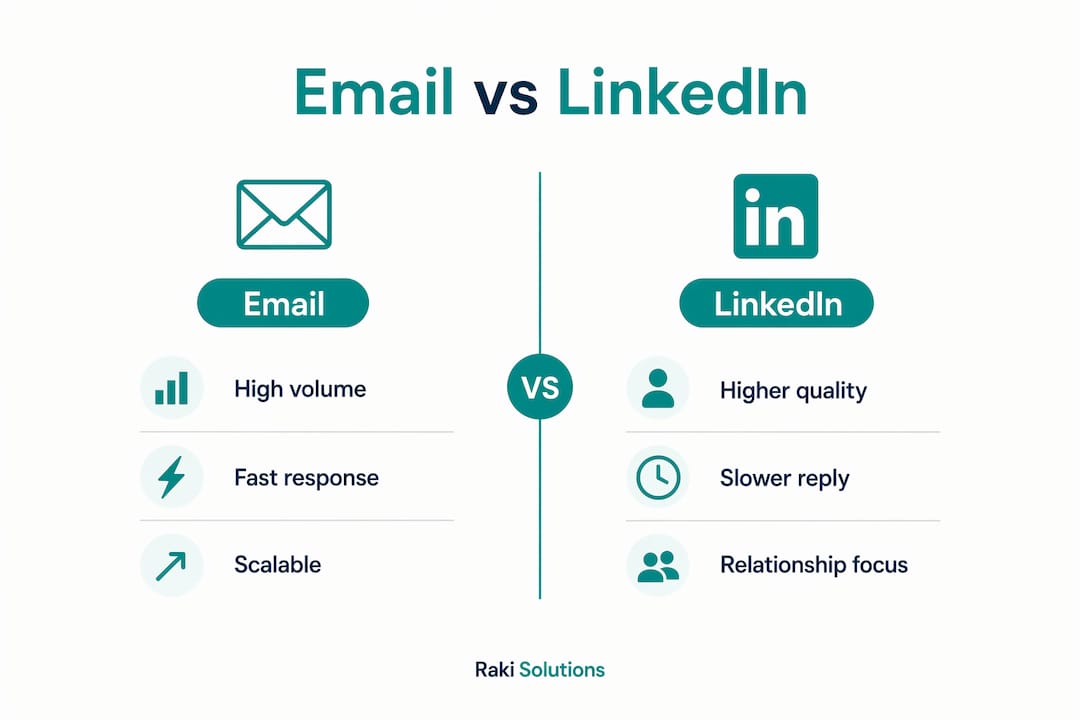
A few dimensions deserve more than a table cell.
Personalization capability differs structurally between the channels. Cold email personalization relies on data enrichment tools like Clay or Apollo to pull firmographic and technographic signals at scale. LinkedIn personalization is manual but richer: you can reference a prospect's recent post, a shared connection, or a comment they left on an industry thread. That specificity is harder to fake and harder to ignore.
Scalability and control create a genuine tradeoff. Email gives you speed and data volume; LinkedIn gives you precision and profile credibility. The teams that try to run LinkedIn at email volume consistently hit account restrictions and false negatives that make their ICP look wrong when the channel is actually just misused.
Compliance is a real operational consideration in Australia. The Spam Act 2003 governs commercial email with specific requirements around unsubscribe mechanisms, sender identification, and subject line accuracy. LinkedIn outreach operates under platform terms of service rather than statutory law, but platform restrictions can be just as damaging operationally as a regulatory fine.
Engagement longevity favors LinkedIn for relationship-based deals. A LinkedIn thread can continue across months without feeling intrusive. A cold email sequence that runs past four or five touches starts generating unsubscribes and spam complaints.
How to combine both channels for better results
Combining LinkedIn and cold email boosts positive reply rates by 2–3 times over single-channel campaigns. The mechanism is straightforward: each channel reinforces the other's signal. A prospect who ignored your email but accepted your LinkedIn connection is telling you something about their preferred surface. A prospect who opened your email three times but never replied is a natural candidate for a LinkedIn touch that references the original message.
The list split strategy is the most practical framework for most Australian B2B teams:
- Broad ICP, mid-market volume: cold email leads. LinkedIn follows only after email proves engagement.
- High-value named accounts (20–50 targets): LinkedIn leads. Email follows if prospects go quiet after initial connection.
- Warm signals (site visits, content engagement, pricing page views): whichever channel the buyer persona prefers, within 24 hours. Same-day outreach on intent signals produces reply rates that dwarf anything a subject line optimization will ever achieve.
A practical sequencing framework:
- Day 1: Initial cold email with specific personalization and a single, clear CTA.
- Day 3: Follow-up email with one new detail or a simpler question, not a repeat of day one.
- Day 6: Email from a new angle tied to a role-specific trigger (risk, revenue, compliance).
- Day 10: LinkedIn connection request with a short, specific note referencing the email thread.
- Day 14+: LinkedIn message or final email that closes the loop on high-fit accounts only.
Multi-threading accelerates deals. When one buyer replies on email, send a soft connection request to two adjacent stakeholders on LinkedIn. Deals with three or more contacts engaged close at significantly higher rates than single-threaded deals.
Pro Tip: Never activate both channels simultaneously on the same list. Prospects who see your email, connection request, and follow-ups stacking up within 48 hours tune out both channels. Let one lead, use the other as a follow-up once you have an engagement signal.
Raki Solutions structures its multi-channel outreach programs around exactly this sequencing logic: dedicated SDR teams handle the email volume motion while reserving LinkedIn for accounts that have already shown signal or sit in the highest-value tier of the target account list.
Technical infrastructure that makes or breaks cold email in Australia
Cold email deliverability is not a marketing problem. It is an infrastructure problem. A perfectly written email that lands in spam produces zero replies, regardless of how good the copy is.
The foundational three:
SPF, DKIM, and DMARC are the non-negotiable technical layer for any cold email program. SPF (Sender Policy Framework) tells receiving mail servers which IP addresses are authorized to send on behalf of your domain. DKIM (DomainKeys Identified Mail) adds a cryptographic signature that verifies the email has not been tampered with in transit. DMARC (Domain-based Message Authentication, Reporting, and Conformance) tells receiving servers what to do when SPF or DKIM checks fail, and sends reports back to the sender. Without all three configured correctly, emails land in spam regardless of message quality.
Infrastructure setup checklist for Australian B2B teams:
- Configure SPF, DKIM, and DMARC on every sending domain before the first send.
- Warm new domains gradually: start at 20–30 emails per day and increase over 4–6 weeks.
- Use separate sending domains from your primary company domain to protect brand reputation.
- Verify lists before sending. Bounce rates above 2% damage sender reputation and reduce inbox placement across subsequent sends.
- Monitor sender reputation monthly using tools like Google Postmaster Tools or MXToolbox. Deliverability decay quietly erodes 20–40% of email pipeline before most teams notice.
- Rotate sending across multiple mailboxes to distribute volume and reduce per-mailbox risk.
- Remove unsubscribes and bounces immediately. Under the Spam Act 2003, unsubscribe requests must be honored within five business days.
Australian compliance specifics. The Spam Act 2003 applies to all commercial electronic messages sent to Australian recipients, regardless of where the sender is located. Every commercial email must include a functional unsubscribe mechanism, accurate sender identification in the header, and a subject line that is not misleading. These are not optional best practices; they are legal requirements with enforcement teeth.
Metrics to track at the campaign level:
- Reply rate (target: above 3% for broad campaigns; above 8% for tightly targeted sequences)
- Bounce rate (hard ceiling: below 2%)
- Delivery rate (target: above 95%)
- Spam complaint rate (keep below 0.1% to maintain inbox placement with major providers)
Raki Solutions manages the full pipeline infrastructure layer for its clients, including domain setup, sender reputation management, list verification, and compliance alignment with Australian regulations. That operational layer is what separates campaigns that generate meetings from campaigns that generate spam folder placements.
Raki Solutions builds the outbound engine so you don't have to
Running a high-performing multi-channel outbound program in Australia requires two things most B2B teams underestimate: the technical infrastructure to keep cold email out of spam, and the SDR capacity to run LinkedIn outreach at the precision it demands. Most companies have neither, which is why their pipeline stays unpredictable.
Raki Solutions provides dedicated SDR teams as a fixed-fee service for B2B companies expanding into APAC and ANZ. The model is straightforward: you get a structured outbound program covering cold email, LinkedIn outreach, and calls, with guaranteed qualified meeting targets, weekly reporting, and full campaign management. No internal hiring, no domain setup headaches, no compliance guesswork under the Spam Act 2003.
The difference from a traditional lead generation agency is the focus on commercial outcomes rather than activity metrics. Raki does not report on emails sent; it reports on qualified meetings booked. For companies entering the Australian or broader ANZ market without an established SDR function, that distinction matters considerably.
If your pipeline is inconsistent or your outreach is not converting at the rate your ICP should support, talk to the Raki Solutions team about what a structured outbound program looks like for your market and target accounts.
Key Takeaways
Cold email and LinkedIn outreach serve different functions in B2B sales: email scales volume prospecting efficiently, while LinkedIn accelerates trust-based engagement with senior buyers and high-value accounts.
| Point | Details |
|---|---|
| Reply rate gap is real | LinkedIn InMail averages 18–25% reply rates; cold email averages 3.43%, with top campaigns hitting 15–25% when tightly targeted. |
| Cost per meeting favors email | Cold email costs less per booked meeting than LinkedIn, but LinkedIn replies convert to meetings at a higher rate (27% vs 18%). |
| Combine channels for best results | Multi-channel campaigns produce 2–3x higher positive reply rates than single-channel outreach; sequence channels by engagement signal, not personal preference. |
| Technical infrastructure is mandatory | SPF, DKIM, and DMARC setup, bounce rates below 2%, and Spam Act 2003 compliance are operational requirements, not optional improvements, for cold email in Australia. |
| Raki Solutions runs both channels | Raki Solutions provides dedicated SDR teams managing cold email and LinkedIn outreach with guaranteed meeting targets for B2B companies expanding into APAC and ANZ. |