What are meeting qualification questions, and why do they matter?
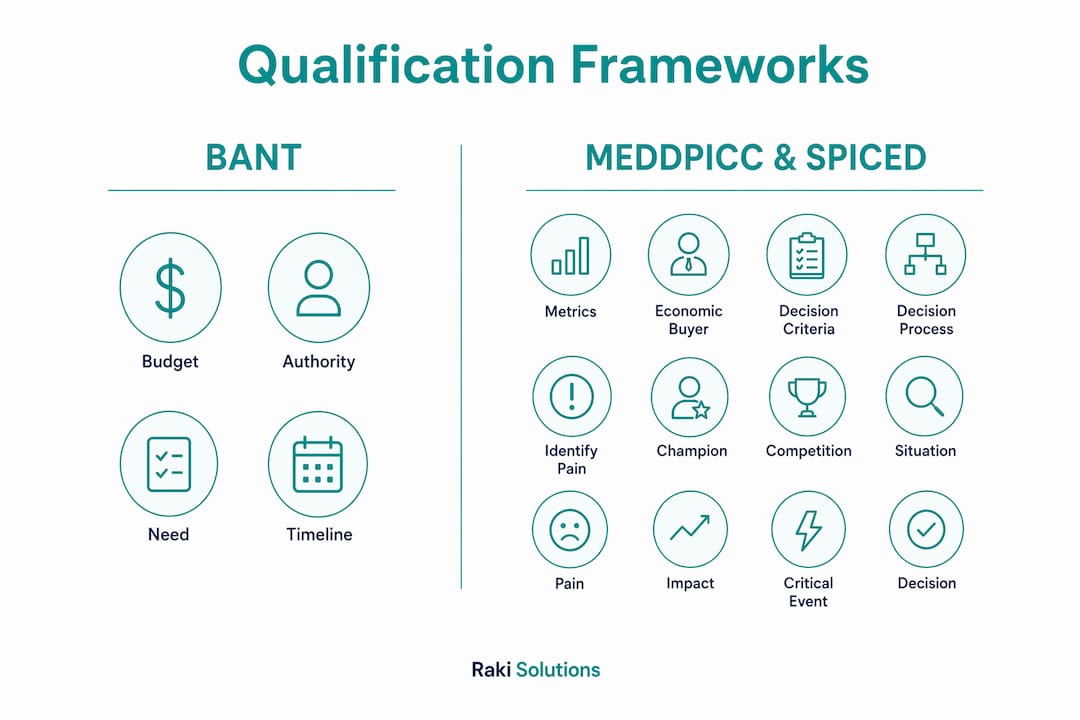
Meeting qualification questions are structured inquiries B2B SDRs use to determine whether a prospect deserves a full sales conversation before any significant time is invested. They assess four core dimensions: Budget, Authority, Need, and Timing, the BANT framework that sales qualification teams have relied on for decades. Get these answers early, and you stop chasing deals that were never real.
The stakes are high in outbound sales. Every unqualified meeting costs an SDR preparation time, an AE's calendar slot, and pipeline credibility with leadership. Qualification questions solve that problem by creating a filter before the meeting, not after.
Key dimensions these questions assess:
- Budget: Does the prospect have allocated funds, or is this exploratory?
- Authority: Are you speaking with a decision-maker or an influencer?
- Need: Is there a genuine, felt problem your solution addresses?
- Timing: Is there urgency, or is this a "maybe next year" conversation?
- Fit: Does the company match your Ideal Customer Profile by size, industry, and use case?
The best qualification questions go beyond data collection. Top-performing salespeople ask implication questions that surface the cost and consequence of a problem, shifting the conversation from transactional to consultative. That shift is what separates a meeting that converts from one that stalls.
Table of Contents
- Types of effective meeting qualification questions and their purposes
- How to research and pre-qualify leads before meetings
- Best practices and common pitfalls when using qualification questions
- How Raki Solutions uses qualification to build predictable pipeline
- Which qualification frameworks work best for outbound SDRs?
- How to integrate qualification questions into SDR workflows and CRM systems
- Raki Solutions delivers qualified meetings, not just outreach activity
- Key Takeaways
Types of effective meeting qualification questions and their purposes
Not all qualifying questions do the same job. The type you ask depends on where you are in the conversation and what you still need to know.
Open-ended questions open the floor. They reveal how a prospect thinks, what they prioritize, and where the real pain sits. Use them early. Examples:
- "What's driving the decision to look at this now?"
- "Walk me through how your team currently handles outbound prospecting."
- "What would a successful outcome look like six months from now?"
Closed-ended questions confirm and commit. Once you have the context, closed questions lock in specifics and move the conversation forward. Examples:
- "Do you have budget allocated for this quarter?"
- "Are you the final decision-maker, or does this need sign-off from someone else?"
Implication questions are where most SDRs leave money on the table. These questions force a prospect to articulate the cost of inaction. If a prospect cannot describe the consequences of not solving their problem, they are rarely ready to buy, regardless of budget or authority. Examples:
- "What happens to your pipeline targets if this problem isn't resolved by Q3?"
- "How much revenue do you estimate you're leaving on the table each month?"
Advanced frameworks like MEDDPICC and SPICED add depth for complex B2B deals with multiple stakeholders. MEDDPICC covers Metrics, Economic Buyer, Decision Criteria, Decision Process, Identify Pain, Champion, and Competition. SPICED maps Situation, Pain, Impact, Critical Event, and Decision. These go well beyond BANT and are worth adopting when your sales cycle involves procurement teams or executive sign-off.
How to research and pre-qualify leads before meetings
Qualification does not start on the call. It starts the moment a prospect enters your pipeline.

Pre-qualifying through CRM data and external sources, including company size, industry, recent funding, and tech stack, lets SDRs confirm ICP fit before a single word is spoken. That research shapes every question you ask and every objection you anticipate.
A practical pre-call research checklist:
- Company fit: Revenue range, headcount, industry vertical, and geography
- Decision-maker verification: LinkedIn title, reporting structure, tenure
- Budget signals: Recent funding rounds, job postings for related roles, or technology spend indicators
- Trigger events: Leadership changes, product launches, or expansion announcements that create urgency
- Prior engagement: CRM history showing past conversations, content downloads, or demo requests
Behavioral insights matter here too. A prospect who downloaded a whitepaper on outbound sales strategy three weeks ago is a different conversation than a cold contact. Integrating behavioral research with qualification approaches helps SDRs tailor their opening questions to what the prospect has already signaled they care about.
Pro Tip: Build a one-page pre-call brief for each target account that maps ICP fit score, known pain points, and one trigger event. SDRs who walk into calls with this brief ask sharper questions and waste less time on discovery basics.
Best practices and common pitfalls when using qualification questions
The biggest mistake SDRs make is turning qualification into an interrogation. Firing five BANT questions in sequence feels like a compliance checklist, not a conversation. Prospects disengage fast.
What works:
- Lead with curiosity, not a script. Ask one open question, listen fully, then follow the thread.
- Confirm administrative details early. Explicit calendar invites with agendas and a 24–48 hour confirmation reduce no-shows significantly.
- Use coaching-style questions that help buyers clarify their own reasoning. Questions that help prospects articulate "why" behind their interest prevent stalls later in the cycle.
- Handle objections by restating the prospect's concern and asking a follow-up, not by defending your solution.
What kills qualification:
- Skipping the authority question because it feels awkward. You will find out at the worst possible moment.
- Accepting vague urgency. "We're looking at this for next year" is not a timeline.
- Failing to probe the cost of inaction. Budget and need alone do not predict a close.
- Ignoring the competitive landscape. Knowing what else a prospect is evaluating shapes how you position.
A quick dos and don'ts summary:
| Do | Don't |
|---|---|
| Ask one question at a time | Stack multiple questions in one breath |
| Confirm attendees and agenda in advance | Assume the right people will show up |
| Probe consequences of inaction | Accept "we have a problem" at face value |
| Use open questions to open, closed to confirm | Lead with yes/no questions |
| Document answers in CRM immediately | Rely on memory for handoff notes |
How Raki Solutions uses qualification to build predictable pipeline
Raki Solutions builds qualification into every layer of its SDR as a Service model, not as a checklist, but as a structured workflow tied to client-specific ICPs and sales cycles.
The approach starts before outreach. Each target account goes through research to verify ICP fit, identify decision-makers, and surface trigger events. That intelligence feeds directly into the qualification questions SDRs ask during multi-channel outreach across email, LinkedIn, and calls. The result is that by the time a meeting is booked, the prospect has already been partially qualified through the outreach sequence itself.
Key service differentiators in Raki Solutions' qualification process:
- Custom qualification frameworks aligned to each client's ICP, deal size, and sales cycle length
- CRM-integrated tracking of qualification responses to measure meeting-to-opportunity conversion
- Weekly reporting on qualification rates, meeting quality scores, and pipeline health
- SDR-to-AE handoff protocols built on clearly defined qualification criteria and structured meeting notes
- Multi-channel outreach that pre-qualifies through engagement signals before the first live conversation
The structured outbound approach Raki Solutions uses means clients in the APAC and ANZ markets get guaranteed qualified meetings, not just activity metrics. Pipeline predictability comes from knowing every meeting in the calendar has passed a defined qualification threshold.
Which qualification frameworks work best for outbound SDRs?
BANT is the starting point, but it is rarely enough on its own for complex B2B sales.
BANT works well for shorter sales cycles and smaller deal sizes. It answers the four core questions fast and helps SDRs make a quick qualify or disqualify call. The weakness: it is prospect-centric and misses competitive and process dynamics.
MEDDPICC is built for enterprise deals. The addition of Champion (an internal advocate) and Competition (what else is being evaluated) makes it far more predictive for multi-stakeholder sales processes. An SDR using MEDDPICC knows not just whether a deal is possible, but whether it is winnable.
SPICED takes a more narrative approach. It maps the prospect's current Situation, the Pain driving action, the business Impact of that pain, a Critical Event creating urgency, and the Decision process. It works particularly well for consultative selling because it mirrors how buyers actually think about their problems.
For Australian B2B companies expanding into APAC, SPICED often fits better than BANT for initial outbound qualification because it opens with situation and pain rather than budget, which builds rapport before asking the harder commercial questions.
How to integrate qualification questions into SDR workflows and CRM systems
Qualification questions only improve pipeline predictability when the answers are captured, tracked, and acted on systematically.
The practical integration looks like this: each qualification question maps to a CRM field. Budget confirmed becomes a dropdown. Decision-maker identified becomes a contact role tag. Urgency level becomes a deal stage criterion. When SDRs log answers in real time, sales leaders can filter pipeline by qualification completeness and spot which deals are advancing on assumptions rather than evidence.
Workflow integration also means building qualification into outreach sequences, not just discovery calls. A LinkedIn message that asks "Are you currently evaluating outbound SDR support for your APAC expansion?" is a qualification question. The reply, or the silence, tells you something before the meeting is even booked. Coaching SDRs to integrate qualification into their outreach sequences rather than saving it all for the call compresses the qualification timeline significantly.
The SDR-to-AE handoff is where poor CRM discipline costs the most. A handoff without documented qualification answers forces the AE to re-qualify from scratch, which frustrates the prospect and delays the deal. Structured handoff templates tied to CRM fields solve this cleanly.
Raki Solutions delivers qualified meetings, not just outreach activity
Most outbound agencies count sends and calls. Raki Solutions counts qualified meetings, and that distinction shapes everything about how the service is built.
For B2B companies entering APAC and ANZ markets, the challenge is not generating outreach volume. It is getting in front of the right decision-makers with enough qualification done upfront that every meeting has a real chance of converting. Raki Solutions handles that entire process: ICP research, decision-maker sourcing, multi-channel outreach, qualification questioning, and CRM-integrated pipeline reporting, all under a fixed-fee model with guaranteed meeting targets.
There is no overhead of hiring and managing an internal SDR team, and no agency billing you for activity that does not convert. If you want a pipeline built on qualified conversations rather than optimistic forecasts, see how Raki Solutions works and book a discovery call to discuss your APAC expansion targets.
Key Takeaways
Qualification questions are the single most reliable way to separate real pipeline from noise, and the frameworks you use determine how much of that signal you actually capture.
| Point | Details |
|---|---|
| BANT is the foundation | Qualifying Budget, Authority, Need, and Timing filters unqualified leads before they consume AE time. |
| Implication questions predict readiness | Prospects who cannot articulate the cost of inaction are rarely ready to buy, regardless of budget. |
| Pre-call research sharpens every question | CRM data and external research on company fit and trigger events improve meeting quality before the first word is spoken. |
| CRM integration makes qualification measurable | Mapping qualification answers to CRM fields turns subjective conversations into trackable pipeline data. |
| Raki Solutions guarantees qualified meetings | Its SDR as a Service model applies custom qualification frameworks and CRM-integrated tracking to deliver predictable pipeline for APAC and ANZ expansion. |