
A pipeline generation plan is a structured system that creates a reliable flow of qualified sales opportunities by connecting ideal customer profiles with orchestrated outreach and qualification processes. Unlike lead generation, which captures interest, pipeline generation moves accounts through defined stages toward predictable revenue. The distinction matters: lead generation acquires interest, while pipeline generation converts that interest into commercial outcomes. For B2B sales leaders entering markets like Australia and the broader ANZ region, building this system from scratch requires more than a campaign. It requires a repeatable, measurable framework.
What goes into a pipeline generation plan that actually works?
A pipeline generation plan fails without three foundations: a precise ideal customer profile (ICP), shared qualification standards across marketing, sales, and RevOps, and a pipeline structure matched to your deal complexity. Get these wrong and every outreach dollar compounds the problem instead of solving it.
Defining your ICP with intent signals
Firmographic data alone, such as company size, industry, and revenue, is not enough to build a reliable ICP. Buying intent signals like job changes, funding rounds, and web traffic spikes are exponentially more valuable for triggering outreach at the right time. A company that just raised a Series A and hired a new VP of Sales is a fundamentally different target than one with identical firmographics but no growth signals. Build your ICP around both layers.

Aligning qualification standards across teams
The most common source of pipeline leakage is misalignment between what marketing calls a qualified lead and what sales calls a qualified opportunity. A pipeline generation plan as a system requires shared definitions, weekly feedback loops, and a single source of truth in your CRM. Without this, marketing fills the top of the funnel with accounts that sales ignores, and neither team understands why conversion rates are low.
Matching pipeline structure to deal complexity
An effective sales pipeline has between 3 and 7 stages. Fewer stages hide bottlenecks. More stages create administrative overhead without diagnostic value. The right number depends on your average contract value and sales cycle length. A transactional product with a two-week cycle needs a different structure than an enterprise deal with a six-month procurement process.
The toolset for a working pipeline includes a CRM for stage tracking, a sales engagement platform for sequencing, intent data tools for signal monitoring, and a system for tracking warm introductions and champion relationships. Each tool serves a specific function. Buying all four without a clear workflow produces data noise, not pipeline.
| Pipeline component | Purpose | Key output |
|---|---|---|
| Ideal customer profile | Defines who to target | Prioritized account list |
| Qualification framework | Filters fit and intent | Stage-ready opportunities |
| Pipeline stage structure | Maps deal progression | Conversion rate visibility |
| Multichannel outreach mix | Generates initial contact | Meeting volume by source |
| Feedback loop cadence | Improves system over time | Refined ICP and messaging |
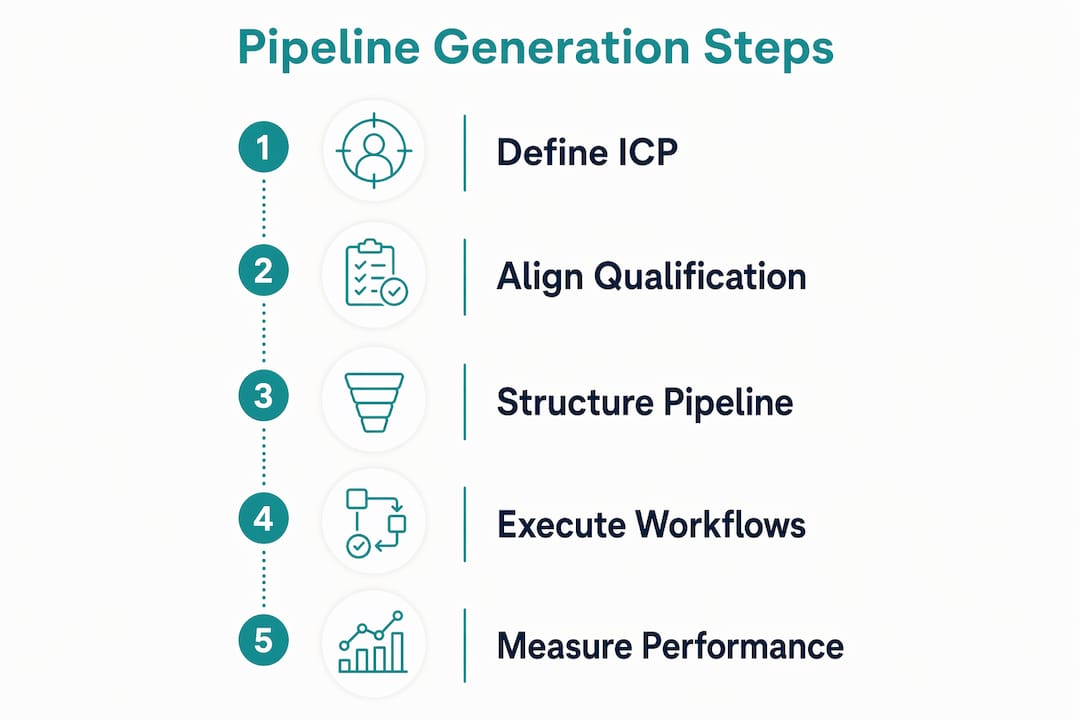
How do you execute pipeline generation workflows at scale?
Execution is where most pipeline plans collapse. Teams build a great ICP and a clean CRM structure, then default to cold email blasts and wonder why nothing converts. The answer lies in channel mix and relationship orchestration.
Warm-graph orchestration as a core tactic
Warm-graph orchestration yields 5–10x higher close rates and 40% faster sales cycles compared to cold outbound alone. The warm graph includes four relationship pillars: your team's existing connections, current customer networks, investor relationships, and partner ecosystems. Each pillar opens doors that cold outreach cannot. The process involves mapping accounts to connectors, scoring those connectors by relationship strength, and activating introductions through a structured workflow rather than ad hoc requests.
Layering channels for speed and compounding growth
Multichannel cold outbound generates pipeline fastest, typically within 14 to 30 days. SEO and digital PR take 4–6 months but compound indefinitely. Seed-stage companies in Australia entering a new vertical should prioritize fast tactics first. Series B companies with established brand recognition should balance fast outbound with compounding inbound channels to reduce long-term customer acquisition costs.
- Map your target account list against your warm graph and score each account by connection strength.
- Activate warm introductions for accounts with strong connector overlap before any cold outreach.
- Run multichannel cold sequences on remaining accounts using email, LinkedIn, and phone in coordinated cadences.
- Route inbound leads from content and digital PR into the same qualification framework as outbound accounts.
- Track stage-to-stage conversion rates weekly and feed findings back to the ICP and messaging team.
Pro Tip: Segment your pipeline by source from day one. Warm-sourced, inbound, and cold outbound opportunities behave differently at every stage. Mixing them in one view produces averages that mislead forecasting and hide the real story.
Combining three or more coordinated tactics generates 200% more pipeline than single-channel operations. That figure reflects the compounding effect of consistent presence across channels. A prospect who sees your LinkedIn content, receives a warm introduction, and then gets a personalized email is in a fundamentally different buying position than one who receives a cold sequence alone.
How do you measure pipeline generation performance for predictable revenue?
Measurement separates a pipeline generation plan from a pipeline generation guess. The metrics that matter most are not the ones most teams track.
Coverage ratios by source
Pipeline coverage ratios vary significantly by source. Warm-sourced pipeline needs 2–3x quota coverage to hit equivalent win rates. Inbound pipeline requires 4–5x. Cold outbound requires 5–7x. These ratios reflect the reality that not all pipeline is equal. A $1M cold outbound pipeline is not the same as a $1M warm-sourced pipeline. Treating them as equivalent produces forecast errors that compound through the quarter.
Stage-to-stage conversion rates as the primary health indicator
Stage-to-stage conversion rate is the most critical metric for diagnosing pipeline health, more important than total pipeline value or lead volume. A leaky pipeline with high volume but poor conversion at stage two signals a qualification problem, not a volume problem. Adding more leads to a leaky pipeline wastes budget. Fixing the leak first is the correct sequence.
| Metric | What it reveals | Review cadence |
|---|---|---|
| Stage-to-stage conversion rate | Qualification and process health | Weekly |
| Pipeline coverage by source | Forecast reliability by channel | Monthly |
| Sales cycle length by source | Efficiency and deal complexity | Monthly |
| Close rate by ICP segment | ICP accuracy | Quarterly |
| CAC by pipeline source | Channel efficiency | Quarterly |
Pro Tip: Run a quarterly pipeline math review. Calculate how much pipeline each source must generate to hit quota, then compare it to actual coverage. The gap tells you exactly where to invest next quarter.
Effective pipeline forecasting removes wishful thinking by using historical win rates and stage-based conversion data. Forecast from data, not from rep optimism. Australian B2B sales cycles often run longer than North American benchmarks due to smaller buying committees and more deliberate procurement processes. Build that reality into your pipeline math from the start.
What are the most common pipeline generation mistakes in new markets?
Entering a new market amplifies every pipeline mistake. Errors that are manageable in a known market become expensive in an unfamiliar one.
- Conflating lead generation with pipeline generation. Accounts without active intent signals belong in a nurture track, not in your active pipeline. Pushing unqualified accounts into pipeline inflates the number but destroys forecast accuracy.
- Over-investing in cold outbound while ignoring warm channels. Cold reply rates have fallen below 1%. Warm-graph orchestration is not a nice-to-have. It is the highest-return channel available to most B2B teams.
- Mixing incompatible sales motions in one pipeline. Different sales motions require distinct pipelines. A product-led growth motion and an enterprise direct sales motion cannot share a pipeline without corrupting both sets of metrics.
- Neglecting data hygiene. Stale contacts, duplicate accounts, and untracked activities produce a CRM that no one trusts. Pipeline ownership must be assigned explicitly, with clear accountability for each stage.
- Scaling tactics before fixing the foundation. Adding SDR headcount to a broken qualification process scales the problem, not the solution.
"The biggest pipeline mistake I see in new market entries is treating pipeline generation as a volume problem. It is a quality and system problem. Fix the qualification framework first. The volume follows."
Key Takeaways
A pipeline generation plan delivers predictable B2B revenue only when it combines a precise ICP, shared qualification standards, and a multichannel outreach system with continuous measurement and feedback.
| Point | Details |
|---|---|
| ICP requires intent signals | Combine firmographics with buying signals like funding and job changes for accurate targeting. |
| Warm-graph orchestration outperforms cold | Warm-sourced pipeline closes 5–10x faster and requires only 2–3x coverage to hit quota. |
| Stage conversion beats volume metrics | Track stage-to-stage conversion rates weekly to diagnose and fix pipeline leaks early. |
| Separate pipelines by sales motion | Mixing motions in one pipeline corrupts forecasting and misaligns sales activity. |
| Match tactics to company stage | Seed-stage teams need fast outbound; Series B teams should balance outbound with compounding inbound. |
Why most pipeline plans fail before they start
The uncomfortable truth about pipeline generation is that most plans fail at the design stage, not the execution stage. Teams spend weeks building outreach sequences and sourcing contact lists, then wonder why the pipeline never materializes. The real failure is almost always upstream: no shared qualification standard, no pipeline math, and no system for turning feedback into iteration.
I have seen this pattern repeatedly with B2B teams entering the Australian market. They arrive with a North American playbook, a cold email tool, and a list of 500 accounts. Six weeks later, they have booked a handful of meetings with companies that will never buy. The ICP was wrong, the intent signals were ignored, and the warm graph was never mapped.
The 2026 shift toward warm-graph orchestration is not a trend. It is a correction. Cold reply rates below 1% are not a temporary dip. They reflect a permanent change in how buyers engage with unsolicited outreach. Teams that build their pipeline plan around warm introductions, intent-triggered sequences, and stage-based qualification will compound their advantage over time. Teams that keep doubling down on cold volume will keep getting the same results.
The right pipeline plan treats marketing, sales, and RevOps as one system with shared goals and shared data. Weekly feedback loops are not optional. They are the mechanism that turns a static plan into a living system. The teams I have seen build the most consistent pipeline in new markets are the ones that review their stage conversion data every week and adjust their ICP, messaging, and channel mix accordingly. They do not wait for the quarterly review to discover a problem. They find it in week two and fix it in week three.
— Rakhveer
How Rakisolutions helps B2B teams build pipeline in ANZ
Building a pipeline generation plan from scratch in a new market is one of the hardest things a B2B sales team can do. The account landscape is unfamiliar, the warm graph is thin, and the qualification framework has not been tested against local buyers.
Rakisolutions specializes in exactly this challenge. The team provides SDR as a Service for B2B companies entering the APAC and ANZ markets, combining structured outbound, warm-graph activation, and stage-based qualification to generate qualified meetings with measurable outcomes. Clients get a dedicated SDR team without the overhead of full-time hires, with guaranteed meeting targets and full pipeline visibility from day one. If your team is ready to build a pipeline that actually converts in the Australian market, Rakisolutions is built for that work.
FAQ
What is a pipeline generation plan?
A pipeline generation plan is a structured system that moves qualified accounts through defined sales stages toward predictable revenue. It combines ICP definition, multichannel outreach, and shared qualification standards across marketing, sales, and RevOps.
How is pipeline generation different from lead generation?
Lead generation captures interest. Pipeline generation manages qualified accounts through a structured process toward a commercial outcome. Accounts without active buying intent belong in nurture, not in the active pipeline.
What pipeline coverage ratio should I target?
Coverage ratios depend on source. Warm-sourced pipeline requires 2–3x quota coverage, inbound requires 4–5x, and cold outbound requires 5–7x to achieve equivalent win rates.
How many stages should a B2B sales pipeline have?
An effective pipeline has between 3 and 7 stages. Fewer stages hide bottlenecks. More stages create overhead without improving diagnostic accuracy.
What is the most important pipeline health metric?
Stage-to-stage conversion rate is the most critical metric. It reveals where accounts stall and whether the problem is qualification, messaging, or process, rather than simply pipeline volume.