
What is a sales development playbook and why does it matter?
A sales development playbook is a concise, living manual that tells your SDR team exactly who to target, what to say, how to sequence outreach, and which numbers to track. Not a 40-page policy document. Not a static PDF that collects digital dust. Think of it as a concise operating guide built around one ICP, a handful of buying signals, and a repeatable cadence your reps can run tomorrow morning.
The core components every effective playbook covers:
- ICP definition: Firmographics, technographics, and a specific pain trigger. Not "mid-market SaaS" but "RevOps leaders at SaaS companies who just posted a new SDR role."
- Buying signals: Three to five specific, verifiable events that indicate a prospect is warmer this week than last.
- Messaging and sequences: Signal-led openers, a multi-channel cadence of 3 touchpoints, and one qualification framework.
- Channels: Email, LinkedIn, and phone coordinated in sequence, not run as separate tracks.
- Metrics: Reply rate, positive reply rate, and meeting booked rate reviewed weekly.
The defining shift in 2026 is relevance over volume. Top-performing outbound programs achieve reply rates between 10% and 25% by targeting on fresh signals, while the platform-wide average sits between roughly 3.43% and 5%. That gap is not a copywriting problem. It is a targeting and timing problem, and a well-built playbook solves it at the system level. For Australian B2B teams, local consultants like Salesmasters and PLAY can accelerate the build.
How do you build a sales development playbook for Australian B2B?
Start narrow. The single most common mistake is a vague ICP that tries to cover every possible buyer. Companies using structured playbooks outperform peers on quota attainment, and the ones that outperform by the widest margin define their ICP with firmographics AND a real pain trigger, not just industry and company size.
Step 1: Define a tight ICP. One role, one company-size band, one or two industries, one specific use case. Add disqualifiers. Knowing who to skip saves reps from burning time on accounts that will never close.

Step 2: Identify several buying signals. Each signal should be verifiable from a public source in under 60 seconds. Funding rounds, executive hires, job postings for SDR roles, product launches, and regulatory changes are the most reliable triggers in Australian B2B markets.
Step 3: Design the sequence. Plan multiple touchpoints per prospect across email, LinkedIn, and phone. Each touch needs a new angle, not a follow-up asking if they saw the last email. Multi-channel outreach generates higher engagement than single-channel approaches.
Step 4: Build the ramp framework. The industry-standard SDR ramp runs three phases covering initial training and supervised outreach, followed by increasing outbound independence, and concluding with full activity aiming for quota attainment.
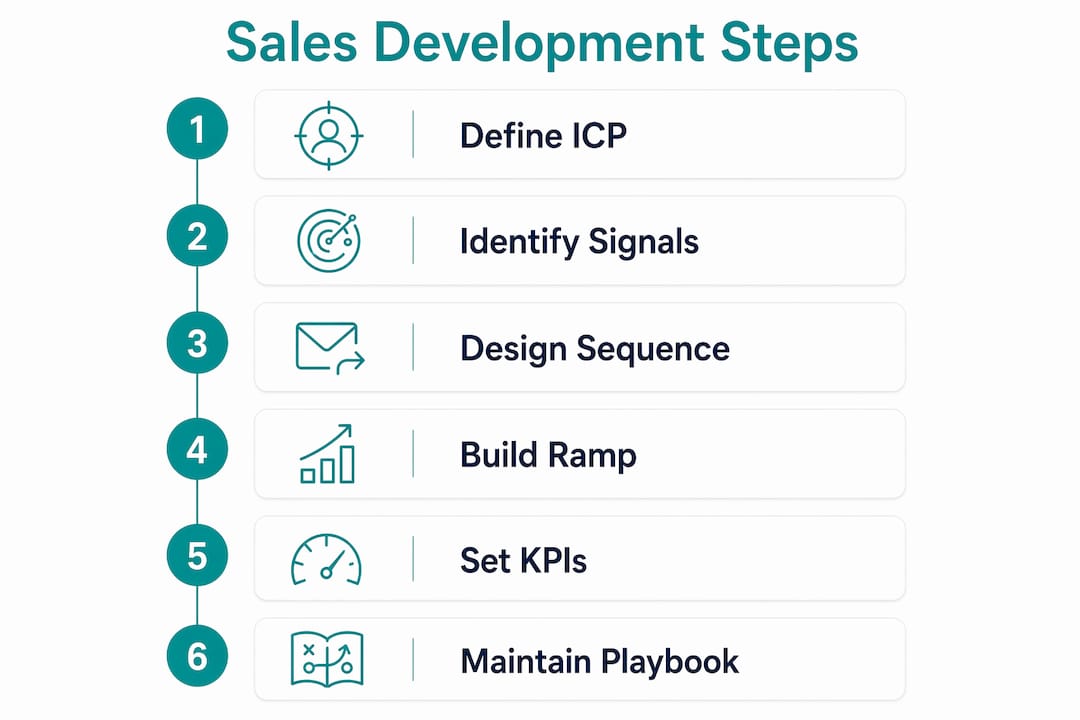
Step 5: Set the right KPIs. Track reply rate, positive reply rate, and meeting booked rate from day one. Positive reply rate, the share of replies that express genuine interest rather than removal requests, is the metric that tells you whether you are reaching the right people. Meeting booked rate for cold outbound typically varies at a low single-digit percentage.
Step 6: Keep it alive. Host the playbook in a dynamic knowledge management system like Notion rather than a static PDF. Run monthly sequence audits cutting the bottom 20% by positive reply rate. Do a full refresh quarterly, re-examining the ICP and signals against the past 90 days of closed-won data.
The biggest pitfall is the template trap: downloading a generic playbook and running it without testing. Iterative testing is what separates a playbook that improves over time from one that becomes an archive within 90 days. Pair that with effective sales coaching techniques to reinforce adoption across the team.
Pro Tip: Assign a named owner, your SDR manager or a senior rep, to maintain the playbook. A playbook without an owner is effectively dead within 90 days of launch.
Which Australian consultants specialize in sales development playbooks?
Two verified Australian consultancies stand out for B2B teams seeking expert help building or refining their outbound playbook.
| Consultant | Services offered | Australian B2B experience | Playbook approach | Rating | Best for |
|---|---|---|---|---|---|
| Salesmasters | Sales training, coaching, strategy, tailored playbook, CRM integration, value-based selling, qualification frameworks | 30+ years specializing in Australian B2B revenue growth | Tailored inbound and outbound process design, value-based selling focus, ongoing coaching | 5★ (15 reviews) | Teams wanting end-to-end playbook development with long-term coaching |
| PLAY | Sales development consulting, innovation services, playbook creation | Verified local Australian B2B consultancy | Specialized playbook consulting with an innovation lens | 4.6★ (5 reviews) | Businesses seeking specialized playbook consulting with a focus on innovation |
Salesmasters brings over 30 years of experience working with Australian B2B businesses on exactly the problems a playbook is meant to solve: inconsistent sales behavior, unclear qualification criteria, and reps who sound different on every call. Their service suite covers the full arc from ICP definition and messaging through CRM integration and ongoing coaching, which means a team can engage them at any stage of playbook maturity. The value-based selling focus is particularly relevant for Australian enterprise and mid-market deals where procurement cycles are long and multiple stakeholders are involved.
PLAY operates as a specialized consultancy with a sharper focus on innovation within the sales development process. For teams that already have a baseline playbook but want a fresh perspective on signal-based prospecting or modern cadence design, PLAY's positioning fits that brief.
How long does it take to build and implement a playbook?
The build phase for a first-version playbook typically runs four to six weeks when a dedicated owner drives it. Week one covers ICP definition and signal identification. Weeks two and three handle sequence design, messaging, and channel coordination. Week four builds the metrics framework and the ramp plan for new SDRs. Weeks five and six cover distribution, onboarding the team, and running the first live sequences.
Implementation, meaning the point where reps are running the playbook independently and hitting consistent activity levels, takes the full 90-day ramp period. By day 90, a well-onboarded SDR should be approaching or achieving their quota. Expect the first meaningful performance data, enough to run a proper sequence audit, around the six-week mark after launch.
A full refresh cycle runs quarterly. Monthly audits handle the bottom 20% of sequences. Playbooks that go six months without a refresh tend to reflect a buyer worldview that no longer matches the market.
What does it cost to build and maintain a playbook?
Building a playbook internally costs primarily in time: a dedicated SDR manager or senior rep spending roughly 20–40 hours on the first version, plus ongoing hours for monthly audits and quarterly refreshes. The tool cost depends on the stack. At minimum, teams need a CRM like HubSpot or Salesforce, a verified data provider, and a sequencer like Outreach or SalesLoft.
Engaging a consultant like Salesmasters or PLAY adds an external fee that varies by scope. Neither publishes fixed pricing publicly, so budget conversations happen directly. For teams with no existing playbook infrastructure, a full-build engagement typically covers ICP definition, sequence design, messaging, and initial coaching. Ongoing retainer arrangements cover quarterly refreshes and coaching sessions.
The hidden cost most teams underestimate is the ramp period. An SDR who is not at full quota for 90 days represents real pipeline opportunity cost. A well-built playbook, with a clear ramp framework and a named owner, shortens that gap.
What do Australian B2B playbook results actually look like?
Concrete published case studies from named Australian B2B companies are not publicly available at the time of writing. What the data does show is the pattern: teams that shift from volume-based prospecting to signal-led outbound see reply rates move from the roughly 3.43%–5% range toward the 10–25% range that top performers achieve. That improvement compounds. Higher reply rates mean more meetings per SDR per month, which means more pipeline per quarter without adding headcount.
The practical signal for Australian sales leaders is this: if your SDR team's positive reply rate is below 2%, the problem is almost always targeting or messaging, not effort. A playbook audit across the seven layers (targeting, infrastructure, timing, messaging, channel, qualification, and metrics) will surface the weakest link faster than any headcount change.
Rakisolutions offers a faster path to qualified pipeline in APAC and ANZ
Building a playbook takes time your pipeline may not have. Rakisolutions offers a fixed-fee SDR as a Service that skips the build phase entirely and delivers guaranteed qualified meetings for B2B companies expanding into APAC and ANZ.
The model is straightforward: a dedicated outbound team handles target account research, decision-maker sourcing, multi-channel outreach across email, LinkedIn, and calls, and full pipeline infrastructure management. Weekly reporting keeps you across what is working and what is being adjusted. Unlike a traditional agency focused on activity metrics, Rakisolutions ties its model to qualified meeting outcomes, which means the incentive structure aligns with yours from day one. For teams that want pipeline moving while the internal playbook matures, or for companies entering the Australian and ANZ market without an existing SDR function, it is a direct alternative worth evaluating.
Key Takeaways
A well-built sales development playbook focused on signal-based prospecting, a structured ramp framework, and weekly metrics reviews is the clearest path to consistent pipeline growth for Australian B2B teams in 2026.
| Point | Details |
|---|---|
| Signal-based targeting wins | Top outbound programs hit 10%–25% reply rates vs. the 3.43%–5% platform average by targeting fresh buyer signals. |
| Keep the playbook short and live | A 12–15 page document with a named owner, monthly audits, and quarterly refreshes outperforms any static manual. |
| Ramp takes 90 days | The standard SDR ramp targets 75–100% of quota by day 90 across three progressive phases. |
| Local consultants accelerate the build | Salesmasters (30+ years, full-service) and PLAY (innovation-focused) are the two verified Australian specialists. |
| Rakisolutions delivers pipeline without the build wait | Fixed-fee SDR as a Service with guaranteed qualified meetings for B2B teams expanding in APAC and ANZ. |