A weekly pipeline review is a structured, time-boxed meeting where a manager and rep make specific decisions about specific deals, each with a named owner and a deadline. The goal is not a status update. It is intervention.
Your 30-minute template, ready to copy:
- 0–5 min: Pipeline health snapshot (coverage ratio, week-over-week change, any red metrics)
- 5–15 min: Stage progression — which deals advanced, stalled, or were added since last week
- 15–25 min: Risk review — work through the 3–5 highest-risk deals; rep explains in 60 seconds, manager coaches or calls it (keep, rescue, disqualify)
- 25–30 min: Document 3–5 actions with named owners and due dates
Who attends: Manager plus one rep (one-on-one format) or manager plus a small team (no more than 4–5 reps for a group roundtable). One-on-ones run 20–30 minutes; group reviews run 30–45 minutes.
Which deals to pick: Commits first, then best-case deals with movement, then anything stuck. Skip the slam-dunks and the clearly dead ones.
The four coaching questions (replace every status update with these):
- What changed with this deal since last week?
- What is the buyer's next committed action, and by when?
- What is blocking this deal right now?
- What do you need from me to move it forward?
Teams that run a consistent weekly inspection cadence improve forecast accuracy by 15–20% and increase sales velocity by up to 25%.
The 14-day rule: Any deal with no buyer-committed next action within 14 days gets flagged automatically. Reps submit their at-risk list 24 hours before the meeting so the manager arrives with targeted questions, not blank curiosity.

Table of Contents
- What is a weekly pipeline review, and why does cadence matter?
- What should reps and managers prepare before the meeting?
- How should you structure the meeting agenda?
- What are the manager and rep roles, and how do you handle missed commits?
- How do CRM hygiene and automation make weekly reviews faster?
- How do you define stage exit criteria and apply the 14-day rule?
- Which metrics should you track in weekly reviews?
- How do you document outcomes and follow up after the meeting?
- What are the most common pipeline review mistakes, and how do you fix them?
- Copyable templates and checklists you can use this week
- Why does the weekly cadence compound, and what does research show?
- Key Takeaways
- The pipeline review discipline most teams skip
- Consistent qualified meetings without the pipeline maintenance overhead
- Useful sources and tools for deeper practice
What is a weekly pipeline review, and why does cadence matter?
Most pipeline meetings fail for a simple reason: they are status meetings dressed up as strategy sessions. The manager asks what is happening, the rep summarizes, and everyone leaves with a slightly better mental model and zero new decisions. That pattern is the single most common reason pipeline reviews produce no change in deal outcomes.
A genuine weekly pipeline review is an inspection cadence, not a reporting cadence. The distinction matters. Reporting tells you where things stand. Inspection forces a decision: rescue this deal, downgrade it, or archive it. Every meeting should end with fewer at-risk deals than it started with, or at minimum, a clear plan for each one.

Why weekly, not biweekly or monthly? Compounding. A weekly cadence creates small, regular course corrections that accumulate. Skip a week and you lose momentum; skip two and accountability erodes to the point where it takes multiple cycles to rebuild. Monthly reviews, by contrast, surface problems too late to fix them within the quarter.
That said, cadence is not one-size-fits-all. New teams with thin pipelines may need biweekly reviews until deal volume justifies weekly meetings. At quarter-end, many managers intensify to twice-weekly check-ins on commits only. The rule of thumb: run weekly whenever the pipeline has enough active deals that a week of inaction on any one of them could cost you the quarter.
What should reps and managers prepare before the meeting?
The fastest way to ruin a pipeline review is to do the analysis live. By the time the manager has dug through CRM notes to understand why a deal stalled, the meeting is 20 minutes in and nothing has been decided. Pre-work solves this.
Rep deliverables (due 24 hours before the meeting)
Reps must update five CRM fields for every deal they plan to discuss, and for any deal the manager flags as at-risk:
- Stage: Current stage, accurately reflecting buyer progress, not rep optimism
- Close date: Based on the buyer's stated timeline, not the rep's preferred quarter
- Next buyer action: The specific thing the buyer has agreed to do, with a date
- Last meaningful buyer action: The most recent thing the buyer actually did (not a rep-sent email)
- Forecast category: Commit, best-case, or pipeline
Reps also submit a short at-risk list: any deal where the buyer has gone quiet, a committed action was missed, or the close date has slipped more than once. This list is the manager's pre-meeting brief.
Manager pre-work
The manager reviews the at-risk list and prepares two or three targeted coaching questions per flagged deal. Not generic questions. Questions like: "The buyer agreed to loop in legal by the 10th and didn't. What's your read on why?" That level of specificity only comes from reading the CRM before the meeting, not during it.
Managers should also scan for cross-account patterns: multiple deals stalling at the same stage, or the same objection appearing across three different reps. Those patterns are coaching opportunities that transcend any single deal.
Checklist: pre-meeting prep
- Rep updates five CRM fields per active deal (24 hours prior)
- Rep submits at-risk list via CRM task or email
- Manager reviews at-risk list and prepares targeted questions
- Manager identifies cross-account risks or stage-level patterns
- Calendar invite includes CRM link and agenda (sent at least 48 hours prior)
Enforcement is straightforward: gate the meeting. If the CRM fields are not updated, the deal does not get discussed. Most reps update their fields after missing one meeting.
How should you structure the meeting agenda?
The agenda below keeps a one-on-one review to 30 minutes and a small-team review to 45. The structure is the same either way; the time per deal scales with group size.
Attendees: One-on-one (manager plus rep) for deal-level coaching. Small team roundtable (manager plus 3–5 reps) for pattern-level coaching using 2–3 deals as shared examples. Never run a group review with more than five reps; it becomes a spectator sport for everyone not presenting.
The three deal types and how much time each gets in 30 minutes:
- Commits (10 minutes): Deals the rep has called as closing this period. Verify the buyer's committed next action exists and is recent. If it does not, the deal is not a commit.
- Best-case deals (10 minutes): Deals with real momentum but not yet committed. Focus on what needs to happen in the next 7 days to advance them.
- Stuck or at-risk deals (10 minutes): Deals flagged on the at-risk list. Apply the 14-day rule. Decide: rescue, downgrade, or archive.
Minute-by-minute run sheet:
- 0–2 min: Manager opens with the pipeline health number (coverage ratio vs. target). No discussion yet.
- 2–12 min: Commits review. For each commit, ask the four coaching questions. If the buyer's next action is missing or overdue, the deal gets reclassified immediately.
- 12–22 min: Best-case and stuck deals. Rep explains each in 60 seconds. Manager coaches or decides.
- 22–28 min: Actions. Document owner, action, and deadline for each decision made.
- 28–30 min: Manager closes with one observation about a pattern seen across deals.
The 30–45 minute limit is not a suggestion. If the meeting runs long, it has drifted from decisions into storytelling. Cut it.
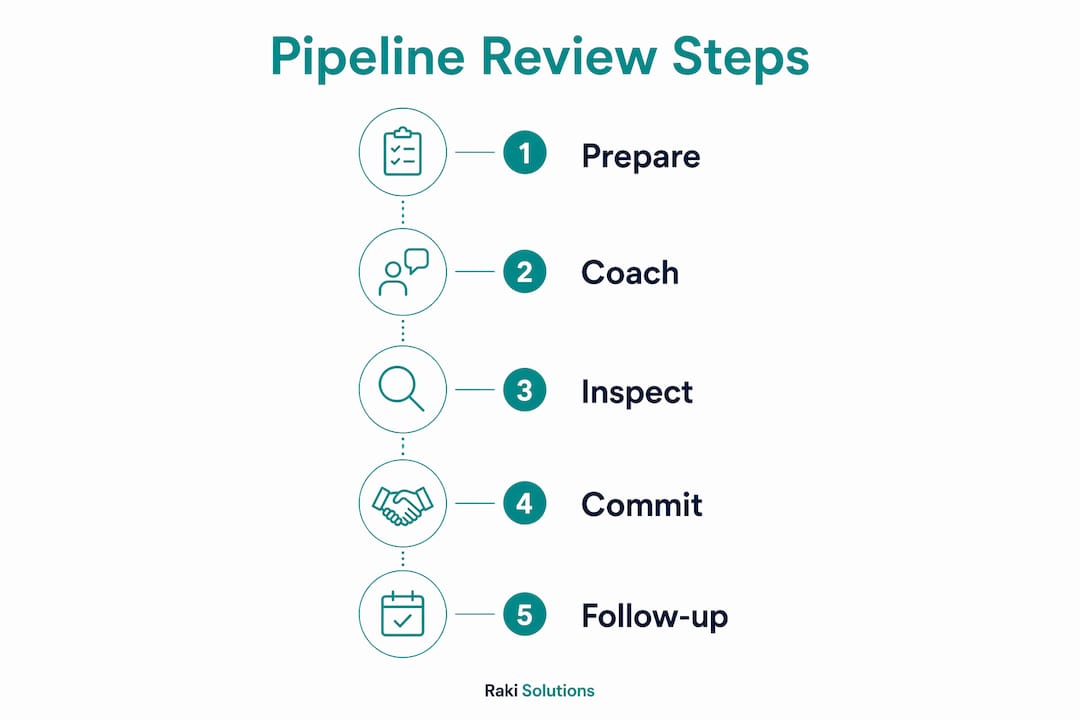
What are the manager and rep roles, and how do you handle missed commits?
Clarity about who owns what is what separates a review that produces accountability from one that produces anxiety.
Manager responsibilities
The manager's job in the review is to coach, not to interrogate. That means arriving with prepared questions, not blank curiosity. During the meeting, the manager listens for what the rep is not saying: the deal where the buyer has gone quiet but the rep is still optimistic, the close date that has slipped twice with no explanation. After the meeting, the manager owns escalation: if a deal needs executive involvement, a pricing exception, or a legal review, the manager initiates it.
Framing matters enormously here. Asking "what is blocking this deal?" instead of "what are you committing?" shifts the dynamic from defensive forecasting to collaborative problem-solving. Reps who feel interrogated stop sharing bad news early, which is the worst possible outcome for forecast accuracy.
Rep responsibilities
Reps own data hygiene, full stop. If the CRM does not reflect reality, the review cannot produce good decisions. Reps also own buyer-committed actions: every deal they present should have a specific next step the buyer has agreed to, not a next step the rep plans to take.
The missed-commit protocol
When a rep calls a deal as a commit and it does not close, the first response is diagnostic, not punitive. Ask: Was the buyer's commitment genuine, or was it rep optimism? Was there a blocker the rep knew about but did not surface? Did the rep have the right support?
If the same deal misses a commit twice, escalate: bring in a second voice (manager, solutions engineer, or executive sponsor) and run a structured deal review. If a rep misses commits across multiple deals in the same period, that is a forecasting skill gap, not a deal problem. Address it in a separate coaching session, not in the pipeline review itself.
Pro Tip: Keep a simple missed-commit log in your CRM. After four weeks, the pattern tells you whether the problem is deal-level (specific accounts), rep-level (one person's forecasting), or process-level (your stage definitions are too loose).
How do CRM hygiene and automation make weekly reviews faster?
The five fields reps update before every meeting are not arbitrary. Each one serves a specific function in the review.
The five must-update fields and why they matter:
- Stage: Tells the manager where the deal sits in the buyer's decision process, not the rep's wishful thinking
- Close date: The single most-manipulated field in any CRM; keeping it honest is what makes coverage ratios meaningful
- Next buyer action: If this field is blank or overdue, the deal is stalled by definition
- Last meaningful buyer action: Distinguishes real engagement from rep-generated activity
- Forecast category: The commit/best-case/pipeline split is what feeds the weekly forecast roll-up
Beyond field discipline, a few lightweight automations make a real difference for busy teams. Deal health scoring (available natively in Salesforce, HubSpot, and Pipedrive, or via CRM integration tools) flags deals that have not progressed in 14 days without the manager having to hunt for them. Required field gating prevents a deal from advancing to the next stage unless the exit criteria fields are populated. A pre-meeting export of the at-risk list, triggered automatically 24 hours before the scheduled review, removes the manual step of building the list from scratch each week.
A few practical rules for keeping CRM data clean without making it a burden: use buyer-action fields rather than activity fields (calls logged ≠ buyer engaged), avoid ambiguous stage names like "Negotiation" that different reps interpret differently, and never let a rep push a close date without logging the reason. That last rule alone cuts forecast variance significantly. For teams exploring lead generation automation to feed the top of the pipeline, clean CRM data downstream is what makes that investment pay off.
How do you define stage exit criteria and apply the 14-day rule?
Stage exit criteria are the observable, buyer-confirmed conditions that must be true before a deal moves forward. Without them, stage advancement is a rep's opinion, not a fact.
Writing exit criteria for common stages
Qualification: Buyer has confirmed budget authority, a specific business problem, and a decision timeline. Rep has spoken to at least one economic buyer, not just a champion.
Evaluation: Buyer has completed a demo or proof of concept and provided written feedback. A mutual action plan exists with dates the buyer has agreed to.
Contract: Legal review has started on the buyer's side. A named decision-maker has confirmed the intent to proceed pending final terms.
Close: Signed agreement received, or verbal commitment from the economic buyer with a specific signature date confirmed in writing.
The 14-day progression rule
Any deal where the buyer has not taken a committed action in 14 days is stalled. Deals silent for more than 14 days close at a materially lower rate; the rule forces a decision rather than letting deals drift.
The decision flow is simple: if the rep can identify a specific, scheduled buyer action in the next 7 days, the deal stays at its current stage and gets a rescue plan. If no such action exists, the deal gets downgraded one stage. If it has been downgraded before and the buyer is still unresponsive, archive it and move on.
Where to focus coaching energy
Middle-of-the-pack deals are where coaching produces the highest return. A deal that is 60% likely to close with no intervention and 80% likely with one targeted action is worth 20 minutes of focused coaching. A deal that is 95% likely to close needs no coaching. A deal that is 10% likely to close and has been silent for 30 days needs to be archived, not discussed.
Which metrics should you track in weekly reviews?
The metrics below are the minimum set needed to turn weekly decisions into a reliable forecast. Track them consistently and the forecast variance number will tell you whether the review discipline is working.
Core metrics:
- Pipeline coverage ratio: Total pipeline value divided by quota. Target is 3x. Below 2x is a pipeline generation problem, not a closing problem.
- Commits vs. best-case: Count and value of deals in each category. The gap between called commits and actual closes is your forecasting skill gap.
- Stage conversion rates: What percentage of deals advance from each stage to the next. A drop at one stage reveals a process or messaging problem.
- Average deal velocity: Average number of days from opportunity creation to close. Track week-over-week to catch slowdowns early.
- Push rate: Percentage of deals where the close date was moved out from the prior week. A push rate above 20% signals systemic optimism in the pipeline.
- Win rate by deal size: Smaller deals often close at higher rates; mixing them with enterprise deals distorts the overall win rate.
Teams with weekly pipeline velocity tracking achieve ~87% forecast accuracy versus ~52% for irregular trackers.
| Metric | Target | Common Reality |
|---|---|---|
| Pipeline coverage ratio | 3x quota | 2x quota |
| Forecast accuracy | 87% | 52% |
| Push rate | Below 20% | 30% |
| Deal velocity (week-over-week change) | Stable or improving | Slowing in Q3/Q4 |
Simple formulas:
- Coverage ratio: Total pipeline value ÷ remaining quota
- Push rate: (Deals with moved close dates this week ÷ total active deals) × 100
- Forecast variance: (Called commits at start of week − actual closes at end of week) ÷ called commits × 100
Weekly review outputs feed directly into a Friday forecast submission. The manager rolls up rep commits, applies a judgment factor based on historical forecast variance, and submits to leadership. Over time, tracking the delta between called commits and actual closes reveals whether the forecasting problem is a rep skill issue or a stage-definition issue.
How do you document outcomes and follow up after the meeting?
The last five minutes of every review are the most important. That is when decisions become tasks, and tasks become accountability.
- During the final 5 minutes: The manager reads back every decision made in the meeting: deal name, action required, owner, and due date. The rep confirms or corrects. Nothing leaves the room as a vague intention.
- Immediately after the meeting: Every action item gets logged as a CRM task with a due date and an owner. If your CRM does not support task creation from meeting notes, a shared spreadsheet with columns for deal, action, owner, and due date works fine. The format matters less than the habit.
- Midweek check-in (Wednesday): A 5-minute async check-in via Slack, Teams, or email. Manager asks: "Any actions from Monday's review that are blocked?" This is not a second meeting. It is a pulse check.
- Friday forecast verification: Manager reviews which actions were completed, updates the forecast roll-up, and flags any missed items for next week's opening agenda.
- Missed-commit escalation: If the same action item appears on the agenda two weeks in a row without progress, it triggers a formal deal review. The manager documents the root cause (buyer-side, rep-side, or resource gap) and assigns a specific escalation step.
Common failure modes to watch for: Actions assigned to "the team" rather than a named person never get done. Due dates of "ASAP" are not due dates. CRM tasks created but never reviewed become digital clutter. The fix for all three is the same: name, action, date, period.
What are the most common pipeline review mistakes, and how do you fix them?
Mistake 1: Running a status meeting instead of an intervention session. The signal is that the manager leaves with a better mental model but no new decisions. The fix is the four coaching questions. If the meeting does not produce at least three named actions with owners, it was a status meeting.
Mistake 2: Reviewing every deal. A 30-minute review covering 15 deals produces 2 minutes per deal, which is enough for a status update and nothing else. Pick 5–7 deals maximum. Use the at-risk list and the 14-day rule to select them.
Mistake 3: Poor CRM hygiene tolerated in the meeting. If a rep presents a deal with a blank "next buyer action" field, the manager's instinct is often to ask about it live and move on. The better response: "Update the field now and we'll come back to this deal." One or two instances of this and reps update their fields before the meeting.
Mistake 4: Blaming reps for missed commits. Blame produces defensiveness, and defensiveness produces sandbagging. Reps who sandbag give you a pessimistic forecast that is just as useless as an optimistic one. The weekly review as a ritual works best when it balances accountability with genuine coaching.
Mistake 5: Inconsistent cadence. Skipping a week because the quarter is busy is exactly when you should not skip. The deals that need attention are the ones that will miss if you do not intervene. Run the meeting even if it is 20 minutes and covers only commits.
Signals that the review is failing: Meeting length creeping past 45 minutes, no change in forecast variance over four weeks, the same missed commits appearing week after week without a root-cause conversation. If you see two of these three, the format needs a reset, not just a reminder to prep better.
Copyable templates and checklists you can use this week
30-minute agenda (copy into your calendar invite)
Weekly Pipeline Review — [Rep Name]
Duration: 30 minutes

0–2 min:   Pipeline health snapshot (coverage ratio, week-over-week)
2–12 min:  Commits review (four coaching questions per deal)
12–22 min: Best-case + at-risk deals (60-second rep summary, manager coaches)
22–28 min: Actions (owner, action, due date for each decision)
28–30 min: Manager closes with one pattern observation
Pre-meeting checklist (rep)
- Stage updated for all active deals
- Close date reflects buyer's stated timeline
- Next buyer action field populated with a specific action and date
- Last meaningful buyer action recorded
- Forecast category set (commit / best-case / pipeline)
- At-risk list submitted to manager 24 hours before the meeting
24-hour pre-meeting email (manager sends to rep)
Post-meeting summary (manager logs in CRM or shared doc)
Adapting for different team sizes: For a team of 8+ reps, run individual one-on-ones for deal-level coaching and a separate 30-minute group review for pattern-level discussion using 2–3 anonymized deals. For short-cycle industries (SaaS trials, transactional B2B), compress the agenda to 20 minutes and focus exclusively on commits and stuck deals. For long-cycle enterprise selling, extend the best-case section to 15 minutes and add a mutual action plan review for each deal.
Why does the weekly cadence compound, and what does research show?
The compounding effect is the most underappreciated aspect of this discipline. A single well-run review produces a handful of good decisions. Twelve consecutive well-run reviews produce a fundamentally different pipeline: cleaner data, more accurate forecasts, and reps who surface problems early because they know help is coming.
Skipping a week does not just delay one set of decisions. It breaks the habit loop for both manager and rep. Reps stop updating CRM fields because they know no one will check. Managers lose the pattern recognition that comes from seeing the same pipeline week over week. Rebuilding that momentum takes multiple cycles, not just one good meeting.
The coaching reframe is equally important. Shifting from "what are you committing?" to "what is blocking this deal?" changes what reps share. A rep who feels interrogated will protect their number. A rep who feels coached will tell you about the procurement delay before it becomes a missed quarter. That early warning is what makes the forecast accurate.
| Metric | Before consistent cadence | After 8+ weeks of weekly reviews |
|---|---|---|
| Forecast accuracy | 52% | 87% |
| Forecast variance | High (30% push rate) | Reduced (target below 20%) |
| Deal velocity | Slowing or unpredictable | Stable or improving week-over-week |
The practical test for any team starting this discipline: run it for four weeks and measure two things. First, forecast variance (called commits vs. actual closes). Second, push rate. If both improve, the cadence is working. If neither moves, the problem is upstream: either the CRM data is too dirty to produce reliable signals, or the coaching questions are still producing status updates instead of decisions.
Key Takeaways
A consistent, coaching-focused weekly pipeline review improves forecast accuracy, increases deal velocity, and gives managers the early-warning system needed to close the quarter on target.
| Point | Details |
|---|---|
| Timebox every review | Keep one-on-ones to 20–30 minutes and team reviews to 30–45 minutes; length creep signals drift into storytelling. |
| Pre-work is non-negotiable | Reps submit five updated CRM fields and an at-risk list 24 hours before; managers arrive with prepared coaching questions. |
| Use the four coaching questions | Replace status updates with: what changed, buyer's next committed action, what's blocking the deal, and what help is needed. |
| Apply the 14-day rule | Any deal with no buyer-committed action in 14 days gets flagged for rescue, downgrade, or archive — decided in the meeting. |
| Raki Solutions for pipeline support | For B2B teams expanding into APAC and ANZ, Raki Solutions delivers a dedicated SDR team and weekly pipeline reporting so internal managers can focus on closing, not prospecting. |
The pipeline review discipline most teams skip
Most sales managers know they should run weekly pipeline reviews. Few run them the way this guide describes. The gap is almost never knowledge. It is the willingness to enforce pre-work, hold the timebox, and have the uncomfortable conversation when a commit is not actually a commit.
The hardest part is not the agenda or the CRM fields. It is the cultural shift from "let's see where we are" to "let's decide what happens next." That shift requires a manager who arrives prepared, asks buyer-focused questions, and treats a missed commit as a diagnostic problem rather than a performance failure. When that culture takes hold, reps start surfacing problems early, forecasts become reliable, and the pipeline review stops feeling like a chore.
For teams expanding into APAC and ANZ markets, the stakes are higher. Deal cycles are longer, buyer relationships are harder to read from a distance, and the cost of a stalled deal is amplified by time zone gaps and limited face time. A disciplined weekly review cadence is not just good practice in that context. It is the difference between a pipeline that reflects reality and one that reflects hope.
Consistent qualified meetings without the pipeline maintenance overhead
Running a tight weekly pipeline review is one half of the equation. The other half is making sure the pipeline has enough qualified deals to review in the first place. For B2B teams targeting APAC and ANZ markets, that is often where the bottleneck sits: not in closing, but in generating enough qualified meetings to keep the pipeline at 3x coverage.
Raki Solutions removes that bottleneck with a dedicated SDR-as-a-Service model built specifically for APAC and ANZ expansion. Instead of your internal team splitting time between prospecting and closing, a dedicated outbound team handles target account research, decision-maker sourcing, and multi-channel outreach across email, LinkedIn, and calls. The result is a steady flow of qualified meetings delivered to your calendar, with weekly reporting that feeds directly into your pipeline review. No long ramp time, no internal hiring overhead, and guaranteed meeting targets built into the engagement.
If your weekly reviews are consistently surfacing a coverage gap rather than a closing problem, that is the signal to bring in dedicated pipeline support. See how Raki Solutions works and book a conversation about what qualified meeting volume looks like for your market.
Useful sources and tools for deeper practice
Weekly Pipeline Inspection Cadence: The Review That Actually Moves Deals — The most detailed practitioner guide on running an inspection-focused cadence. Covers the compounding effect, coaching question frameworks, and how to measure forecast variance improvement.
Make Sales Pipeline Review Meetings Productive — Salesforce's guidance on shifting from status meetings to intervention sessions. Useful for teams using Salesforce CRM who want to align their review format with their tool.
Weekly Revenue Review Template — A free downloadable template with pipeline velocity tracking built in. The source for the 87% vs. 52% forecast accuracy comparison cited in this guide.
Running a Weekly Pipeline Review That Doesn't Waste an Hour — Covers the five must-update CRM fields, the 14-day rule, and how to standardize commit vs. best-case definitions. Practical and concise.
Pipeline Analytics: How to See What's Really Happening in Your Funnel — A data-driven complement to this guide. Covers stage distribution analysis, velocity analysis, and risk scoring for teams that want to move beyond gut-feel reviews.
Raki Solutions — For B2B teams in Australia expanding into APAC and ANZ who need a dedicated outbound function to keep the pipeline full between weekly reviews.