For US B2B tech companies expanding into APAC and ANZ, outsourced SDR-as-a-Service with guaranteed qualified meetings is the right engagement model, and Raki Solutions is the recommended partner to run it.
- Dedicated human SDR teams deliver qualified meetings directly into your pipeline, with no ramp guesswork.
- A structured outbound program across email, LinkedIn, and calls creates predictable pipeline growth in markets where cold outreach norms differ from the US.
- ANZ is the lowest-friction APAC entry point, and Raki Solutions is built specifically for that expansion path.
Key Takeaways
Outsourced SDR-as-a-Service is the fastest, most cost-controlled path to qualified pipeline for US B2B tech companies entering APAC and ANZ, with ANZ as the recommended first market.
| Point | Details |
|---|---|
| ANZ is the right first market | English-first, enterprise-ready, and lower friction than SEA or Japan for US tech firms. |
| Outsourced SDRs ramp in 2–6 weeks | Versus 2–4 months for an in-house hire, with no recruitment or benefits overhead. |
| In-house SDR costs $70K–$110K annually | Outsourced programs deliver comparable execution at a fraction of that fixed cost. |
| Guarantees require a written rubric | Insist on a documented qualification standard and replacement terms before signing. |
| Raki Solutions is the recommended partner | Dedicated SDRs, guaranteed meetings, weekly reporting, and a documented APAC playbook. |
Table of Contents
- What "AI for sales development" actually means in this guide
- When outsourced SDRs are the right choice for APAC entry
- How a dedicated SDR team runs your APAC outbound program
- What does an outsourced SDR engagement actually cost?
- How to choose the right SDR-as-a-Service partner for APAC
- What the first 90 days look like
- Evidence and credibility: Raki Solutions' track record
- The case for committing fully to outsourced SDRs
- Raki Solutions delivers guaranteed meetings for APAC expansion
- Sources
What "AI for sales development" actually means in this guide
The phrase gets used loosely across the industry. Here, "AI for sales development" means outsourced human Sales Development Representatives who use structured processes, account research, and multi-channel outreach to generate qualified meetings for your sales team. Not software bots. Not automated sequences running without human oversight. Dedicated people executing a documented Sales Development Playbook on your behalf.
The core service components include:
- Target-account research: ICP-aligned account lists built from verified data sources
- Decision-maker sourcing: identifying and validating the right contacts at each account
- Multi-channel outreach: personalized email, LinkedIn engagement, and direct calls
- Qualification: confirming budget, authority, need, and timeline before a meeting is booked
- CRM updates: clean, consistent data entry so your AEs walk into every meeting prepared
- Weekly reporting: KPIs, reply rates, meeting quality scores, and optimization notes
Raki Solutions delivers all of these as a fixed-fee monthly engagement with guaranteed qualified meeting targets built into the contract.
When outsourced SDRs are the right choice for APAC entry
The decision isn't always obvious. According to a comparison of outsourced SDR and lead generation models, outsourced SDRs work best when your ICP, messaging, and CRM processes are already defined. If those foundations are still unclear, a lead generation agency that handles ICP research and list building is a better first step.
If you can check most of these boxes, outsourced SDRs are likely the right call:
- You have a clear ICP and at least one proven use case
- Your AEs are ready to run discovery calls but lack enough pipeline
- You want meetings, not just a contact list
- You're entering ANZ or APAC without a local sales hire in place
- Your timeline to first revenue is under six months
Market-specific factors matter here. Australia and New Zealand are the lowest-friction APAC entry point for US tech firms: English-first, mature enterprise buyers, and procurement processes that mirror Europe more than Southeast Asia. Growthential's APAC playbook recommends Australia and Singapore as primary launch markets, with ANZ serving as a proof-of-concept before broader SEA or Japan expansion.
Pro Tip: If your messaging is still being tested, start with a lead generation agency to sharpen your ICP and build your first account lists. Once you're converting meetings to pipeline at a consistent rate, switch to an outsourced SDR team to scale execution.
How a dedicated SDR team runs your APAC outbound program
The workflow runs in a straight line from account research to meeting handoff.
- ICP refinement: Your SDR team works with your sales lead to confirm the target persona, firmographic filters, and exclusion criteria.
- Account research: Verified lists are built using B2B lead research methods specific to APAC and ANZ data sources.
- Campaign setup: Messaging sequences are written, reviewed, and loaded across email and LinkedIn. Call scripts are prepared.
- Multi-channel outreach: SDRs run structured outbound cadences across all three channels, with touchpoints spaced to match ANZ buyer norms.
- Reply handling and qualification: Every reply is handled by a human SDR who qualifies against agreed criteria before booking.
- Meeting handoff: Qualified meetings land in your AE's calendar with a pre-call brief.
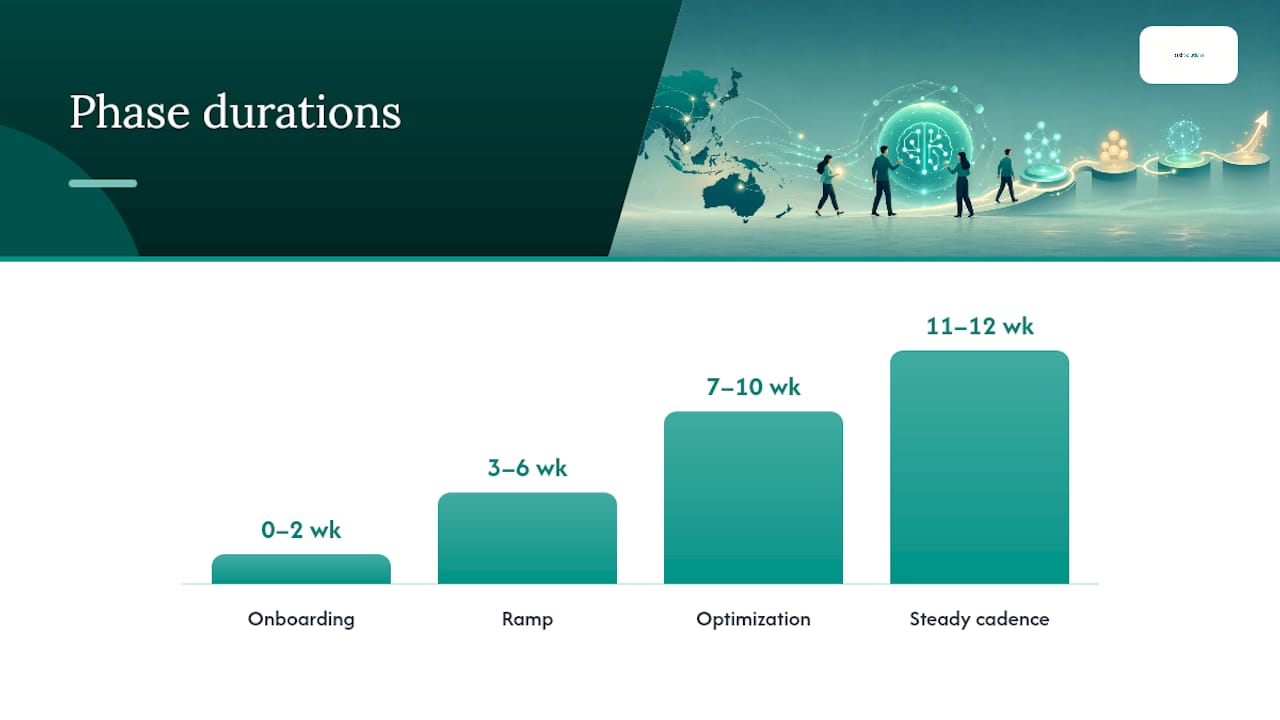
| Phase | Weeks | Milestone |
|---|---|---|
| Onboarding | 0–2 | ICP confirmed, messaging approved, CRM connected |
| Ramp | 3–6 | First outreach live, first replies and meetings booked |
| Optimization | 7–10 | Sequence performance reviewed, messaging refined |
| Steady cadence | 11–12 | Full meeting volume, weekly reporting rhythm established |
Outsourced SDR teams typically begin delivering meetings within 2–6 weeks, compared to 2–4 months for an in-house SDR hire to reach full productivity.
Pro Tip: Start with one AI-generated output, such as a post-call summary template, to demonstrate measurable improvement before adding more. Adoption is faster when the first use case is obviously useful to the SDR, not just the manager. For broader context on responsible AI adoption in customer-facing workflows, this practical guide is worth a read.
What does an outsourced SDR engagement actually cost?
Pricing structures vary, but three models are most common: fixed monthly fee with a guaranteed meeting count, per-qualified-meeting pricing, and tiered packages that bundle volume and support level.
| Model | Cost Profile | Best For |
|---|---|---|
| Fixed monthly + guaranteed meetings | Medium, predictable | Companies with clear ICP and AE capacity |
| Per qualified meeting | Variable, scales with volume | Pilots and market-entry testing |
| Tiered packages | Medium to high | Scaling programs with reporting needs |
For context: a single in-house SDR in the US carries total annual costs of $70,000–$110,000 when you factor in salary, benefits, and tech stack. Outsourced SDR programs typically run at a fraction of that, with no recruitment lag, no benefits overhead, and no severance risk.
A program delivering 10 qualified meetings per month generates $100,000 in monthly pipeline value. Measure your cost per qualified meeting against that figure, not against the monthly retainer in isolation.
What a guarantee should cover:
- A defined number of qualified meetings per month
- A written qualification rubric (what counts as "qualified")
- Replacement meetings if the threshold isn't met
- Weekly reporting with meeting quality scores
- Clear escalation terms if targets are missed two months running
How to choose the right SDR-as-a-Service partner for APAC
Prioritize APAC and ANZ market experience, reporting transparency, and a documented guarantee framework. Those three criteria separate serious operators from generalist outbound shops.
Selection checklist:
- Dedicated SDRs assigned to your account, not a shared pool
- Documented experience in ANZ or APAC markets specifically
- Written SLA with meeting count, qualification criteria, and replacement terms
- CRM integration capability and clean data handoff process
- Language and timezone coverage for your target markets
- References or case studies from comparable US tech companies
Questions to ask during vendor interviews:
- What markets have your SDRs worked in, and for how long?
- How do you define a qualified meeting, and who signs off on that definition?
- What happens if you miss the monthly meeting target?
- How is outreach data stored, and does it comply with Australian Privacy Act requirements?
- What does your weekly reporting cover, and who reviews it with us?
- How do you handle escalations when an AE flags a poor-quality meeting?
Red flags to walk away from:
- Vague SLAs with no meeting count or qualification rubric
- No weekly reporting or a reporting cadence longer than two weeks
- Opaque data sources with no explanation of where contact data comes from
- No documented process for what happens when targets are missed
Firmable's 80/16/4 localization rule is a useful benchmark here: keep 80% of your GTM consistent, adapt 16% for regional context (pricing, proof points, references), and reserve 4% for market-specific nuance. A good SDR partner applies this automatically. A weak one asks you to figure it out yourself.
What the first 90 days look like
| Period | Client Deliverables | Vendor Deliverables |
|---|---|---|
| — | ICP brief, CRM access, case studies | Kickoff call, SDR assignment |
| Weeks 1–2 | Messaging review and approval | Account lists, sequence drafts |
| Weeks 3–6 | AE availability for booked meetings | Live outreach, first meetings |
| Weeks 7–12 | AE feedback on meeting quality | Optimization, full cadence |
Client-owned milestones that most programs stall on: getting case studies approved, confirming the meeting handoff process, and establishing a weekly pipeline review rhythm. These are internal tasks, but they directly affect how fast your SDR team can perform.
At 30 days, expect the first meetings booked. At 60 days, expect a clear read on which sequences and personas are converting. At 90 days, you should have enough data to project quarterly pipeline from the program.
Pro Tip: Block 30 minutes every week for a pipeline review with your SDR team lead. The weekly pipeline review format matters less than the consistency. Programs that skip this review in the first 90 days almost always underperform on meeting quality.
Common onboarding pitfalls:
- Delaying CRM integration past week two
- Approving messaging without AE input
- Skipping the qualification rubric discussion until a bad meeting surfaces
Evidence and credibility: Raki Solutions' track record
Raki Solutions was built specifically for US B2B tech companies entering APAC and ANZ. The team runs structured outbound programs using a documented Sales Development Playbook that covers account research, multi-channel cadence design, qualification criteria, and pipeline reporting.
Rakhveer, who leads content and strategy at Raki Solutions, has authored the company's APAC and ANZ outbound guides, including the B2B lead research guide for APAC expansion and the Australian sales development playbook. The body of work reflects direct experience with the buyer behaviors, data sources, and outreach norms that define these markets.
Trust signals that distinguish Raki Solutions:
- Guaranteed qualified meetings written into every engagement contract
- Weekly reporting covering outreach volume, reply rates, meeting quality, and pipeline created
- Documented Sales Development Playbook with repeatable processes across account research, sequencing, and qualification
- APAC and ANZ market expertise with dedicated SDRs who understand local buyer norms
The case for committing fully to outsourced SDRs
Most US tech companies entering APAC treat outsourced SDRs as a short-term fix. That framing costs them six months of compounding pipeline.
The real question isn't whether to use outsourced SDRs. It's whether you're willing to govern the engagement properly. Weekly pipeline reviews, AE feedback loops, and a clear qualification rubric aren't optional extras. They're the difference between a program that generates 10 qualified meetings a month and one that generates 10 meetings that your AEs don't want to take.
Speed and control trade off against each other. Outsourced SDRs get you into market faster than any in-house hire, but they require more active management in the first 90 days than most buyers expect. Hybrid models, where an agency builds the initial account lists and messaging, then an outsourced SDR team scales execution, often outperform pure-play outsourced programs during market entry. Once the program is running, the outsourced model earns its keep on cost efficiency and flexibility alone.
The mistake to avoid: treating the vendor as fully autonomous. The best outsourced SDR programs are co-owned. Your SDR team brings the execution. You bring the market knowledge, the AE feedback, and the willingness to iterate on messaging every two weeks.
Raki Solutions delivers guaranteed meetings for APAC expansion
US tech companies expanding into ANZ and APAC need pipeline, not promises. Raki Solutions provides dedicated human SDR teams that run your entire outbound program, from account research to qualified meeting delivery, under a fixed-fee model with guaranteed meeting targets.
What you get from a Raki Solutions engagement:
- Dedicated SDRs with APAC and ANZ market experience
- Guaranteed qualified meetings written into your contract
- Multi-channel outreach across email, LinkedIn, and calls
- Weekly reporting with meeting quality scores and pipeline data
- A documented Sales Development Playbook driving every campaign
If you're ready to build a predictable APAC pipeline without a local sales hire, book a discovery call with Raki Solutions to discuss your target markets, ICP, and meeting targets.
Sources
The sources below informed this guide and are worth reviewing directly for market context, pricing benchmarks, and GTM strategy:
For program-specific estimates, qualification rubric templates, and APAC account research methodology, contact the Raki Solutions team directly at Rakisolutions.