For B2B teams expanding into APAC and ANZ through an outsourced SDR motion, the right call is a high-confidence intent data feed integrated into your CRM and paired with a dedicated SDR execution partner. Full ABM platforms are powerful but slow to deploy. A feed gets you to first contact in days, not months.
Your shortlist breaks down into three categories:
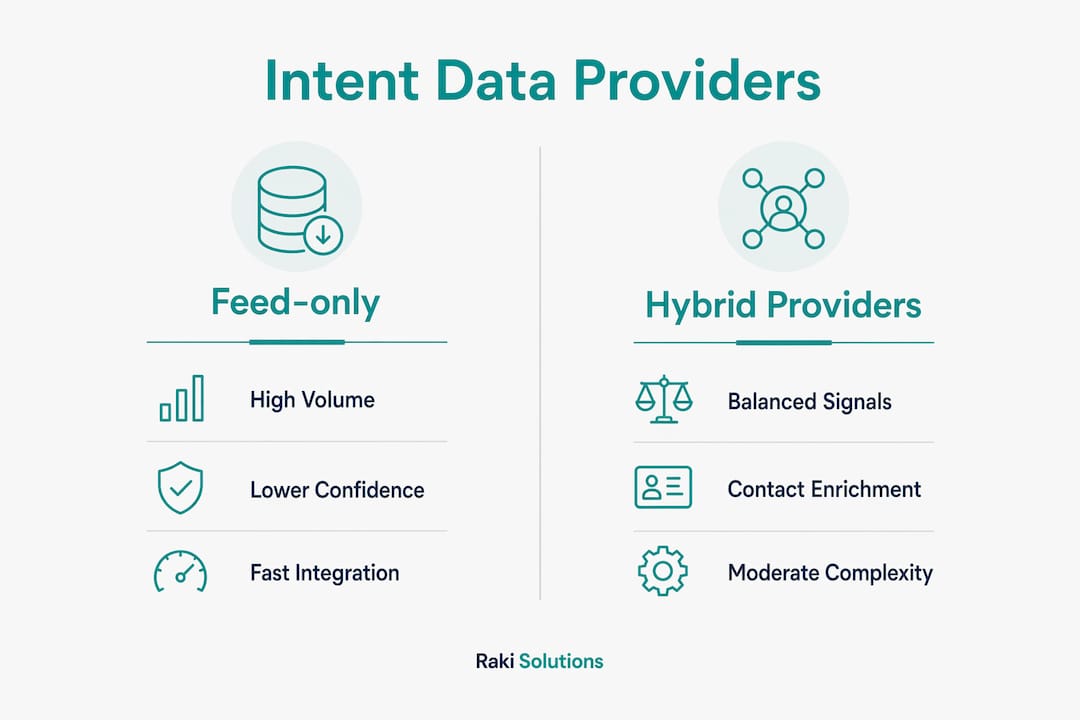
- Intent-only feeds (e.g., Bombora-style): account-level surge signals from publisher co-ops, portable across your existing stack. Fast to integrate, but you'll need enrichment and an SDR team to act on them.
- Hybrid providers (e.g., Cognism-style): intent signals bundled with contact enrichment. Reduces friction between signal and outreach, which matters when your SDR team is external.
- Full ABM platforms (e.g., 6sense-style): predictive scoring, web deanonymization, and cross-channel orchestration. Best for enterprise teams with RevOps capacity. Overkill for most APAC pilots.
Buyer intent data raises outbound efficiency when correctly operationalized by sales teams. The critical word is "operationalized." A signal sitting in a dashboard does nothing. It needs an SDR to act on it.
Table of Contents
- Which intent data providers fit an outsourced SDR program?
- How do you match provider type to your team's outbound maturity?
- How do you judge signal quality before committing to a provider?
- Raki Solutions turns intent signals into booked APAC meetings
- Key Takeaways
Which intent data providers fit an outsourced SDR program?
| Provider Type | Best For | Signal Type & Source | Signal Confidence vs. Volume | Integrations | Contact Enrichment | APAC/ANZ Coverage | Pricing Model |
|---|---|---|---|---|---|---|---|
| Bombora-style intent feed | Teams with existing ABM/CRM stack and RevOps capacity | Third-party publisher co-op (thousands of topics) | High volume, moderate confidence | Salesforce, HubSpot, Marketo, Outreach | Not native — requires enrichment partner | Moderate; ask for regional sample exports | Data feed subscription |
| Cognism-style hybrid provider | SDR teams wanting intent + enrichment in one subscription | Third-party signals + curated contact data | Moderate volume, higher usable confidence | CRM + sales engagement tools | Native contact enrichment included | Moderate; verify ANZ depth | Per-seat subscription |
| 6sense-style ABM/revenue platform | Enterprise teams with RevOps, ad spend, and orchestration needs | First-party web deanonymization + third-party + review sites | Lower volume, highest predictive confidence | Native CRM, MAP, DSP integrations | Account + limited contact resolution | Strong global; verify APAC depth | Platform seats + ad spend |

A few things worth noting for outsourced SDR programs specifically. First, many intent providers don't supply contact-level resolution natively, which means account-level signals need an enrichment step before your SDR team can dial or sequence anyone. Second, data feeds integrate in days while comprehensive ABM platforms often take months to configure. For a short APAC pilot, that timeline difference is decisive.
How do you match provider type to your team's outbound maturity?
The honest answer: most teams buying intent data for the first time overestimate their readiness for a full ABM platform. Here's a cleaner way to think about it.
Maturity map
Early-stage outbound (no ABM, no RevOps, CRM is partially clean): Start with an intent-only feed or a hybrid provider. You need signals you can act on immediately, not a platform that requires six weeks of configuration. A Bombora-style feed plugged into Salesforce or HubSpot, paired with a contact enrichment tool like Apollo or Clearbit, gets you to outreach within a week.
Scaling outbound (some RevOps, CRM routing rules in place, engagement tool active): A hybrid provider makes sense here. You get intent and enrichment in one subscription, which cuts the integration work your outsourced SDR team would otherwise spend on manual list-building.
Enterprise ABM (dedicated RevOps, programmatic ad spend, multi-channel orchestration): A 6sense-style platform earns its cost. Predictive buying-stage models and native orchestration justify the configuration time when you have the team to run it.
Before you buy: a pre-purchase checklist
- CRM is clean and segmented by ICP (garbage in, garbage out with intent signals)
- Contact enrichment tool or vendor is already contracted
- Sales engagement platform (Outreach, Salesloft, Apollo) is live and sequenced
- KPIs are defined: meetings per 100 targeted accounts, not raw lead volume
- APAC/ANZ ICP accounts are mapped and loaded as a named account list
Questions to ask vendors during demos
- What is your source breakdown for APAC and ANZ signals specifically? Can you show a sample export?
- How frequently is the data refreshed, and what's the SLA for signal latency?
- Does your topic taxonomy cover the categories my buyers research, or do I need to build custom topics?
- What does integration with [our CRM] look like, and how long does it take?
- What contract flexibility do you offer for a 60-day pilot?
- How do you handle CCPA compliance and data processing agreements for US-based buyers?
Intent data providers fall into three primary categories, and the right one depends almost entirely on what you can operationalize, not what looks best in a demo. A common mistake is treating intent data as an automated pipeline generator when it's primarily a prioritization tool that requires disciplined outreach to deliver commercial value.
Pro Tip: Run a 30–60 day proof-of-concept: pick one intent feed, load a moderate number of target accounts into your CRM, hand them to your outsourced SDR team, and measure meetings booked per accounts contacted. That single KPI tells you more than any vendor benchmark.
For implementation, expect days to weeks for a data feed integration and months for a comprehensive ABM platform. Budget your RevOps resources accordingly when calculating total cost of ownership.
How do you judge signal quality before committing to a provider?
Signal confidence beats signal volume for outbound SDR work, especially in APAC and ANZ. Here's why: the region has fewer named accounts in most B2B categories than North America or Europe. A noisy list of 5,000 accounts with weak signals wastes your SDR team's time. A clean list of 300 accounts showing genuine surge activity produces meetings.
"For APAC and ANZ expansion, regional coverage and source transparency matter more than raw global volume. Ask vendors for regional sample exports and source breakdowns before contracting." — Abmatic AI, 6sense vs Bombora Intent Data Comparison
Large third-party co-ops can provide massive breadth across publisher networks, but buyers must ask for sample exports and understand topic taxonomies before signing. Many vendors have thinner APAC/ANZ coverage than their global headline numbers suggest.
Red flags to watch:
- Opaque signal provenance ("proprietary AI" with no source breakdown)
- Guaranteed pipeline claims without contact-level resolution
- No CCPA data processing agreement available on request
- Implementation timelines with no clear milestones or deliverables
- APAC/ANZ coverage claims unsupported by regional sample data
How to run a 4–8 week signal validation pilot
- Define your ICP account list for the target APAC/ANZ market (100–300 named accounts).
- Select 3–5 intent topics that map to your buyers' research behavior, not your product features.
- Pull a sample export from the vendor and check match rate against your named account list.
- Load surging accounts into your CRM and route them to your outsourced SDR team with a dedicated sequence.
- Measure weekly: meetings booked per 100 accounts contacted, lead-to-meeting conversion rate, and enrichment match rate (what percentage of accounts resolved to a contactable decision-maker).
- Iterate on topic taxonomy after week two based on which signals correlated with actual meetings, not just opens or replies.
Running a short proof-of-concept that pairs a data feed with a managed SDR pilot and measures meetings per 100 targeted accounts is the most reliable way to validate a provider before a full contract. For APAC and ANZ outreach channel selection, the channel mix matters as much as the signal quality — LinkedIn performs differently across Singapore, Australia, and Japan.
Intent data alone often becomes shelfware when organizations lack the bandwidth to act on signals. That's the execution gap a managed SDR partner closes. For teams building outbound sales cadences around intent triggers, the cadence structure and timing are as important as the signal itself. Pairing intent with audience-targeted content also improves reply rates when SDRs reference relevant material in their outreach.
Raki Solutions turns intent signals into booked APAC meetings
Choosing the right intent data provider is only half the equation. The other half is having an SDR team that knows what to do with the signal the moment it fires.
Raki Solutions pairs account research, decision-maker sourcing, and multi-channel outreach across email, LinkedIn, and calls to convert intent signals into qualified meetings with guaranteed targets. For APAC and ANZ expansion, that means no ramp time on regional nuance, no internal hiring overhead, and a fixed-fee pilot structure with agreed meeting targets before you commit to a full engagement.
A typical pilot runs 30–60 days: discovery and ICP alignment, target account and topic selection, intent-signal integration into your CRM, SDR outreach launch, and a measurement and scaling plan at the end. You know the cost before you start, and you know the meeting target before the first sequence goes out.
If you're evaluating intent data vendors and want a partner to operationalize the signals, book a pilot conversation with Raki Solutions.
Key Takeaways
Intent data paired with a dedicated SDR execution partner is the fastest path to qualified meetings for B2B teams expanding into APAC and ANZ.
| Point | Details |
|---|---|
| Feed first for fast pilots | Data feeds integrate in days vs. months for ABM platforms — the right choice for 30–60 day APAC pilots. |
| Confidence beats volume | Fewer high-confidence accounts outperform broad noisy lists for SDR efficiency in APAC and ANZ. |
| Enrichment is non-negotiable | Most intent providers deliver account-level signals only; contact enrichment is a required separate step before SDR outreach. |
| Ask for regional samples | APAC/ANZ coverage varies widely — always request a regional sample export and source breakdown before contracting. |
| Raki Solutions closes the execution gap | Raki Solutions converts intent signals into guaranteed qualified meetings through fixed-fee SDR pilots built for APAC and ANZ expansion. |