A 3-channel, signal-informed sequence with video at steps 3 and 4 consistently outperforms single-channel cold email. That is the short answer. Most B2B teams that commit to email, LinkedIn, and phone across 8–10 touches over 2–3 weeks see 2–4x higher reply rates than teams running email alone.
Your three execution paths, in plain terms:
- Build in-house: Best for teams with RevOps bandwidth, existing CRM infrastructure, and 3+ months before pipeline pressure hits. Requires native-execution tooling, not bolt-on integrations.
- Buy an integrated platform: Best for SDR teams of 2–10 reps who need a single tool that handles email, LinkedIn, phone, and video natively with conditional logic. Fastest path to a running sequence.
- Hire an SDR-as-a-Service partner: Best when you need qualified meetings in a new market (especially APAC or ANZ) within 60–90 days and lack local research capability or outreach infrastructure.
The sections below give you a ready-to-run sequence template, a platform evaluation checklist, a measurement plan, and a decision framework for choosing between those three paths.
Key Takeaways
A 3-channel, signal-informed sequence of 8–10 touches over 14 days is the highest-probability path to consistent B2B pipeline, with meetings booked per 100 sequences as the primary metric to optimize.
| Point | Details |
|---|---|
| Use at least 3 channels | Email, LinkedIn, and phone together produce 2–4x higher reply rates than email alone. |
| Run 8–10 touches minimum | Most replies arrive between touch 4 and touch 7; stopping early leaves pipeline on the table. |
| Measure at sequence level | Track meetings booked per 100 sequences, not reply rate by channel, to diagnose what to fix. |
| Hire when speed matters | An SDR-as-a-Service partner reaches first qualified meetings in 30–60 days without hiring overhead. |
| Raki Solutions for APAC/ANZ | Raki provides dedicated SDR teams with local market expertise and guaranteed qualified meeting targets. |
Table of Contents
- What is multi-channel outreach and how does it differ from omnichannel?
- Which channels actually drive B2B replies in 2026?
- A ready-to-run 8-touch sequence template
- How to measure what your sequence is actually doing
- What to look for when evaluating outreach platforms
- Common mistakes that kill reply rates
- When should you hire an SDR partner instead of building in-house?
- The approach that actually works for APAC-focused B2B teams
- Raki Solutions runs the outreach so your team focuses on closing
- Sources
What is multi-channel outreach and how does it differ from omnichannel?
Multi-channel outreach is the practice of coordinating multiple, distinct touches across different channels to the same prospect within a single, planned sequence. Email, LinkedIn, phone, video, and SMS each play a defined role, and the sequence logic determines which channel fires next based on what the prospect did or did not do.
That is not the same as omnichannel marketing. Omnichannel is a customer-experience architecture, built around creating a seamless, consistent experience across every touchpoint a buyer might encounter, from ads to support chat to in-store. Multi-channel outbound is narrower and more tactical: a structured cadence designed to generate a reply or a meeting from a cold or warm prospect.
The distinction matters when you are evaluating tools. An omnichannel platform optimizes for brand consistency and customer journeys. A multi-channel outbound platform needs to execute sequences reliably, respect rate limits, and fire the right channel at the right time without manual intervention.
Native channel execution vs. bolt-on integrations is where most teams get burned. Native execution means the platform controls the action directly, whether sending an email from your connected inbox, triggering a LinkedIn connection request via a browser extension or API, or logging a call from a built-in dialer. Bolt-on integrations rely on Zapier-style webhooks or third-party bridges that can break, delay, or fail silently. When a LinkedIn step fires 48 hours late because a webhook timed out, your sequence loses its timing logic entirely.
Four concepts you will see throughout this article:
- Sequence architecture: the ordered set of touches, channels, and timing rules that define a cadence
- Signal-informed touches: adjusting the next step based on prospect behavior (email open, LinkedIn profile view, website visit)
- Exit criteria: the conditions that remove a prospect from automation (reply, meeting booked, unsubscribe, or explicit opt-out)
- Channel coverage matrix: a map of which channels a platform executes natively vs. through integrations
Forbes notes that layering channels is the natural evolution of outbound marketing, because B2B buyers are harder to reach through any single channel than they were five years ago.
Which channels actually drive B2B replies in 2026?
The core five, ranked by typical B2B impact:
- Email: High volume, low friction, easy to personalize at scale. Best for delivering a clear value proposition with a single call to action. Deliverability is the primary risk; warm-up and domain health matter more than copy in most cases.
- LinkedIn: Trust-building before the cold email lands. A connection request or profile view creates familiarity that lifts email open rates. LinkedIn-first architectures often outperform email-first for B2B because the prospect recognizes the sender's name.
- Phone: Best placed after at least one prior touch has created context. Cold calls with zero prior engagement have low conversion; calls placed after an email open or a LinkedIn interaction convert at a meaningfully higher rate. Use voicemail strategically, not as a default.
- Personalized video: High-impact at steps 3 and 4. Sendspark's vendor data shows video emails generating roughly 3x the replies of equivalent text-only messages. Video works because it signals effort and creates a human connection that text cannot replicate.
- SMS and AI voice: Appropriate only with prior consent or in markets where cold SMS is permitted. Best reserved for late-sequence touches or for prospects who have already engaged. Overuse here damages sender reputation fast.
Channel-specific tactical notes:
- Email subject lines under 7 words outperform longer ones in most B2B tests. Keep the first email under 100 words.
- LinkedIn messages should reference something specific to the prospect's role or recent activity. Generic connection notes get ignored.
- Phone calls work best between 8–9 AM and 4–5 PM in the prospect's local time zone. Leave a voicemail only if you have a specific, relevant reason to call.
- Video personalization does not require recording a unique video for every prospect. Record a 60-second template video, then personalize the thumbnail and the first 5 seconds with the prospect's name and company. Tools like Sendspark and Vidyard support this model.
The rule that matters most: never send the same message across channels. If your LinkedIn message says exactly what your email said, you are not running a multi-channel sequence. You are running one message on two platforms. Each channel should reference the prior touch and add something new.
Pro Tip: Record one core video per ICP segment, then use a personalized thumbnail (prospect's name + company logo on a whiteboard or screen) to make it feel custom. This approach cuts video production time by 80% while preserving the reply-rate lift.
A ready-to-run 8-touch sequence template
The structure below follows a 14-day cadence with pacing adjusted for cold outreach. Two to three business days between early touches; compress to one to two days after any engagement signal.
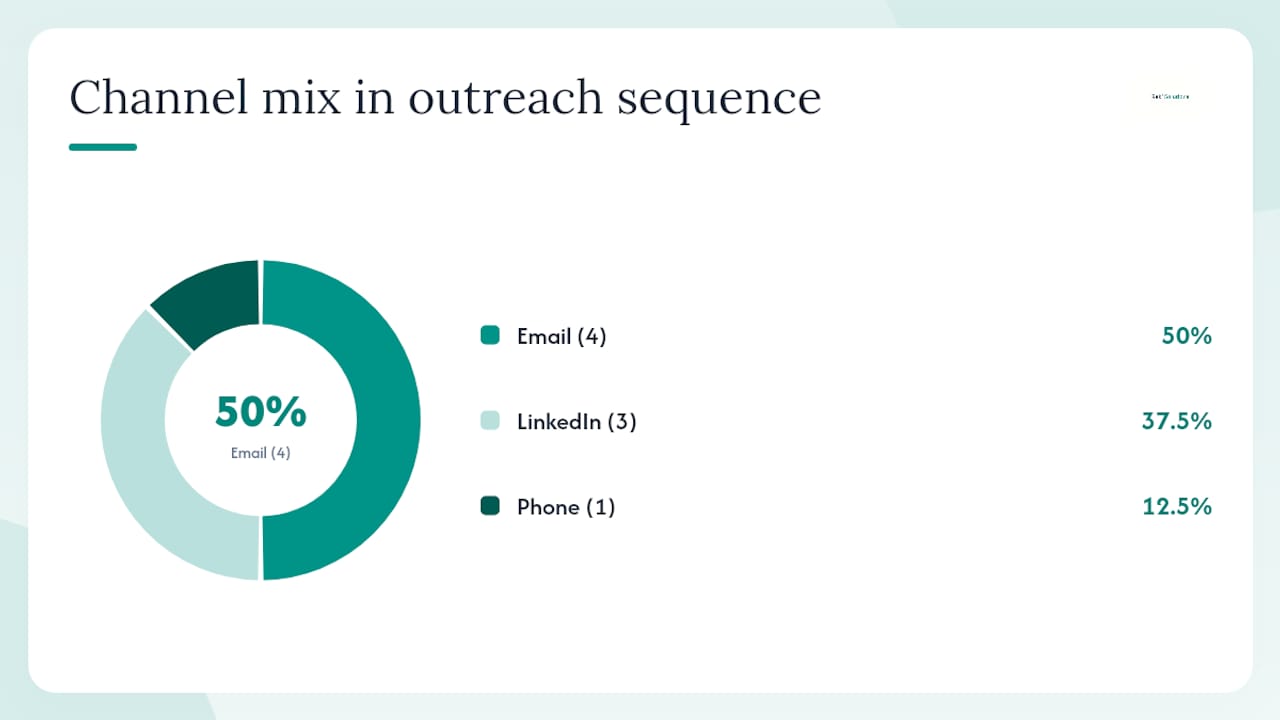
| Day | Channel | Action | Goal |
|---|---|---|---|
| 1 | Send connection request with a brief, relevant note | Create familiarity before email lands | |
| 2 | Send first cold email (short, one CTA, clear value prop) | Establish the ask and open a thread | |
| 4 | Send a direct message if connected; view profile if not | Reinforce recognition, add a new angle | |
| 6 | Follow-up email referencing the first (new angle, not a resend) | Catch prospects who opened but did not reply | |
| 8 | Phone | Call with voicemail referencing email and LinkedIn | Add a human voice; create urgency without pressure |
| 10 | Email + Video | Send a short personalized video embedded in email | Highest-effort touch; designed to break through |
| 12 | Final LinkedIn message with a soft close | Last social touch before sequence ends | |
| 14 | Break-up email ("Should I close your file?") | Prompt a decision; often generates replies from silent prospects |
Pacing rationale: Cold prospects need 2–3 business days between early touches to avoid feeling harassed. Once a prospect opens an email, clicks a link, or views your LinkedIn profile, compress the next touch to 24 hours. That signal means they are paying attention.
For signal-driven acceleration, use intent data or platform engagement signals to identify prospects who are actively researching your category. Move those prospects to a faster, higher-frequency sequence immediately.
Exit criteria: Remove any prospect from the sequence the moment they reply (positive or negative), book a meeting, unsubscribe, or request no further contact. Automated sequences that keep firing after a reply are one of the fastest ways to destroy a relationship before it starts.
Variations by ICP:
- SMB: Compress to 6 touches over 10 days. SMB buyers make faster decisions; a long sequence loses them.
- Mid-market: The 8-touch, 14-day template above fits well. Add a case study link at touch 5.
- Enterprise: Extend to 10–12 touches over 21–28 days. Add a second phone call and a personalized LinkedIn voice note. Enterprise buyers require more social proof and more patience.
For a deeper look at cadence variations by ICP, the outbound sales cadence guide covers alternative structures for different deal sizes and buying cycles.
How to measure what your sequence is actually doing
Measuring at the channel level is a trap. A prospect who ignores your first three emails and replies after a phone call did not convert because of the phone call. They converted because of the sequence. Attribute wins at the sequence level, not the touch level.
The five metrics that matter:
- Sequence-to-meeting rate: Meetings booked divided by sequences started. This is your primary pipeline metric.
- Reply rate by channel: Tracks which channel generated the first response. Useful for diagnosing weak steps, not for attributing the win.
- Meetings booked per 100 sequences: The most comparable benchmark across teams and tools. Aim for 3–8 meetings per 100 sequences depending on ICP and market.
- Touches-to-meeting: How many touches, on average, before a prospect books. Most practitioners report that the majority of replies arrive between touch 4 and touch 7, which means stopping after two touches leaves most of your reply volume untouched.
- Video watch rate: For sequences that include video, track what percentage of recipients watched more than 50% of the video. A low watch rate points to a thumbnail or subject line problem, not a video content problem.
Benchmark: Research and practitioner data consistently cite an average of 8 touches to book a first meeting with a cold B2B prospect. Teams running fewer than 6 touches are statistically unlikely to reach that threshold.
Running a split test: Change one variable at a time. Test sequence A (email-first) against sequence B (LinkedIn-first) with matched prospect lists. Run each for at least 50 sequences before drawing conclusions. The metric to compare is meetings booked per 100 sequences, not reply rate alone, because a high reply rate with no meetings booked is a messaging problem, not a channel problem.
Deliverability metrics belong in your measurement stack too: bounce rate, spam complaint rate, and inbox placement rate. A sequence with a 40% open rate on day one and a 5% open rate on day 14 is a warming signal that your domain reputation is degrading mid-campaign.
What to look for when evaluating outreach platforms
Gartner's sales technology guidance is clear: integrated cross-channel visibility is not optional for reliable sequencing. Platforms that cannot show you the full sequence state for a prospect in a single view will cause coordination failures.
| Feature | What to accept | What to reject |
|---|---|---|
| Email execution | Native send from connected inbox with warm-up | Relay-only sending with no warm-up tooling |
| LinkedIn execution | Native via browser extension or official API | Zapier webhook to a third-party tool |
| Phone/dialer | Built-in dialer with call logging | Manual log-only with no native dial |
| Video | Native embed or direct integration with Sendspark/Vidyard | Copy-paste link with no tracking |
| Conditional logic | If/then branching based on opens, clicks, replies | Linear sequence only, no branching |
| CRM sync | Bi-directional, real-time sync with Salesforce/HubSpot | One-way export on a schedule |
| Deliverability tooling | Built-in warm-up, bounce detection, spam scoring | None; relies entirely on your domain health |
| Reporting | Sequence-level and step-level metrics in one dashboard | Channel-by-channel reports in separate views |
Procurement questions to ask any vendor:
- How does your platform execute LinkedIn steps? Show me the architecture, not the demo.
- What deliverability metrics do you publish from your customer base?
- Can I run a real sequence against 20 of my own prospects during the trial?
That last question is the most important. Gartner's guidance specifically flags sandbox-only demos as insufficient for validating cross-channel orchestration. If a vendor will not let you run a live sequence during a trial, treat that as a red flag.
Pricing model tradeoffs:
- Per-seat: Predictable cost, but incentivizes over-licensing. Works well for stable teams.
- Per-qualified-meeting: Aligns vendor incentives with your outcomes. Watch for how "qualified" is defined in the contract.
- Per-outreach volume: Low entry cost, but scales poorly as you grow. Often the cheapest option that becomes the most expensive.
Vendor lock-in warning signs: proprietary contact data you cannot export, sequence templates stored only in the platform's format, and CRM integrations that require the vendor's middleware to function. Check user reviews on G2 and Capterra for real-world feedback on whether a platform's native capabilities match its marketing claims.
Common mistakes that kill reply rates
Most multi-channel sequences fail for one of five reasons.
Stopping too early is the most common. Two touches and a shrug is not a sequence. The data is consistent: most replies come between touch 4 and touch 7. Quitting at touch 2 means you are doing the work of warming up a prospect and then handing the meeting to whoever follows up next.
Repeating the same pitch across channels signals that you have nothing new to say. Each touch should add a new angle, a new piece of evidence, or a new format. If your LinkedIn message is a copy of your email, delete the LinkedIn message.
Excessive frequency is the opposite problem. Three touches in 24 hours reads as desperation and triggers spam filters. Respect the pacing rules: 2–3 days between early touches, 1–2 days after engagement.
Ignoring deliverability is a slow-burn failure. Most teams notice it only when open rates drop by half. By then, the domain is already flagged. Warm up new sending domains for at least 3–4 weeks before launching a sequence. Monitor bounce rates weekly.
Failing to remove engaged prospects from automation is the most relationship-damaging mistake. A prospect who replied "not right now, try me in Q3" and then receives three more automated emails in the same week will not take your call in Q3.
Best practices that move the needle:
- Use signal-driven calling: call within 4 hours of an email open or a LinkedIn profile view
- Write unique value into every touch; reference the prior channel explicitly ("I sent you a note on LinkedIn last week...")
- Set hard exit criteria in your platform before the sequence launches, not after
- Measure sequence-level outcomes weekly and adjust the weakest step first
- Keep your sending volume per domain under 100 emails per day until warm-up is complete
Pro Tip: Set a weekly calendar reminder to check your domain's spam complaint rate in Google Postmaster Tools or Microsoft SNDS. Catching a spike early, before it compounds, is the single most effective habit for protecting long-term deliverability.
When should you hire an SDR partner instead of building in-house?
The build vs. buy vs. hire decision comes down to four variables: timeline, in-house skill set, target market familiarity, and monthly meeting targets.
Decision checklist:
- Do you need qualified meetings in a new market within 60–90 days? If yes, building in-house is almost certainly too slow.
- Does your team have a dedicated SDR manager, a warmed sending domain, and a tested sequence? If not, a tool purchase alone will not close those gaps.
- Are you expanding into APAC or ANZ, where buyer behavior, time zones, and engagement patterns differ significantly from North American norms? Local expertise compresses ramp time.
- Is your monthly meeting target above what one or two internal SDRs can realistically produce? An SDR-as-a-Service partner scales without the hiring and onboarding overhead.
- Do you have the RevOps bandwidth to build conditional logic, maintain CRM sync, and QA sequences weekly? If not, you are buying a tool you will underuse.
Typical ramp timelines and cost considerations:
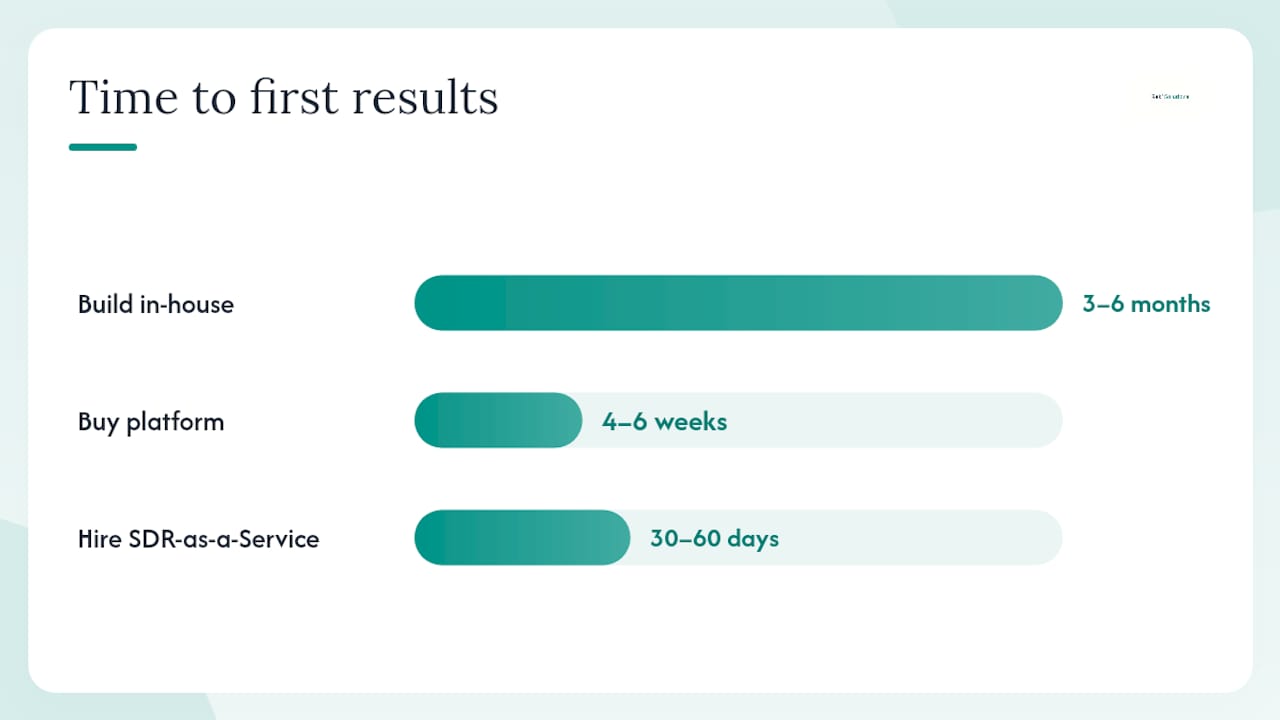
- Build in-house: 3–6 months to first consistent pipeline. Requires tooling ($500–$2,000/month depending on stack), SDR hiring and onboarding (60–90 days), and sequence testing (4–6 weeks). High control, high time cost.
- Buy an integrated platform: 4–6 weeks to a running sequence. Platform costs vary widely by seat count and feature tier. Fastest path if you already have SDRs and a tested ICP.
- Hire an SDR-as-a-Service partner: 30–60 days to first qualified meetings in most engagements. No hiring overhead, no tooling procurement, no sequence QA burden. Cost is typically a fixed monthly fee or a per-qualified-meeting rate.
A typical outsourced engagement looks like this: A B2B technology company expanding into Australia contracts an SDR partner in week one. The partner spends weeks one and two on account research, decision-maker sourcing, and campaign setup. Sequences launch in week three. First qualified meetings typically arrive by week four to six. By month three, the partner has enough data to optimize messaging by vertical and seniority level, and the client's AEs are running discovery calls rather than prospecting.
If you are evaluating SDR partners, include these in your RFP:
- Guaranteed qualified meeting targets per month (and how "qualified" is defined)
- Weekly reporting cadence and what metrics are included
- Sequence ownership: who writes, tests, and optimizes the copy
- Ramp timeline commitment and what happens if targets are missed in month one
- Decision-maker sourcing methodology and data sources used for APAC/ANZ lists
Evaluate early performance at the 30-day mark by looking at sequence launch date, number of sequences started, reply rate, and meetings booked. A partner who cannot show you those four numbers in week five is not running a structured program.
The approach that actually works for APAC-focused B2B teams
Most articles about multi-channel outreach treat it as a universal playbook. It is not. The sequence shape, channel weighting, and timing that work for a North American SaaS company selling to US mid-market buyers do not transfer directly to APAC or ANZ expansion.
LinkedIn penetration, email response norms, and phone etiquette vary meaningfully across Singapore, Australia, Japan, and India. A sequence built without that local context will underperform, not because the multi-channel approach is wrong, but because the channel mix and messaging are calibrated for the wrong market.
The practical default for most teams entering APAC or ANZ: start with a signal-informed, integrated sequence (email + LinkedIn + phone, 8 touches, 14 days), validate the ICP and messaging with a small batch of 50–100 sequences, and then decide whether to scale in-house or bring in an SDR partner with regional expertise.
Speed-to-pipeline matters more than cost optimization in a new market. The cost of a slow ramp, missed quarters, and a poorly calibrated ICP almost always exceeds the cost of an experienced SDR partner who already knows the market.
Raki Solutions runs the outreach so your team focuses on closing
Expanding into APAC or ANZ with a cold outbound program is not a tooling problem. It is a research, execution, and local-expertise problem. Raki Solutions provides dedicated SDR teams that handle the full outbound stack: target account research, decision-maker sourcing, multi-channel sequences across email, LinkedIn, and phone, and weekly optimization based on live performance data.
The difference from buying a platform and running it yourself: Raki's SDRs bring pre-built APAC/ANZ market knowledge, tested messaging frameworks, and a guaranteed qualified meeting model. You do not pay for activity. You pay for meetings with the right people. Engagements typically reach first qualified meetings within 30–60 days of launch, with no hiring overhead and no tooling procurement on your side.
If you are evaluating whether an SDR-as-a-Service engagement fits your pipeline goals, book a discovery call with Raki Solutions to walk through your ICP, target market, and meeting targets. The call takes 30 minutes and ends with a clear picture of what a pilot engagement would look like.
Sources
The sources below back the benchmarks, sequence templates, and platform guidance in this article.
- Multichannel outbound playbook: email, LinkedIn, phone 2026
- Multi-Channel Outreach Strategy: Complete Guide | Sendspark
- Multi-Channel Outreach: Build Sequences That Get 3x Replies
- Multichannel Sales Cadence Template: 14-Day Outbound Sequence | Revenue
- Why Multichannel Outreach Is The Next Phase In Outbound Marketing
- Gartner — sales technology insights
- Why a Multi-Channel Approach to Outbound Sales Is a Must
- Amplemarket reviews on G2