A weekly SDR-delivered report must prove three things: qualified meeting evidence (recording and checklist), pipeline value broken down by stage, and raw CRM-exportable data you can verify yourself. Without all three, you are trusting a vendor's summary instead of auditing their work.
Must-have fields in every weekly report:
- Meeting link or recording URL, plus the qualification checklist used for that specific meeting
- Opportunity name, company, estimated value, and current pipeline stage
- SDR attribution tag so the opportunity traces back to the correct campaign
- Outreach activity totals: touches sent, conversations held, and reply rate
- Show rate for the week (meetings held vs. meetings booked), which typically falls within industry-accepted ranges
Pro Tip: Insist on raw data access from day one. A CRM export or CSV gives you the unfiltered ledger. If a vendor only offers dashboard screenshots, they control what you see.
Table of Contents
- What should your weekly SDR sales report include?
- How do you score an SDR provider's reporting quality?
- What reporting nuances should you expect for APAC and ANZ?
- How do you audit the weekly report in 10–30 minutes?
- What pricing and SLA terms should you negotiate?
- Key Takeaways
- The gap between a report and a decision
- Raki Solutions delivers the weekly report and the proof behind it
- Useful sources
What should your weekly SDR sales report include?
The KPI categories that matter for an outsourced B2B team span acquisition, efficiency, quality, and value. Translated into a weekly SDR report, that means six data layers.
Weekly KPIs to demand:
- Qualified meetings booked and held (with show rate; a healthy show rate typically falls within industry-accepted ranges)
- SAO/opportunity conversion from meetings, which generally follows known industry performance ranges
- Pipeline value sourced, broken down by stage
- Outreach activity: total touches, conversations, and reply rate
- Pipeline velocity indicators: average days from first touch to meeting
- Cost per opportunity (useful for budget reviews)
Sample weekly metrics row:
| Metric | This Week | 4-Week Trend |
|---|---|---|
| Qualified meetings held | 4 | 3 / 4 / 3 / 4 |
| Show rate | — | 65% / 70% / 60% / — |
| SAO conversion | 40% | 40% / 40% |
| Outreach touches | — | 195 / 220 / 205 / — |
The 4-week trend column is what separates a useful report from a snapshot. A single good week means nothing; a rising show rate over four weeks means your messaging is landing.
Meeting evidence checklist (attach to each reported meeting):
- Recording link (Zoom, Teams, or Gong-equivalent)
- Transcript or timestamped summary
- Qualification checklist completed by the SDR
- AE feedback field (accepted / returned / pending)
This report should feed directly into your 30-minute weekly pipeline review, where the numbers drive decisions rather than just get read aloud.
Pro Tip: Request that account research notes appear as attached fields in the CRM export for each opportunity. A meeting without context on why that account was targeted is half a data point.
How do you score an SDR provider's reporting quality?
Disputes with outsourced teams often trace back to measurement problems, not performance problems. A clear scoring rubric prevents that. Rate each dimension 0–4; a total below 16 out of 24 is a red flag before you sign anything.
- Data access and exportability — Does the provider deliver a CRM-tagged export or CSV every week, not just a PDF? Score 4 if raw data arrives automatically; 0 if you have to ask.
- Meeting qualification rigor — Is there a named qualification checklist attached to every meeting? Vague notes ("seemed interested") score 0.
- CRM integration and attribution — Can you trace each opportunity back to the SDR campaign that sourced it? Broken attribution means you cannot calculate cost per opportunity.
- Verification evidence — Are recordings and transcripts linked in the report? Reviewing call recordings is the fastest way to catch inflated qualification claims.
- Cadence and timeliness — Does the report arrive on the same day each week, within an agreed window? Late reports break the pipeline review rhythm.
- Recommended next steps — Does the report include one or two specific changes to test the following week, or is it purely backward-looking?
Common red flags:
- Activity-only reports (calls made, emails sent) with no meeting outcomes
- No raw data export, only dashboard access controlled by the vendor
- Meeting definitions that shift week to week ("exploratory call" vs. "qualified meeting")
- Reports delivered more than 24 hours after the agreed window
Before signing a monthly contract, request a 2-week proof-of-performance. Ask for two full weekly reports in the format described above, including raw exports and at least three call recordings. If a provider hesitates, that hesitation is the answer.
What reporting nuances should you expect for APAC and ANZ?
Regional benchmarks differ from global averages in ways that matter for fair performance evaluation. Show rates in APAC tend to run slightly lower than North American benchmarks during the first 4–6 weeks of a campaign, partly because decision-makers in markets like Australia, Singapore, and Japan often require more touchpoints before committing to a meeting. Calibrate your expectations accordingly rather than applying a single global show-rate target.
Regional metrics and operational items to demand:
- Timezone-adjusted scheduling fields in the report (AEST, SGT, JST clearly labeled)
- Local calling hours logged per SDR (Australian decision-makers are typically reachable 9 AM–12 PM AEST; Southeast Asian markets shift later)
- Regional contactability rate: what percentage of targeted accounts responded to any outreach channel
- Account penetration depth: how many contacts within a target account were engaged, not just reached
Focused account research for APAC and ANZ materially improves meeting quality. Research notes attached to each CRM opportunity tell you why a specific contact was targeted, which is the context your AE needs before the call.
Pro Tip: Build a local holiday calendar into your weekly cadence expectations. Australia Day, Anzac Day, Chinese New Year, and Golden Week in Japan each create dead zones that compress the effective outreach window. A provider who does not flag these in the weekly report is not managing the region.
How do you audit the weekly report in 10–30 minutes?
A practical weekly audit does not require a data team. It requires 30 minutes and a clear sequence.
- Minutes 0–5: Header and KPI sanity check. Do the week dates match the reporting period? Do the KPI totals add up (meetings held cannot exceed meetings booked)? Flag any field left blank.
- Minutes 5–15: Cross-check three random pipeline lines. Pull the same three opportunities from your CRM or the raw CSV. Verify that opportunity name, company, value, and stage match exactly. Check that the SDR attribution tag is present and correct.
- Minutes 15–30: Listen to one recording and check AE feedback. Pick the highest-value meeting from the week. Listen to the first five minutes. Does the SDR follow the qualification checklist? Does the AE feedback field reflect what actually happened?
What to look for at each step:
- Mismatched opportunity values between the report and CRM (a $22,000 deal in the report showing as $18,000 in Salesforce is a data integrity problem)
- Missing recording links or transcripts for meetings marked "qualified"
- Attribution tags that point to the wrong campaign or are blank
- Qualification notes that are generic rather than checklist-specific
Escalation template for red flags: "We identified [X] discrepancies in this week's report: [list]. Please provide the corrected CSV export and the missing recordings by [date]. If unresolved by [date + 48 hours], we will pause the next payment pending review."
What pricing and SLA terms should you negotiate?
Three pricing models are common for outsourced SDR services. Fixed monthly fee with guaranteed meetings is the most buyer-friendly because the risk sits with the provider. Price-per-qualified-meeting gives you variable cost control but can incentivize providers to lower their qualification bar. A hybrid model (base fee plus per-meeting bonus above a floor) balances both.
SLA must-haves to negotiate into the contract:
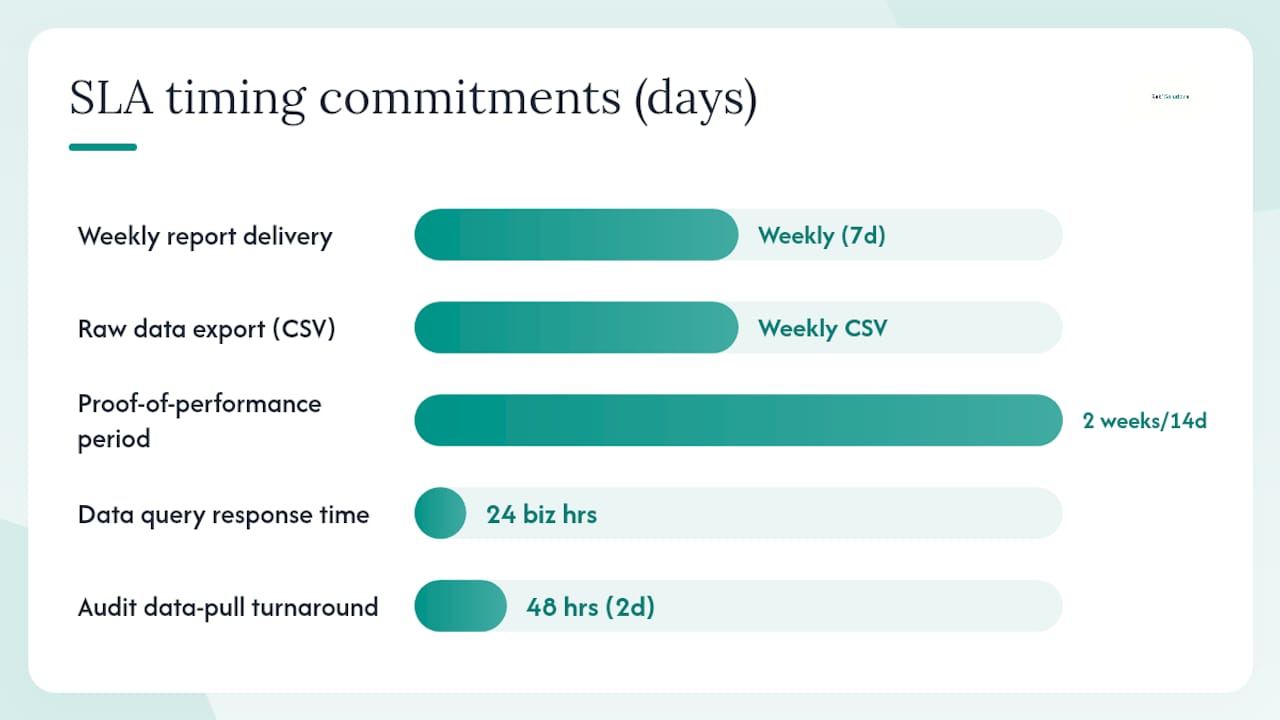
- Weekly report delivery: specific day and time (e.g., every Monday by 9 AM your local time)
- Raw data export frequency: weekly CSV, not monthly
- Meeting evidence requirements: recording and qualification checklist mandatory for every reported meeting
- Make-good clause: credits or replacement meetings if the provider misses the guaranteed meeting target in any given month
- Data query response time: provider must respond to data discrepancy requests within 24 business hours
Negotiation tips:
- Tie the first payment milestone to a 2-week proof-of-performance with full reporting, not just a kickoff call.
- Require a verified performance statement each month, including a sign-off process before the next invoice is approved. This mirrors the verified close record practice used by well-run SDR teams.
- Build in an audit right: you can request a full CRM data pull at any point during the contract with a 48-hour turnaround.
- For outsourcing agencies in Australia and ANZ, confirm that the guaranteed meeting definition is written into the contract, not left to verbal agreement.
Cost per qualified meeting varies by market and ACV. APAC/ANZ engagements tend to be at the higher end of common industry ranges, reflecting longer outreach cycles and smaller addressable contact pools in some markets.
Key Takeaways
A weekly SDR report is only worth the paper it is printed on if it includes raw CRM-exportable data, meeting recordings, and a qualification checklist for every reported meeting.
| Point | Details |
|---|---|
| Three non-negotiables | Every weekly report must include meeting evidence, pipeline by stage, and a raw CRM export or CSV. |
| Show rate benchmark | A healthy show rate is 60–70%; track the 4-week trend, not just the current week. |
| Audit in 30 minutes | Cross-check three pipeline lines to CRM, listen to one recording, verify attribution tags. |
| SLA essentials | Negotiate a make-good clause, weekly CSV delivery, and a verified monthly performance sign-off. |
| Raki Solutions | Delivers weekly pipeline and qualified-meeting reports for APAC/ANZ SDR engagements, including recordings, CRM exports, and a 30-minute pipeline review playbook. |
Immediate asks to send your SDR provider this week:
- Send this week's CSV export with all required fields populated
- Provide links to three call recordings from the last two weeks
- Confirm the qualification checklist used for each reported meeting
- Schedule a 30-minute weekly pipeline review using the pipeline review playbook
- Confirm the SLA delivery day and time for weekly reports going forward
For procurement: request a 14-day proof-of-performance before committing to a full monthly contract. Store every weekly export in a shared folder so you have an auditable trail from day one.
The gap between a report and a decision
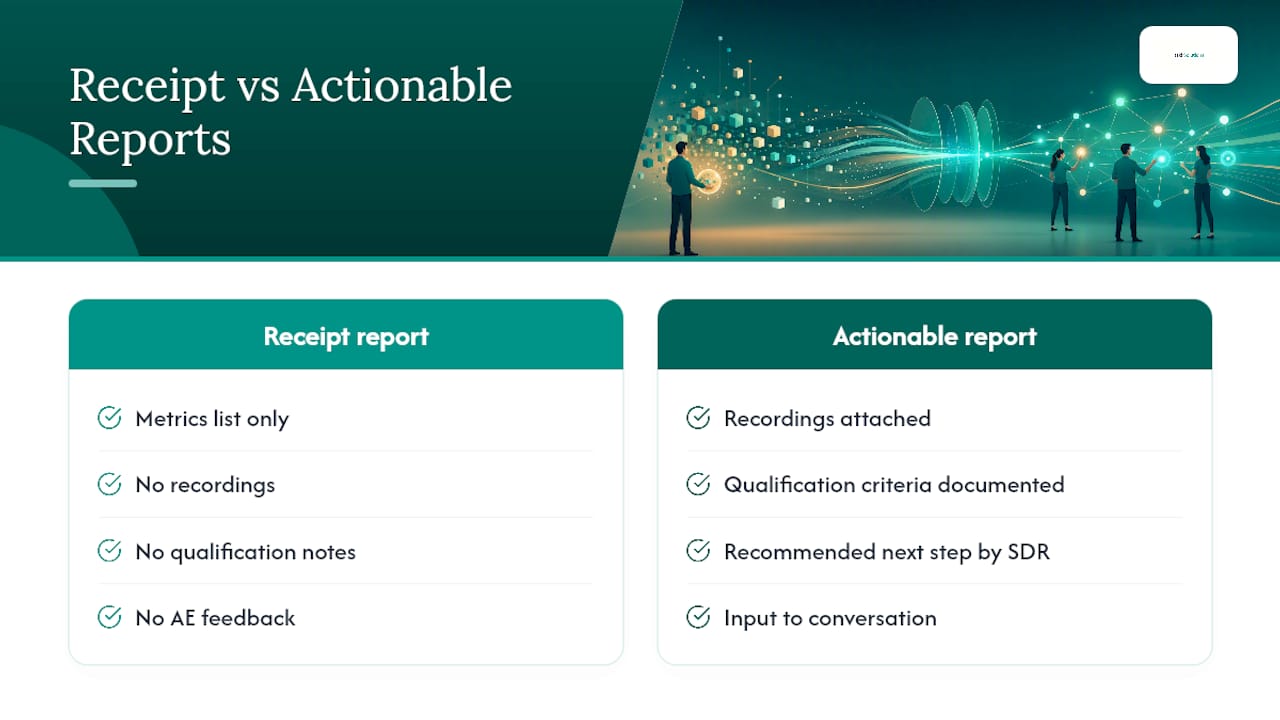
Most outsourced SDR providers send a report. Fewer send one that actually drives a decision. The difference is not the number of metrics; it is whether the report answers the question your AE will ask on Monday morning: "Which of these meetings should I prioritize, and why?"
A report that lists 12 meetings booked with no recordings, no qualification notes, and no AE feedback is not a sales reporting tool. It is a receipt. The providers worth working with treat the weekly report as the input to a conversation, not the end of one. That means recordings attached, qualification criteria documented, and a recommended next step written by the SDR who ran the outreach.
The other thing most buyers underestimate: the report format matters as much as the data. A 10-minute fillable template with a 4-week trend column will surface a stalling campaign faster than a 40-slide monthly deck. Short, templated, and delivered on time beats comprehensive and late every single time.
Raki Solutions delivers the weekly report and the proof behind it
Expanding into APAC and ANZ means your SDR provider is operating in a different timezone, a different market, and often a different business culture. You need more than pipeline numbers. You need the evidence behind them.
Raki Solutions runs SDR-as-a-Service for APAC and ANZ with weekly pipeline and qualified-meeting reports built to the standard described in this guide: CRM-exportable data, call recordings, qualification checklists, and a 30-minute pipeline review playbook included as standard. Every engagement starts with a 14-day proof-of-performance so you can audit the report quality before committing to a full contract. Request a sample weekly report or start your proof-of-performance at rakisolutions.com.
Useful sources
- How to Measure SDR-as-a-Service · Wexley Growth
- Sales Report Template for Web Agency SDR Teams — 2026 Edition | Get Map Leads
- How to Measure the Success of Your Outsourced Sales Team | Cape Solutions UK
- 10 KPIs That Actually Measure Outsourced B2B SaaS Sales T... | Autobound
- How to Track SDR Performance at a Web Agency — Metrics, Reports, Reviews | Get Map Leads
- Raki Solutions | B2B Pipeline Execution Partner for APAC & ANZ | Outbound Growth
- Weekly Pipeline Review: A 30-Minute Playbook for Sales Managers