A defensible starting point for most B2B tech companies expanding into Australia and ANZ is 6–10 guaranteed qualified meetings per SDR per month, or roughly 2–3 per week. That range holds up because it maps to realistic outbound conversion rates for the region, and leaves enough pipeline headroom to hit revenue targets without burning through partner capacity.
Two numbers anchor the business case:
- Gravitas reports that senior SDRs focused on qualification convert over 60% of meetings into registered pipeline, which means 8 meetings a month can realistically produce 4–5 active pipeline opportunities.
- Hiring a junior BDM in Sydney or Melbourne runs AUD 160,000–200,000 fully loaded in Year 1, with 3–6 months of recruitment and another 60–90 days of ramp before a single qualified meeting lands.
The math is straightforward: outsourced guaranteed meetings cost a fraction of that Year 1 overhead and produce output from week one, not month nine.
Key Takeaways
Setting guaranteed qualified meeting targets requires a formula, a contract, and internal capacity, not just a number agreed on a call.
| Point | Details |
|---|---|
| Use the formula | Divide pipeline target by deal value, close rate, and meeting-to-pipeline rate to get a defensible monthly target. |
| Compare real costs | A junior BDM in Sydney or Melbourne costs AUD 160,000–200,000 fully loaded in Year 1 with no output guarantee. |
| Insist on SLA clauses | Require rebook-first remedies, a 48-hour dispute window, and weekly contact-level evidence in every contract. |
| Audit capacity first | Cap guaranteed volume to what your AEs can actually take; above 70% utilization, scale the commitment down. |
| Raki Solutions | Delivers contractually guaranteed qualified meetings for APAC/ANZ with senior SDRs, weekly reporting, and a pilot-first model. |
Table of Contents
- What does 'set meeting targets' mean in an SDR-as-a-Service contract?
- How do you calculate the right guaranteed meeting volume?
- What does hiring a junior BDM in Australia actually cost you?
- What counts as a qualified meeting and what SLA terms should you require?
- How do you decide how many meetings your team can actually take?
- What do sample guaranteed-meeting packages look like in Australia?
- What contract clauses should you negotiate before signing?
- Which KPIs should you track weekly and monthly?
- What does a 30/60/90-day ramp to guaranteed targets look like?
- Why senior SDRs and guaranteed targets are the only model worth buying
- Guaranteed qualified meetings for APAC/ANZ: what Raki Solutions delivers
- Sources
What does 'set meeting targets' mean in an SDR-as-a-Service contract?
In this context, "set meeting targets" refers to the numeric commitment an SDR-as-a-Service provider makes to deliver a specific number of guaranteed qualified sales meetings within a defined period. It has nothing to do with agenda-setting or workshop facilitation. The commitment is commercial and contractual.
What counts as a guaranteed qualified meeting:
- A confirmed calendar appointment with a decision-maker (VP, Director, C-suite, or equivalent budget/authority holder) at a target account.
- The prospect has a recognized pain or need, a plausible timeline, and has agreed to a specific next step.
- Contact-level evidence is provided: name, title, company, LinkedIn profile, and call notes.
What does not count:
- No-shows or cancellations with no reschedule.
- Exploratory conversations that did not result in a booked calendar event.
- Internal meetings, partner calls, or warm introductions from existing relationships.
- Meetings outside the agreed geography (Australia, ANZ, or defined APAC territory).
ANZ sales teams have historically leaned hard on inbound, but that dependency is now a liability as international competitors run structured outbound into the same accounts. Guaranteed meeting targets are how growth-stage tech companies get proactive pipeline without waiting for inbound to recover.
How do you calculate the right guaranteed meeting volume?
Start with your revenue target and work backward. The core formula:
Required qualified meetings = (Pipeline target ÷ Average deal value) ÷ Pipeline-to-close rate ÷ Meeting-to-pipeline rate
Calculation steps
- Set your quarterly pipeline target (e.g., AUD 1,500,000).
- Divide by average deal value (e.g., AUD 75,000) → 20 opportunities needed.
- Divide by pipeline-to-close rate (e.g., 30%) → 67 qualified meetings needed per quarter.
- Divide by 3 months → roughly 22 meetings per month, or 5–6 per week.
- Adjust for ramp: in months 1–2, expect 50–70% of full volume.
The 80/16/4 APAC localization framework is worth applying here: keep 80% of your ICP criteria consistent with your home market, adapt roughly 16% for ANZ-specific buying signals (company size, tech stack, industry verticals), and reserve 4% for purely local nuance like EOFY budget cycles in June.
Pro Tip: Run all three scenarios before you sign. If the conservative case still produces enough pipeline to justify the contract cost, you have a defensible floor. If you need the aggressive case to break even, the risk profile is too high.
What does hiring a junior BDM in Australia actually cost you?
The fully loaded Year 1 cost for a junior BDM in Sydney or Melbourne sits at AUD 160,000–200,000, and that figure does not include the 3–6 months you spend recruiting or the 60–90 days of onboarding before they book their first qualified meeting.
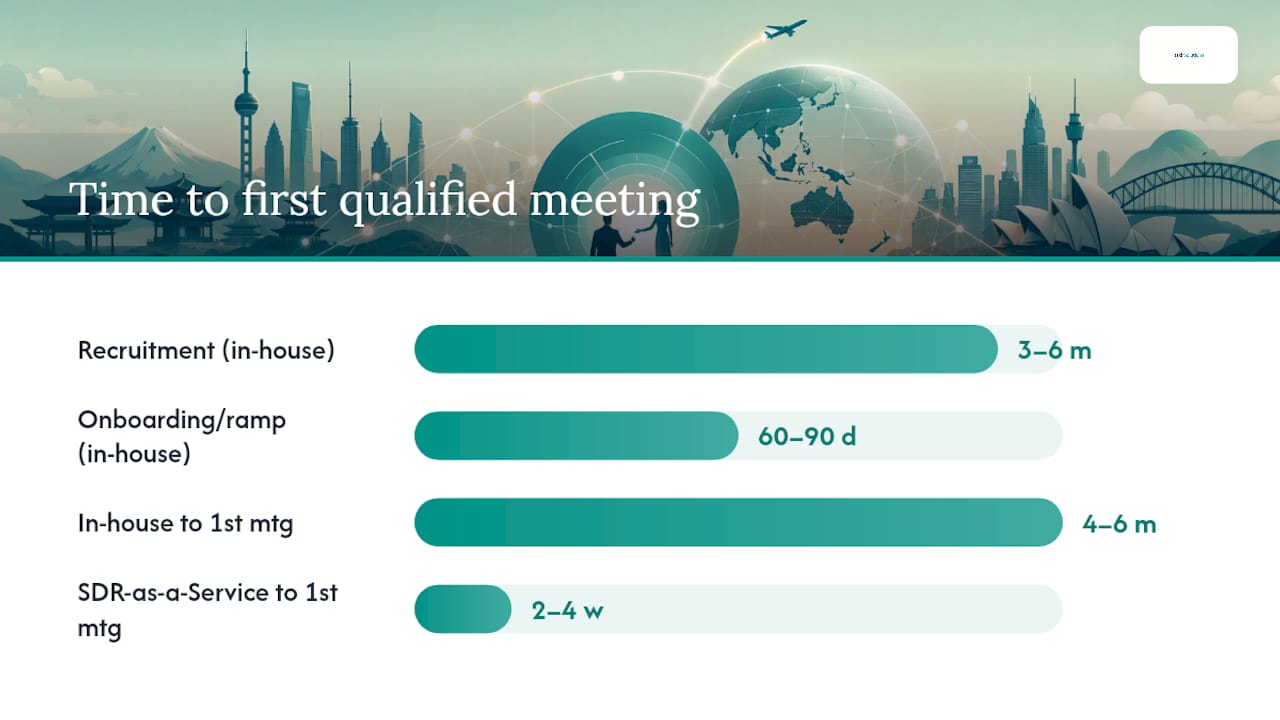
| Cost line | Junior BDM (in-house) | SDR-as-a-Service |
|---|---|---|
| Base salary | a substantial amount typical for junior BDM roles | Not applicable |
| Fully loaded Year 1 | AUD 160,000–200,000 | Typically lower; per-meeting or retainer model |
| Recruitment time | 3–6 months | None |
| Onboarding/ramp | 60–90 days | 2–4 weeks |
| Output guarantee | None | Contractual |
| Time to first qualified meeting | 4–6 months | 2–4 weeks |
Key differences worth flagging:
- An in-house junior hire carries no output guarantee. If they underperform, you absorb the cost.
- SDR-as-a-Service pricing is tied to delivery, not headcount, so you pay for meetings, not potential.
- Non-salary overheads (tools, management time, HR, benefits) add 30–40% on top of base salary for in-house hires.
For a deeper look at SDR outsourcing options for Australian B2B teams, the cost comparison extends beyond salary to include tool stacks and management overhead.
What counts as a qualified meeting and what SLA terms should you require?
Qualification criteria to write into the contract:
- Decision-maker level: VP, Director, Head of, or C-suite with budget authority.
- Pain/need: A documented business problem the prospect acknowledged on the call.
- Timeline: A plausible purchase or evaluation window (typically within 6 months).
- Agreed next step: A confirmed calendar event, not a "maybe next week."
- Evidence: Contact name, title, LinkedIn URL, company, call notes, and ideally a recording.
SLA terms to negotiate before signing:
- Define the measurement window (calendar month or rolling 30 days).
- Specify remedy tiers: rebook first, then credit or refund if repeated failures occur.
- Set a show-rate floor (e.g., 80% of booked meetings must show up).
- Include a dispute-resolution step: buyer flags a meeting as unqualified within 48 hours, provider reviews and responds within 5 business days.
- Require weekly reporting with contact-level evidence for every meeting booked.
Example SLA language to request:
- "Provider guarantees delivery of [X] qualified meetings per calendar month. A meeting is qualified when it meets all criteria in Schedule A. If fewer than [X] meetings are delivered, Provider will rebook the shortfall within the following calendar month or issue a pro-rata credit."
- "Buyer may dispute a meeting's qualification within 48 hours of the scheduled time. Provider will review evidence and respond within 5 business days."
For a full set of meeting qualification questions that map to these criteria, Raki Solutions has a practical process guide worth reviewing before you finalize Schedule A.
How do you decide how many meetings your team can actually take?
AI-enabled outbound produces meetings, but the system's job ends at booking. If your AEs have no capacity to run discovery calls, guaranteed volume becomes wasted pipeline. Run this audit before finalizing targets:
- How many AEs do you have available for APAC/ANZ discovery calls?
- What is their current utilization rate? Above 70% and you need to scale down committed volume.
- Do you have implementation or delivery resources to support post-meeting scoping?
- Is outbound time blocked in AE calendars, or will meetings compete with existing accounts?
Pro Tip: Align guaranteed meetings to a fixed weekly intake cadence, for example, 2 new meetings per AE per week maximum, and write that cap into the contract. It protects show-up quality and prevents your team from canceling meetings they cannot prepare for.
What do sample guaranteed-meeting packages look like in Australia?
| Package | Guaranteed meetings/month | Ramp time | Pricing model | Reporting cadence |
|---|---|---|---|---|
| Starter | 6–8 | 2–3 weeks | Per guaranteed meeting | Weekly |
| Growth | 6–10 | 3–4 weeks | Monthly retainer + per-meeting floor | Weekly + monthly review |
| Enterprise | 20+ | 4–6 weeks | Hybrid retainer + custom SLA | Weekly + bi-weekly exec review |
Key contract triggers to watch for:
- Rebook clauses: shortfalls in month 1 roll into month 2 delivery.
- Refund thresholds: if cumulative shortfall exceeds 20% over two consecutive months, a pro-rata refund applies.
- Ramp acceptance: the first 2–3 weeks are a validation period; full guarantee kicks in at week 4.
Custom pricing is appropriate when average deal values exceed AUD 150,000, when the target account list is highly specific (fewer than 200 accounts), or when market complexity requires localized messaging across multiple ANZ sub-regions.
What contract clauses should you negotiate before signing?
Negotiation checklist
- Guarantee metric definition: Exact criteria for a qualified meeting (Schedule A).
- Measurement source: Who tracks delivery, and what system of record governs disputes.
- Remedy tiers: Rebook → credit → refund, with timelines for each.
- Termination for non-performance: Right to exit if shortfall exceeds a defined threshold over two consecutive months.
- Ramp acceptance criteria: Pilot period length and the output threshold that triggers full-volume commitment.
- Confidentiality and IP: Prospect data, call recordings, and contact lists belong to the buyer.
- Reporting obligations: Weekly delivery of contact-level evidence and campaign metrics.
Example clause snippets:
- "Termination for non-performance: Buyer may terminate with 14 days' written notice if Provider delivers fewer than 70% of guaranteed meetings in two consecutive calendar months."
- "All prospect contact data, call recordings, and meeting notes generated under this agreement are the exclusive property of Buyer."
- "Provider will deliver a weekly report by COB Friday containing: meetings booked, contact details, call notes, show/no-show status, and campaign deliverability metrics."
Negotiation tactics:
- Trade price for a higher guarantee floor, not a lower one. A cheaper contract with a weak guarantee is a worse deal.
- Request operational transparency: weekly syncs and access to call recordings are non-negotiable for enforcing SLA.
- Start with a pilot (4–6 weeks) before committing to a 6-month term.
Which KPIs should you track weekly and monthly?
Weekly metrics:
- Meetings booked vs. target.
- Show rate (meetings attended ÷ meetings booked).
- Meeting quality flags (disputed qualifications).
- Contact-level evidence received (name, title, notes, recording).
- Outbound cadence and deliverability stats (open rate, reply rate, bounce rate).
Monthly metrics:
- Conversion: meetings → registered pipeline opportunities.
- Pipeline value generated vs. target.
- Meetings → SQL rate and meetings → closed/won rate (lagging).
- Cumulative shortfall vs. guarantee (triggers SLA remedies).
| Metric | Healthy range | Red flag |
|---|---|---|
| Show rate | 80%+ | Below 70% |
| Meeting-to-pipeline conversion | 50–60%+ | Below 40% |
| Email deliverability (inbox rate) | 90%+ | Below 80% |
| Disputed qualifications | Under 10% | Above 20% |
Red flags to act on immediately: a sudden drop in show rate (prospect list quality issue), deliverability problems (sending domain needs attention, per best practices for dedicated sending infrastructure), or a pattern of meetings that pass the booking criteria but fail discovery.
What does a 30/60/90-day ramp to guaranteed targets look like?
Days 1–30: foundation and validation
- Provider completes account research and builds the target account list.
- Messaging is drafted, reviewed, and approved by the buyer.
- Sending infrastructure is provisioned and warmed.
- First outreach sequences launch in week 2.
- First qualified meeting delivered by end of week 3 (pilot acceptance milestone).
Owner: Provider leads; buyer approves messaging and ICP.
Days 31–60: stabilization
- Show-rate data reviewed; messaging adjusted based on reply patterns.
- Full weekly meeting cadence established (target: 80%+ of monthly guarantee).
- Buyer AEs run discovery calls and feed back qualification accuracy.
- Campaign deliverability monitored weekly.
Owner: Shared. Provider optimizes outreach; buyer tracks pipeline conversion.
Days 61–90: scale and optimize
- Full guaranteed volume delivered consistently.
- Monthly pipeline conversion reviewed against benchmarks.
- ICP refined using account research insights from live campaign data.
- Contract renewal or volume adjustment negotiated based on conversion data.
Owner: Buyer leads commercial review; provider delivers optimization report.
A short pilot before committing to full volume accelerates learning and validates meeting quality faster than any in-house ramp could.
Why senior SDRs and guaranteed targets are the only model worth buying
The conventional wisdom in APAC outbound is that volume solves everything. Run more sequences, book more meetings, and pipeline will follow. It does not work that way, and the data is clear: senior SDRs focused on qualification convert over 60% of meetings into registered pipeline, while junior reps learning on your accounts produce calendar filler that wastes AE time and distorts your pipeline metrics.

What actually matters is the combination: senior reps who know how to qualify, a multi-channel approach (email, LinkedIn, and calls in sequence), and a contractual guarantee that ties payment to delivery. Without the guarantee, you are paying for activity. Without senior reps, you are paying for meetings that will not convert.
The buyer's side of this equation is equally important. Raki Solutions builds guaranteed targets into every engagement, but the conversion from meeting to pipeline depends on what happens after the booking. AEs need to be briefed, capacity needs to be confirmed, and discovery calls need to run within 48–72 hours of booking to preserve momentum.
Pro Tip: Brief your SDR partner on your top 3 objections and your strongest proof point before outreach begins. Senior SDRs can pre-handle objections in the booking conversation, which materially improves show rates and first-call quality.
Guaranteed qualified meetings for APAC/ANZ: what Raki Solutions delivers
Raki Solutions contracts guaranteed qualified meetings for B2B tech companies expanding into APAC and ANZ, with senior SDRs running multi-channel outreach across email, LinkedIn, and calls. The difference from a traditional agency is the contractual floor: you agree on a target, Raki delivers it or rebooks the shortfall.
What a pilot engagement delivers in week one: a validated target account list, approved messaging sequences, provisioned sending infrastructure, and the first qualified meetings on your AE's calendar. No 6-month hiring process. No ramp risk. No output uncertainty.
- Guaranteed meeting counts written into the contract with rebook and credit clauses.
- Weekly reporting with contact-level evidence for every meeting booked.
- Senior SDRs with APAC/ANZ market knowledge, not junior reps learning on your accounts.
Start a scoping conversation with Raki Solutions to confirm your target range, review sample SLA language, and get a pilot proposal within 48 hours.