
The fastest path to qualified meetings in APAC and ANZ is a dedicated SDR-as-a-Service, not a contact list. Hire a provider that delivers partner-voice sequences, managed sending infrastructure, and guaranteed qualified meetings. Then book a discovery call with Raki Solutions to get your first meetings on the calendar.
Three non-negotiables from any provider:
- Partner-voice personalization: every sequence must be written for the specific target firm, not pulled from a generic template
- Dedicated sending domains: your primary domain stays clean; outreach runs on warmed, monitored subdomains
- Guaranteed qualified meetings: SLAs tied to meeting counts, not activity metrics
Table of Contents
- Why outsourcing SDR outreach beats hiring for APAC & ANZ
- What a modern contact data provider must deliver day-to-day
- How to evaluate and choose an SDR-as-a-Service partner for APAC & ANZ
- Pricing models, expected fees, and a realistic ramp timeline
- The right channel mix and messaging for APAC & ANZ
- What success looks like: outcomes, KPIs, and case summaries
- Key Takeaways
- Why the conventional wisdom on outbound for APAC gets it wrong
- Raki Solutions: dedicated SDR teams for APAC & ANZ expansion
- Useful sources and further reading
Why outsourcing SDR outreach beats hiring for APAC & ANZ
Hiring a local BDM in Australia or New Zealand is slow and expensive. According to SEEK and Hays benchmarks cited by Kepla, fully loaded first-year costs for a mid-market BDM hire are materially higher than a managed outbound engagement, and the ramp time is longer. An outsourced SDR team can start producing meetings in weeks, not quarters.
The market dynamics in APAC and ANZ make this even more compelling. Referral networks saturate quickly. Senior buyers in Australia and New Zealand actively resist generic outreach, so the playbook that works in the US often backfires here. You need regional SDR expertise baked in from day one, not learned on your dime over six months.
The operational benefits stack up fast:
- Predictable monthly cost tied to deliverables, not headcount
- Access to SDRs who already know regional channel preferences and messaging norms
- Multi-channel playbooks (email, LinkedIn, calls) calibrated for APAC/ANZ buyer behavior
- Reduced compliance and deliverability risk because the provider manages the infrastructure
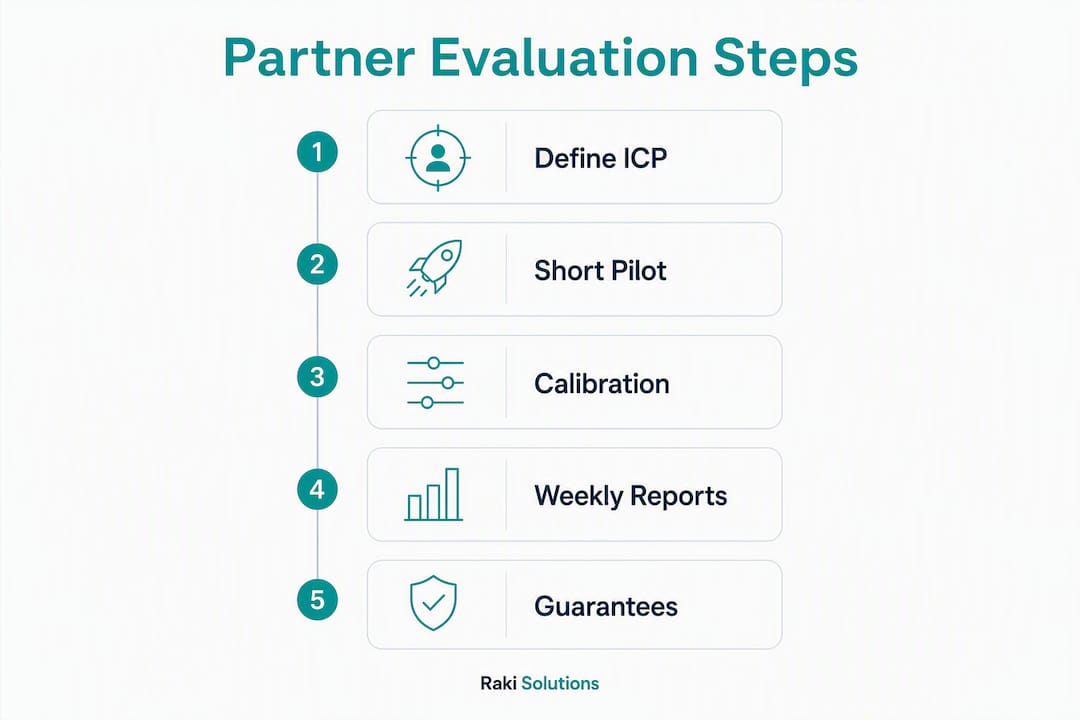
Pro Tip: Demand a short pilot with explicit calibration milestones. An open-ended trial with no defined checkpoints is a red flag. A credible provider will agree to a 30-day calibration phase with defined ICP, sequence drafts reviewed, and a first-meeting target.
What a modern contact data provider must deliver day-to-day
The phrase "contact data providers" gets used loosely. In the context of APAC and ANZ expansion, it means an SDR-as-a-Service: a team that researches target accounts, sources and verifies decision-maker contacts, writes and executes outreach, qualifies replies, and books meetings. Raw list vendors are a different product entirely.

Kepla identifies four components as the minimal working system: data and ICP scoring, partner-voice sequence drafting, managed sending infrastructure, and a human approval gate. Miss any one and the program underperforms.
Here is what the full delivery scope looks like in practice:
- Target-account research aligned to a precise ICP (industry, firm size, seniority, deal type)
- Decision-maker sourcing, email verification, and enrichment with local signals
- Partner-voice sequence drafting per account, reviewed before sending
- Dedicated sending domains with monitored warm-up and rotation
- Multi-channel execution: email, LinkedIn, and calls
- Reply triage and meeting qualification against agreed criteria
- CRM integration and weekly reporting
| Deliverable | What it includes | Why it matters |
|---|---|---|
| Target-account list | Firmographic filters, ICP score, local signals | Precision targeting reduces wasted outreach |
| Verified contact data | Email validity check, persona note, trigger note | Raw data is not ready-to-send data without enrichment |
| Sequence drafts | Partner-voice copy per account, reviewed by client | Personalization drives reply rates in ANZ |
| Weekly report | Emails sent, open rate, reply rate, meetings booked, pipeline value | Tracks progress against SLA |
Pro Tip: Ask to see a sample weekly report before signing. If it shows only activity (emails sent, calls made) with no meeting or pipeline metrics, the provider is optimizing for effort, not outcomes.
How to evaluate and choose an SDR-as-a-Service partner for APAC & ANZ
Prioritize providers that combine partner-voice personalization, proven deliverability infrastructure, and genuine regional experience. Those three criteria separate the specialists from the commodity vendors.
Evaluation checklist:
- ICP alignment: Can they define your ICP at the level of practice area, firm size, target seniority, and deal type? Vague ICPs like "mid-market commercial firms" are a documented cause of poor targeting.
- Sample target lists: Ask for a sample list built to your ICP before committing.
- Deliverability infrastructure: Do they use dedicated sending domains with documented warm-up protocols?
- CRM and tech integrations: Can they push contacts and meeting notes directly into your stack?
- Regional SDR expertise: Have their SDRs run APAC/ANZ campaigns, not just US or European ones?
- SLA and guarantee clarity: Are meeting guarantees written into the contract, not just mentioned in the pitch?
- Reporting and KPIs: Weekly reports with meeting counts, pipeline value, and sequence performance.
- References and case studies: At least two APAC/ANZ-specific engagements with named outcomes.
| Question to ask | What a good answer looks like |
|---|---|
| How do you warm sending domains? | Dedicated subdomain, 3–4 week warm-up, monitored bounce and spam rates |
| How do you write partner-voice sequences? | Account-level research, client review gate before sending |
| Show me two APAC/ANZ case studies | Named outcomes: SQL count, conversion rate, pipeline value |
| What happens if we miss the meeting guarantee? | Clear SLA remedy: credit, extension, or partial refund |
Red flags to walk away from:
- Vendors that only sell lists with no outreach execution
- Providers that refuse to share sample sequences before signing
- Outreach sent from the client's primary domain with no dedicated infrastructure
- No APAC/ANZ-specific case studies, only US or European references
For a deeper look at SDR outsourcing evaluation criteria, the Raki Solutions blog covers how to structure engagements for APAC and ANZ specifically.
Pricing models, expected fees, and a realistic ramp timeline
Expect fixed monthly fees tied to guaranteed meeting targets, a per-qualified-meeting model, or a hybrid of both. Low-cost list vendors will not offer meeting guarantees because they are not executing outreach.
Common pricing structures:
- Monthly retainer with guaranteed meetings: fixed fee, SLA defines minimum qualified meetings per month
- Per-qualified-meeting pricing: pay per meeting that meets agreed qualification criteria
- Hybrid retainer + per-meeting: base fee covers infrastructure and SDR time; bonus per meeting above the floor
- Enterprise custom: multi-market, multi-SDR engagements with custom SLAs
What drives price variance: number of dedicated SDRs, regional coverage (APAC-wide vs. ANZ-only), guarantee level, campaign complexity, and CRM integration requirements.
| Phase | Activities | Realistic timeline |
|---|---|---|
| Discovery and ICP definition | ICP workshop, account universe sizing, persona mapping | Week 1–2 |
| List building and verification | Account research, contact sourcing, enrichment, email validation | Week 2–3 |
| Sequence creation and domain warm-up | Partner-voice drafts, client review, domain warm-up begins | Week 3–4 |
| Initial sends and calibration | First outreach, reply triage, sequence optimization | Week 4–6 |
| Steady-state optimization | Weekly reporting, A/B testing, pipeline tracking | Week 6 onward |
Contract items to confirm before signing: minimum commitment period (typically 3 months), SLA definitions for "qualified meeting," data ownership on exit, CRM integration scope, and cancellation notice period.
The right channel mix and messaging for APAC & ANZ
A coordinated, account-first multi-channel motion anchored by partner-voice email, LinkedIn, and selective calls outperforms generic mass sequences in APAC and ANZ. ReachInbox's analysis of Australian B2B outreach confirms that coordinated multi-touch, account-level targeting builds the familiarity senior buyers need before they accept a meeting.
Channel guidance:
- Email: the primary channel for first contact; must be partner-voice, not templated
- LinkedIn: reinforces email touches, adds social proof, and works well for senior titles in financial services and technology
- Calls: add selectively for high-value accounts after two email touches; cold calling in Australia works best as a follow-up, not a cold opener
- Local signals: for high-value targets, reference ASX filings, press coverage, or local office openings
Partner-voice personalization means writing "why this company now" into every first message. Practical triggers include local office openings, expansion hiring, regulatory filings, and noticed technology rollouts. Western-style hype ("game-changing solution") triggers distrust in regional decision-makers. A message that references a specific hiring signal or regulatory change lands differently than one that leads with superlatives.
Regional benchmark: Senior buyers in ANZ reject generic mass outreach. Scale only works when messages are partner-voice and backed by verifiable local signals. — Kepla AI
Pro Tip: Never send volume outreach from your primary company domain. Use a dedicated sending subdomain, warm it for 3–4 weeks, and monitor bounce and spam rates weekly. One deliverability failure can damage your sender reputation for months.
What success looks like: outcomes, KPIs, and case summaries
Demand documented case outcomes showing SQL counts, SQL-to-opportunity conversion rates, and pipeline impact. Activity metrics alone (emails sent, calls made) are not proof of a working program.
| Metric | What to demand | Industry reference point |
|---|---|---|
| Guaranteed qualified meetings | Written SLA, minimum per month | Defined in contract |
| SQL-to-opportunity conversion | % of meetings that advance to pipeline | S2M's TIBCO APAC program reported a high conversion rate |
| Ramp time to first meeting | Weeks from contract to first qualified meeting | A multi-week ramp is realistic |
| Weekly reporting cadence | Open rate, reply rate, meetings booked, pipeline value | Delivered every Monday |
| Team model | Dedicated SDRs vs. shared agents | Dedicated SDRs produce better regional consistency |
Short case summaries:
A US-based SaaS firm expanding into Australia engaged a regional SDR-as-a-Service for a 90-day pilot. The provider built a target list, verified contacts, and ran partner-voice sequences across email and LinkedIn. Result: multiple qualified meetings within the first two months, with several advancing to active pipeline.
A technology vendor entering Singapore and Hong Kong used a managed outbound program with dedicated sending infrastructure and local-signal personalization. The program generated a strong number of SQLs early on, with a healthy SQL-to-opportunity conversion rate consistent with S2M's TIBCO APAC benchmark.
What makes a credible testimonial or reference:
- Named company or industry vertical (not just "a SaaS client")
- Specific SQL count and conversion rate
- Timeline from contract to first meeting
- Reference contact available on request
Key Takeaways
The most effective approach to APAC and ANZ expansion is a dedicated SDR-as-a-Service with partner-voice personalization, dedicated sending infrastructure, and guaranteed qualified meetings written into the contract.
| Point | Details |
|---|---|
| Demand meeting guarantees | SLAs must define "qualified meeting" and include a remedy if targets are missed. |
| Insist on dedicated sending domains | Sending from your primary domain without warm-up risks permanent deliverability damage. |
| Use partner-voice sequences | Account-specific "why this company now" messaging drives reply rates in ANZ senior buyers. |
| Expect a 4–6 week ramp | Discovery, list building, and domain warm-up take time; first meetings typically arrive in week 4–6. |
| Raki Solutions | Offers dedicated SDR teams with guaranteed qualified meetings and partner-voice outreach for APAC and ANZ expansion. |
Why the conventional wisdom on outbound for APAC gets it wrong
Most US growth teams assume their existing outbound playbook travels. It rarely does. The mistake is not the channel or the volume; it is the message. APAC and ANZ senior buyers have seen enough templated sequences to recognize one in the first sentence. The moment they do, the meeting is gone.
The real lever is specificity. A message that references a company's recent Singapore office opening, a new VP of Operations hire, or a regulatory change affecting their sector reads like research. It signals that the sender actually understands the business. That is not a nice-to-have in ANZ; it is the price of entry for a reply from a decision-maker at a firm worth pursuing.
The other thing teams underestimate is deliverability. Sending from your primary domain without dedicated infrastructure is not just a technical risk; it is a business risk. One spam complaint spike can suppress your domain for months, affecting not just outbound but every email your company sends. The providers who treat this as an afterthought are the ones whose clients stop seeing results after week six.
Raki Solutions: dedicated SDR teams for APAC & ANZ expansion
Raki Solutions runs dedicated SDR-as-a-Service engagements for B2B tech companies expanding into APAC and ANZ. The core offer is simple: a dedicated team that researches your target accounts, sources and verifies decision-maker contacts, writes partner-voice sequences, manages sending infrastructure, and delivers guaranteed qualified meetings.
Every engagement includes:
- Tiered packages tied to guaranteed meeting counts and SLA cadence
- Dedicated sending domains with monitored warm-up, so your primary domain stays protected
- CRM integration and data ownership on exit, no lock-in on your contacts
- Weekly reporting with meeting counts, pipeline value, and sequence performance
Minimum commitment periods and SLA terms are defined upfront. You own your data. Contracts include clear exit clauses and KPI definitions so there are no surprises.
Book a discovery call with Raki Solutions to get a sample target list built to your ICP and a clear proposal for your APAC or ANZ expansion.
Useful sources and further reading
Primary external sources:
Raki Solutions resources:
- Best B2B lead research for APAC and ANZ expansion
- B2B list building for APAC and ANZ outbound teams
- Email vs. LinkedIn outreach in Australian B2B
- Intent data providers for APAC SDR outbound
- Decision-maker sourcing: a B2B guide