The Do Not Call Register does not cover standard business phone numbers. If you run B2B telemarketing in Australia, that means most of your calling list falls outside the Register's scope — but the exceptions matter more than the rule, and the compliance obligations on your side of the call are real and enforceable.
- Act now: Before your next calling campaign, screen your list against the Do Not Call Register to catch any personal or dual-use numbers that may be registered.
- Primary contacts: ACMA manages the Register at Acma. For registration questions or complaints, call 1300 792 958 or visit donotcall.gov.au.
The core rule for B2B callers: Business numbers are generally excluded from the Do Not Call Register. However, any number used primarily for personal use — including a mobile a contact uses for both work and personal calls — can be registered and must be treated as protected.
Key Takeaways
The Do Not Call Register excludes business numbers but still affects B2B callers through dual-use mobiles, privacy obligations, and mandatory screening requirements before every campaign.
| Point | Details |
|---|---|
| Business numbers excluded | Dedicated business landlines and company numbers are generally not covered by the Register. |
| Dual-use mobiles are registerable | Any mobile used primarily for personal purposes can be registered, even if the contact is a business prospect. |
| Screen before every campaign | Re-screen calling lists against the Register within 30 days of each campaign launch, not quarterly. |
| Privacy Act still applies | OAIC's Australian Privacy Principles govern personal data handling even when DNC exemptions exist for business contact information. |
| Raki Solutions | Provides SDR as a Service with built-in list hygiene and DNCR-compliant outbound for B2B teams in ANZ and APAC. |
Table of Contents
- What the Do Not Call Register covers for B2B callers
- Can organisations register business phone numbers?
- How to register a number on the Do Not Call Register
- What businesses making telemarketing calls must do
- Exemptions and permitted calls overview
- How recipients and organisations can check numbers and stop unsolicited calls
- How to lodge a complaint and what enforcement looks like
- Practical compliance checklist for B2B teams before you call
- APAC and cross-border considerations for B2B teams
- Where to go next — official links and ACMA contacts
- Raki Solutions helps B2B teams call with confidence
- Frequently asked questions
- Sources
What the Do Not Call Register covers for B2B callers
The Do Not Call Register is a free, secure database managed by the Australian Communications and Media Authority (ACMA). Its purpose is to let Australians opt out of unsolicited telemarketing calls and faxes. Businesses making outbound calls need to understand exactly which number types fall inside and outside its scope.
Numbers the Register covers:
- Home (fixed-line residential) numbers
- Personal mobile numbers
- Personal fax numbers
- Numbers used primarily for personal use, even if also used for work
Numbers generally excluded:
- Dedicated business landlines
- Business fax numbers
- Numbers registered solely in a company or organisation's name for business use
Official scope note: The Register is designed to protect individuals from unsolicited contact, not to restrict legitimate business-to-business communication. The line between "business" and "personal" is drawn by how the number is primarily used, not by who pays the bill.
One practical implication: a sole trader's mobile is almost certainly registered or registerable, even if that person is your target prospect. The same applies to a small-business owner who uses one phone for everything. Treat any mobile number with care until you have confirmed its primary use.
Can organisations register business phone numbers?
The short answer is no — with important exceptions. A number listed under a company ABN and used exclusively for business purposes cannot be added to the Register. That exclusion is the reason B2B telemarketing in Australia operates differently from consumer calling.
The exceptions are where teams get tripped up:
- Dual-use mobiles: A contact's mobile that they use for personal calls, family communication, and work is eligible for registration. If it is registered, you cannot call it for telemarketing purposes regardless of the business context.
- Role-based direct dials: A direct dial assigned to a specific individual (rather than a department or company) may blur the line, particularly if that person uses it outside business hours for personal matters.
- Shared or home-office fax lines: A fax number that doubles as a home fax can be registered.
- Sole traders and micro-businesses: Their contact numbers often serve personal and business purposes simultaneously. Assume registrability unless you have clear evidence otherwise.
Pro Tip: Before calling any mobile number in your B2B list, run a quick internal check: Is this number listed under an individual's name or a company name? Is it a mobile or a landline? Does your data source indicate it is a direct personal contact? If two of those three point toward personal use, screen it against the Register before calling.
How to register a number on the Do Not Call Register
Whether you are an individual protecting your own number or an organisation managing eligible numbers, the official registration portal at donotcall.gov.au walks you through the process. Registration is free and permanent — numbers do not expire once added.
- Create or sign in to your account at donotcall.gov.au using your email address.
- Enter account holder details — your name and contact information as the person responsible for the account.
- Add organisation details if you are registering numbers on behalf of an organisation (where eligible).
- Nominate a nominee if someone else will manage the account on the account holder's behalf.
- Enter the numbers you want to register — home, personal mobile, or eligible fax numbers.
- Confirm and submit. You will receive a confirmation, and the numbers take effect on the Register within a short processing period.
For assistance with registration, call ACMA's contact centre on 1300 792 958 during business hours.
Account ownership matters: The person who creates the account is responsible for its accuracy. If you are registering numbers for an organisation, confirm that the account holder has authority to do so. Nominees can manage day-to-day tasks, but the account holder retains legal responsibility for the registration.
What businesses making telemarketing calls must do
Registering numbers is the consumer side of the equation. For businesses making outbound calls, the ACMA telemarketing industry standard sets out mandatory operational obligations that apply regardless of whether you are calling consumers or businesses.
Core obligations for callers:
- Screen calling lists against the Register before each campaign. ACMA expects this to happen within a reasonable period before dialing — not once a quarter and then forgotten.
- Obtain a Subscription Account Number (SAN) if you are a seller accessing Register data directly. Telemarketers working on behalf of a seller use the seller's SAN, not their own.
- Keep records of when lists were screened, which SAN was used, and what suppression decisions were made. These records are your primary defence in an enforcement investigation.
- Honor stop requests immediately. If a contact asks not to be called, that instruction must be logged and actioned before the next campaign cycle.
- Apply timing and frequency rules. The industry standard restricts calling hours and limits how often you can contact the same number.
SAN ownership is the seller's responsibility. If you outsource calling to a third-party telemarketer, your business (as the seller) must own the SAN and control access to Register data. The telemarketer operates under your SAN, not independently. This means vendor contracts need to spell out who screens lists, who holds the SAN, and how suppression data flows back to you.
Pro Tip: Set a calendar reminder to re-screen your calling list against the Register no more than 30 days before each campaign launch. Stale screens are one of the most common compliance gaps ACMA identifies in investigations. Pair this with a list hygiene process that flags newly registered numbers automatically.
Exemptions and permitted calls overview
Not every outbound call to a registered number is a breach. ACMA recognizes several categories of permitted calls, and B2B teams regularly operate within them — provided the conditions are genuinely met.
Common exemptions:
- Existing business relationship: If the person or organisation has an established relationship with your business (a current or recent customer, for example), a call may be permitted even if their number is registered. The relationship must be genuine and recent, not a tenuous historical connection.
- Express consent: If the individual has explicitly consented to receive calls from your organisation, that consent overrides the Register. Consent must be documented and specific — a generic "contact me" checkbox rarely qualifies.
- Market research: Calls made solely for genuine research purposes (not disguised sales) may be exempt, subject to conditions.
- Certain charities and political communication: Some not-for-profit and political calls have specific exemptions under the legislation.
- Government bodies: Calls made by or on behalf of government agencies for official purposes are generally exempt.
The exemption is only as strong as your documentation. Claiming an existing relationship exemption without a clear record of when and how that relationship was established is a compliance risk, not a defence. ACMA can and does ask for evidence.
For B2B cold outreach to a new prospect whose number turns out to be registered, no standard exemption applies. The practical answer is to screen first and remove registered numbers from cold-call lists. Consult ACMA's full guidance for the complete list of exemptions and their precise legal conditions.
How recipients and organisations can check numbers and stop unsolicited calls
If your organisation is receiving unwanted calls, or if you want to verify whether a number is currently on the Register, the process is straightforward.
- Check online at donotcall.gov.au using the check-a-number tool available on the site.
- Call ACMA on 1300 792 958 if you need assistance confirming a number's status or have questions about the process.
- Register the number if it is not already listed and you want to stop receiving telemarketing calls.
- Remove a number through your donotcall.gov.au account if circumstances change and you no longer want it listed.
For businesses on the calling side, when a contact asks you to stop calling, that request must be treated as binding immediately. Log the date, the contact's name and number, and the name of the staff member who received the request. Update your CRM suppression flags before the next campaign runs.
List hygiene is not a one-time task. Suppression lists drift. Contacts change numbers, new registrations happen daily, and CRM data degrades over time. A monthly audit of your suppression list against active campaign lists catches the gaps before ACMA does.
How to lodge a complaint and what enforcement looks like
Recipients who believe they have received an unlawful telemarketing call can lodge a complaint directly with ACMA through donotcall.gov.au. The complaint process asks for the caller's number, the date and time of the call, and a brief description of what was said.
What ACMA can do after a complaint:
- Issue a formal warning
- Issue an infringement notice (a financial penalty)
- Seek an enforceable undertaking (a binding commitment to change practices)
- Pursue civil penalty proceedings for serious or repeated breaches
What your business should do after receiving a complaint:
- Investigate the specific call immediately: who made it, against which list, and whether that list was screened.
- Remediate the gap — update suppression records, retrain the relevant team member, and fix the process that allowed the breach.
- Document everything. ACMA expects to see a paper trail showing you took the complaint seriously and acted on it.
A single complaint rarely ends in a penalty. ACMA's typical first response is investigation and education. Repeated complaints, or evidence of systemic non-compliance, are what trigger infringement notices and civil proceedings. The businesses that face serious enforcement action are usually those with no records, no screening process, and no response to prior warnings.
For state-level guidance, Consumer Protection WA also summarizes the scheme and can be a useful reference for Western Australian businesses.
Practical compliance checklist for B2B teams before you call
This checklist applies to any B2B team running outbound calls in Australia. Work through it before each campaign, not after.
- Confirm number type. Is each number a business landline, a mobile, or a home line? Flag all mobiles and any number associated with an individual rather than a company.
- Screen against the Register. Run flagged numbers through the DNCR portal. Do this within 30 days of your campaign launch date, not at the start of the quarter.
- Document consent or relationship. For any registered number you plan to call under an exemption, record the basis: when the relationship started, what consent was given, and where that evidence lives in your CRM.
- Update suppression flags in your CRM. Remove or suppress any number that comes back as registered and has no valid exemption. This step must happen before the list goes to the calling team.
- Train your calling team. Every person making outbound calls should know how to handle a stop request, what to say when a contact asks to be removed, and where to log that interaction.
- Review vendor contracts. If a third-party telemarketer is calling on your behalf, confirm in writing that your business owns the SAN, that the vendor screens against your suppression list, and that a Data Processing Agreement (DPA) is in place.
Pro Tip: For dual-use numbers — mobiles that appear in your B2B database but could plausibly be personal — create a separate "uncertain" segment in your CRM. Screen those numbers first, log the outcome, and document your decision. That audit trail is what protects you if a complaint is ever filed. For deeper guidance on responsible account research before outreach, the process matters as much as the list.
APAC and cross-border considerations for B2B teams
Australia's Do Not Call Register is one piece of a much larger compliance picture for teams running outbound across the Asia-Pacific region. Forrester's analysis makes the point plainly: GDPR compliance alone does not satisfy APAC obligations. Local laws vary significantly on consent requirements, data localization, cross-border transfer rules, and enforcement approaches.
What this means for Australian B2B teams going regional:
- Singapore's PDPA, Japan's APPI, South Korea's PIPA, and India's DPDP Act each impose different consent and transfer requirements. What is lawful in Australia may not be lawful in the market you are calling into.
- Behavioral data and lead scoring change the picture. Business contact information may have carve-outs under some DNC frameworks, but any profiling, intent scoring, or AI-driven personalization built from that data is processing personal information and typically requires privacy safeguards under the Australian Privacy Principles and equivalent local laws.
- Assuming a blanket B2B exemption across APAC is one of the most common and costly mistakes regional outbound teams make.
Governance steps for cross-border outreach:
- Appoint a privacy lead or designate a compliance owner for each target market.
- Map data flows: where contact data originates, where it is stored, and where it is processed.
- Update DPAs with every vendor and telemarketing partner that touches contact data.
- Run transfer impact assessments for any cross-border data movement.
- Adopt privacy-by-design as a baseline, not a retrofit.
Forrester's 2024 business privacy survey found that 46% of APAC privacy decision-makers reported full GDPR compliance — yet GDPR alone does not address the localized requirements that APAC regulators actually enforce. Treating GDPR as a ceiling rather than a floor is a structural risk for any team operating across the region.
Pro Tip: Subscribe to ACMA's newsletters at acma.gov.au to track enforcement updates and regulatory changes in Australia. For APAC markets, pair that with local counsel or a managed compliance service — the regulatory pace in markets like India and South Korea has accelerated sharply, and keeping up manually is genuinely difficult for lean teams.
Where to go next — official links and ACMA contacts
Bookmark these resources. They are the authoritative starting points for every compliance step described in this article.
- ACMA Do Not Call Register — scope, industry obligations, enforcement, and official guidance.
- Donotcall — register, check, or remove numbers; access industry tools and complaint forms.
- Register your numbers — direct link to the registration flow.
- ACMA contact centre: 1300 792 958 — for registration assistance, compliance questions, and complaint referrals.
- OAIC Australian Privacy Principles — governs how personal information is handled; applies even when DNC exemptions exist.
- Consumer Protection WA — state-level summary useful for Western Australian businesses.
When to seek legal or privacy counsel: If your outbound program involves dual-use numbers at scale, cross-border APAC calling, or complex consent arrangements, a one-off review with a privacy lawyer or compliance specialist is worth the cost. The official ACMA and OAIC pages provide the framework; a qualified adviser applies it to your specific situation.
What B2B outbound compliance actually requires
Most compliance commentary on the Do Not Call Register treats it as a consumer protection issue and moves on. That framing misses the operational reality for B2B teams: the Register is one layer of a compliance stack that also includes the Privacy Act, the ACMA telemarketing industry standard, and, for any team calling into APAC markets, a patchwork of local laws that do not defer to each other.
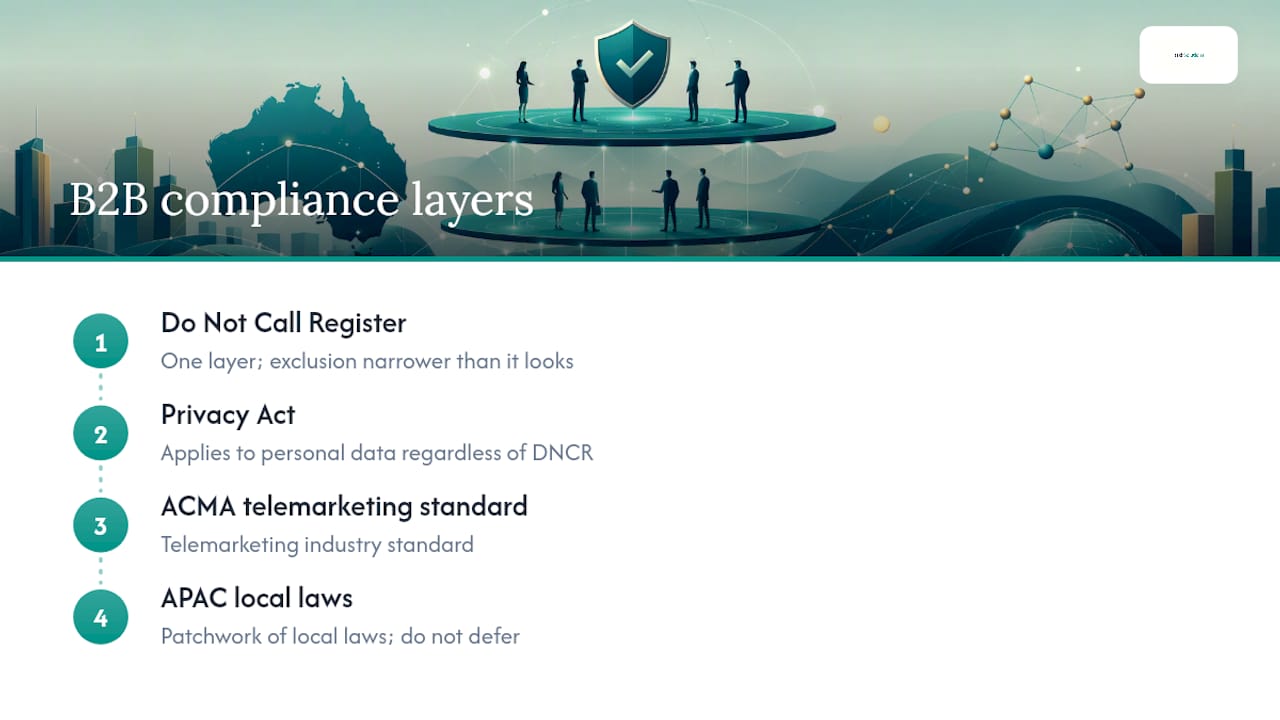
The businesses that get this right are not the ones with the most sophisticated legal teams. They are the ones that treat screening as a process, not a checkbox — teams that build suppression into their CRM workflow, document consent decisions at the point of data capture, and train callers to handle stop requests without hesitation. That operational discipline is what separates a defensible compliance posture from a liability.

One thing I would push back on: the assumption that B2B calling is inherently lower-risk because business numbers are excluded from the Register. That exclusion is narrower than it looks. Mobile numbers, sole trader contacts, and dual-use lines are everywhere in B2B databases, and the privacy obligations that attach to personal data do not disappear because the context is commercial. The Australian Privacy Principles apply to how you handle that data regardless of whether the DNCR does.
For teams expanding into APAC, the risk compounds. Forrester's finding that GDPR compliance covers only part of the APAC picture is not a technicality — it reflects the fact that regulators in Singapore, Japan, South Korea, and India are actively enforcing their own frameworks, on their own terms, with their own penalties. Building a regional outbound program on Australian compliance assumptions alone is a structural gap, not a minor oversight.
The practical answer is not to stop calling. It is to call with a process that can withstand scrutiny: screened lists, documented decisions, trained teams, and contracts that assign responsibility clearly. That is what compliant cold calling in Australia actually looks like in practice.
Raki Solutions helps B2B teams call with confidence
Running compliant outbound at scale across Australia and APAC takes more than a checklist. Raki Solutions delivers SDR as a Service built for B2B teams expanding into ANZ and APAC markets — with list hygiene, DNCR screening, and suppression management handled as part of the engagement, not bolted on afterward.
Every Raki Solutions engagement includes target account research, decision-maker sourcing, and multi-channel outreach via email, LinkedIn, and phone — with compliance-aware processes embedded from the start. That means your team gets qualified meetings without the operational overhead of managing SAN accounts, vendor DPAs, or manual list audits in-house. If you want to see how a managed outbound program handles the compliance layer while still hitting pipeline targets, book a call with the Raki Solutions team to walk through your current setup.
Frequently asked questions
Can a business number be added to the Do Not Call Register? Generally no. Dedicated business numbers are excluded. The exception is any number used primarily for personal use — including mobiles that a business contact also uses for personal calls.
How often should B2B teams screen calling lists against the Register? Screen within 30 days before each campaign launch. Stale screens are a common compliance gap ACMA identifies during investigations.
What happens if we accidentally call a registered number? Stop contact immediately, log the incident, investigate how the number passed through your screening process, and remediate the gap. A single incident handled transparently rarely results in a penalty. Repeated breaches without corrective action are what trigger enforcement.
Does the Do Not Call Register apply to calls made from outside Australia? The Register applies to calls made to Australian numbers, regardless of where the call originates. Offshore calling operations targeting Australian numbers are subject to the same obligations.
Where do privacy obligations fit alongside the Do Not Call Register? The Register governs whether you can make the call. The Australian Privacy Principles govern how you collect, store, and use the personal data behind that call. Both apply, and a DNC exemption does not remove your Privacy Act obligations.
What is a Subscription Account Number (SAN)? A SAN is the account identifier that gives a business access to Register data for screening purposes. Sellers must own their SAN. If you use a third-party telemarketer, your business retains SAN ownership and the telemarketer operates under it.
This article is general information, not a substitute for advice from a qualified lawyer. Consult a qualified legal professional about your own circumstances before acting on anything here.
Sources
- Acma
- Register your numbers - Do Not Call ...
- Do Not Call Register: Home
- Australian Privacy Principles - OAIC
- GDPR Isn’t Enough: Navigate Privacy Regulations In APAC
This article provides general information about the Do Not Call Register and related compliance obligations in Australia. It is not legal advice. For complex compliance situations, consult a qualified privacy lawyer or contact ACMA directly on 1300 792 958.